



Last updated: August 15, 2026
Place
Casimir Pulaski Memorial
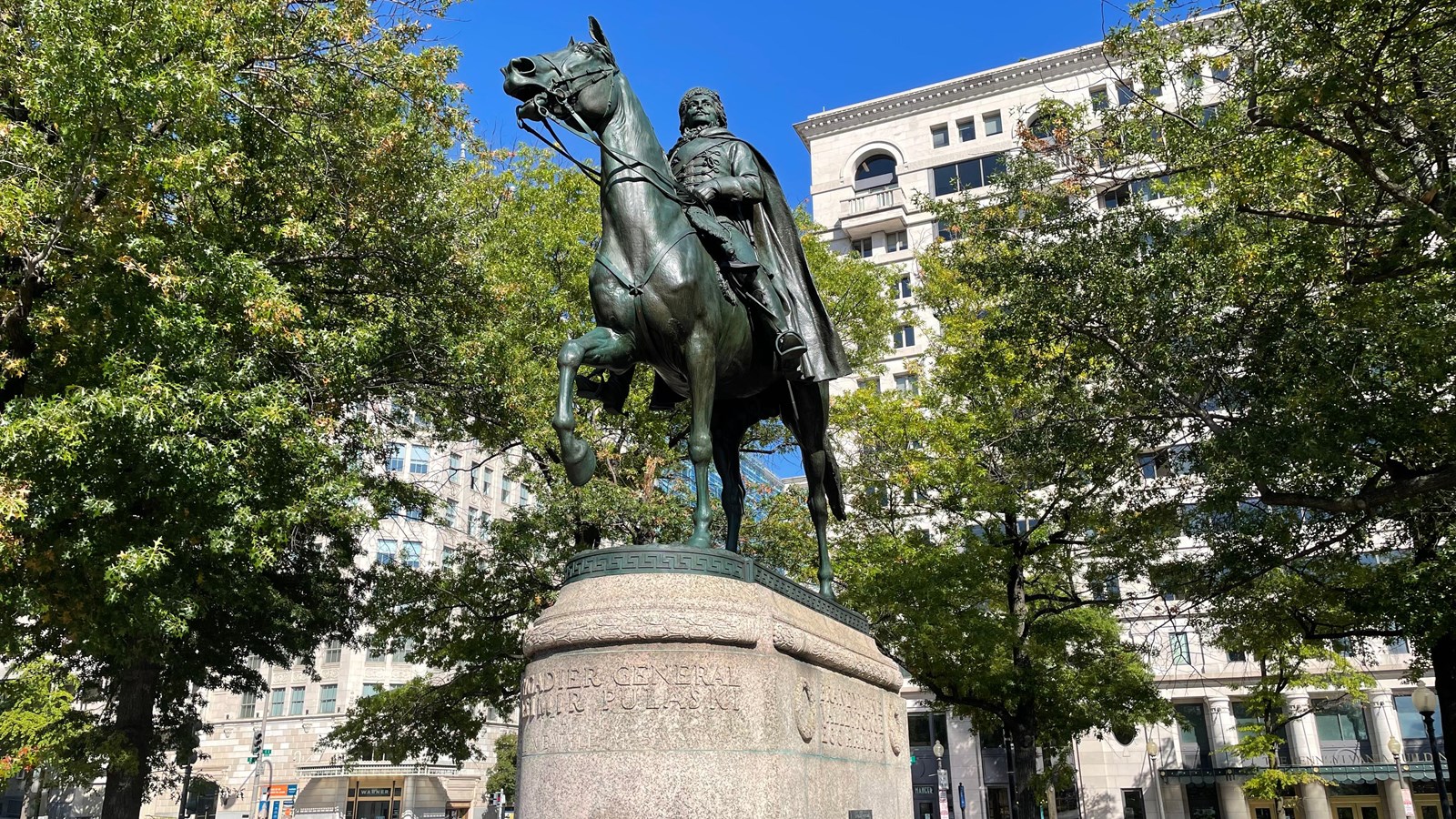
National Park Service photo by Nathan Adams
Quick Facts
Location:
Washington, DC
Significance:
American Revolution
Amenities
2 listed
Historical/Interpretive Information/Exhibits, Public Transit
Near Freedom Plaza on Pennsylvania Avenue stands the statue of Polish-American Revolutionary War hero Casimir Pulaski. Born into Polish nobility in 1745 in Warsaw, he began his military career in 1762. Two years later, his family joined other nobles in revolting against the Russian-backed Polish king, during which Pulaski commanded cavalry units. After a failed plot to kidnap the king, he fled to Paris, where he met Benjamin Franklin. Franklin urged him to join the patriot cause in America. Pulaski arrived in Boston on July 23, 1777, and met General Washington a month later. Though he spoke no English and required a translator, Washington recognized his cavalry skill and recommended him for command. Congress hesitated, but Washington kept him on as a volunteer aide.
Pulaski seized his moment at the Battle of Brandywine on September 11, 1777. When the British outflanked the American line and Washington ordered a retreat, Pulaski requested a cavalry detachment to slow the British advance. His action helped the army escape and likely saved Washington himself. Congress soon made him a brigadier general in charge of the Light Dragoons. Despite leading several engagements, he grew frustrated with his limited authority.
Washington then allowed him to form a new cavalry unit—Pulaski’s Legion—which was sent to defend Charleston, South Carolina. His performance impressed American and French commanders, who included him in the campaign to retake Savannah. On October 9, 1779, during the assault on the city, Pulaski attempted to rally French troops when he was struck by grapeshot. He was taken to a ship on the Savannah River and died several days later. His burial site remains debated; some claimed he was buried at sea. Remains discovered in 1853 were interred in Monterey Square in Savannah, and a monument was erected the next year. In 2019, Smithsonian DNA testing indicated the remains are most likely Pulaski’s.
Pulaski’s legacy endures. Remembered as the “Father of the American Cavalry,” his name appears on towns, counties, naval vessels, monuments, and a Civil War–era fort in Savannah. Polish-Americans celebrate him each year on Pulaski Day, the first Monday in March. In 2009, Congress and President Obama granted him honorary U.S. citizenship, only the seventh person to receive the distinction.
In 1903, Congress authorized a monument to him on Pennsylvania Avenue. Polish sculptor Kazimierz Chodziński created the nine-foot bronze equestrian statue with architect Albert Ross. Pulaski is shown wearing the uniform of a Polish marshal, which he preferred to that of the Continental Army. The granite pedestal bears the battles he fought and a brief biography. President William Howard Taft dedicated the statue on May 11, 1910, alongside the Polish National Alliance and other dignitaries. At the ceremony, Francis Pulaski, a descendant, said of him: “He brought to your shores his bravery and his military talents and offered them for the defense of your ideals and your independence.”