



Last updated: December 22, 2025
Place
David G. Farragut Memorial
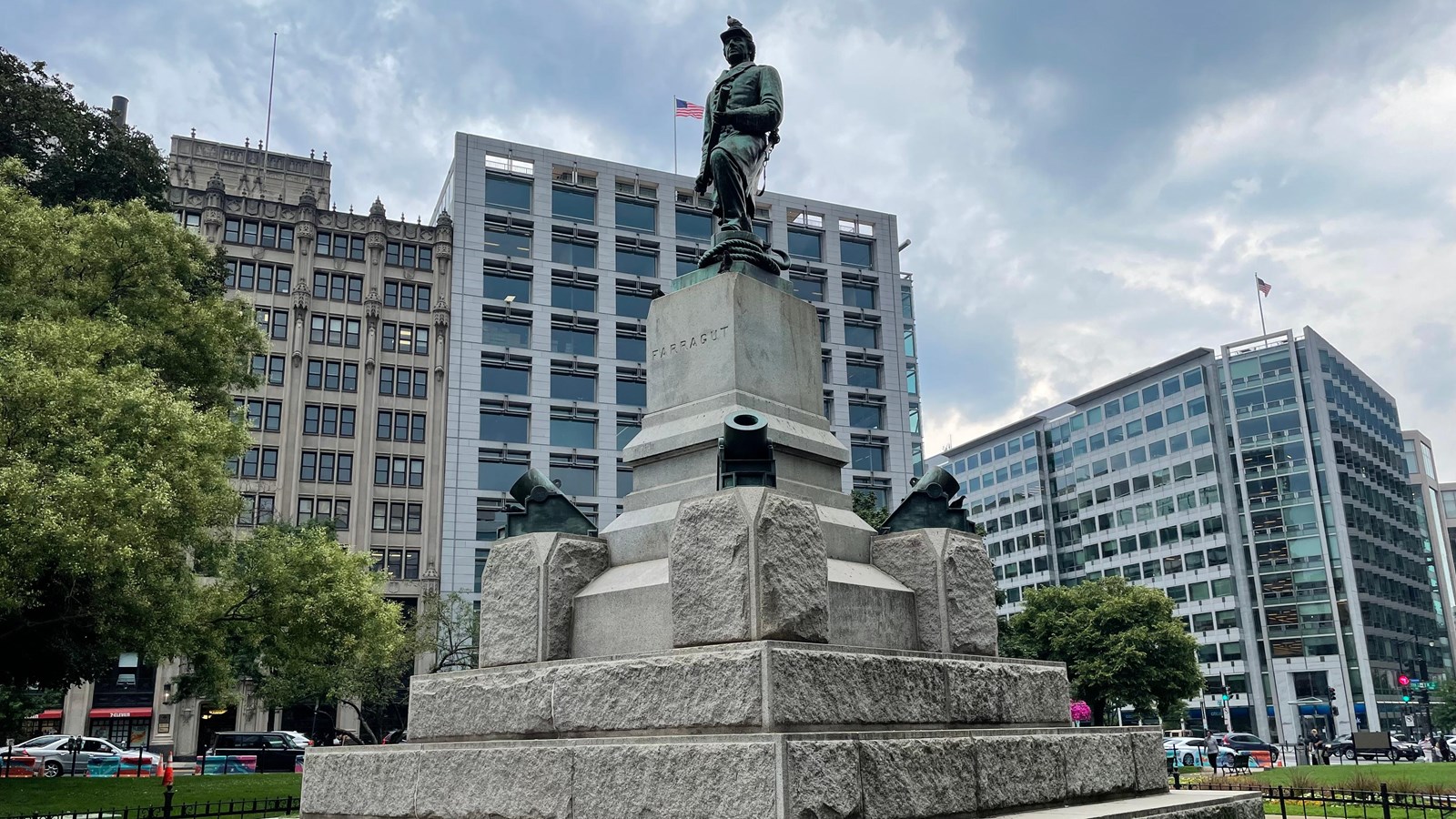
National Park Service photo by Nathan Adams
Quick Facts
Location:
Washington, DC
Amenities
3 listed
Historical/Interpretive Information/Exhibits, Public Transit, Wheelchair Accessible
After the Civil War, the U.S. government created numerous memorials across Washington, D.C., to honor those who fought for the Union. One of them is the standing statue of Admiral David G. Farragut at 17th and K Streets NW, in today’s Farragut Square. The location was fitting—Union artillery once encamped on the site.
President Abraham Lincoln relied on Farragut from the start and never had to replace him. Farragut became the first vice admiral and later the first full admiral in U.S. Navy history, the latter rank created expressly for him.
On August 5, 1864, he won one of the war’s signature victories when his fleet captured Mobile Bay, the last major Confederate port on the Gulf of Mexico. The triumph bolstered Lincoln before the 1864 election. During the battle Farragut famously had himself lashed to the rigging of his flagship, the USS Hartford, directing the assault and allegedly shouting, “Damn the torpedoes! Full speed ahead!”
After Farragut’s death in 1870, support grew for a memorial. In April 1872, Congress appropriated $20,000 and launched a design competition. The winner was sculptor Lavinia “Vinnie” Ream, who in 1866 had become the first woman commissioned by the federal government for a work of art when she was selected to sculpt President Lincoln.
Using photographs provided by Farragut’s widow, Virginia, Ream spent six years on the sculpture. She worked first in Washington, then had the piece cast at the Washington Navy Yard. The resulting 10-foot bronze portrays Farragut standing as if on a ship’s deck, telescope in hand as he watches a naval engagement. Both the statue and four mortars at its base were cast from the bronze propeller of the USS Hartford.
The figure stands on a massive rusticated pedestal of Maine granite, facing south toward Farragut’s birthplace in Tennessee. Inside the pedestal, a box holds documents from his career and a miniature bronze model of the Hartford’s propeller.
The statue was unveiled on April 25, 1881—the 19th anniversary of Farragut’s capture of New Orleans—before 4,000 invited guests and thousands of spectators. Attendees included President James A. Garfield and First Lady Lucretia Garfield, members of the Cabinet, Vinnie Ream, Virginia Farragut, the Capital City Guards (an African American unit), and John Philip Sousa, who conducted the Marine Band.
Accepting the statue on behalf of the nation, President Garfield predicted that Washington would only grow richer in monuments:
“As the years pass on, these squares and public places will be rendered more and more populous, more and more eloquently by the presence of the heroes of other days. Today we come to hail this hero, who comes from the sea, down from the shrouds of his flagship, wreathed with the smoke and glory of victory…to take his place as our honored compatriot, and a perpetual guardian of his country’s glory.”