



Last updated: January 6, 2026
Person
Thaonawyuthe — Chainbreaker

Quick Facts
Significance:
A Seneca Warrior, Thaonawyuthe saw his homelands forever changed by the American Revolution. His account of his life is one of the most extensive Native perspectives on the war and its effects on the Haudenosaunee Confederacy.
Place of Birth:
Seneca/Cayuga Village Kendaia, near Seneca Lake, Haudenosaunee Confederacy
Date of Birth:
Disputed: Between 1737 and 1760
Place of Death:
Allegany Reservation of the Seneca Nation, USA
Date of Death:
December 26, 1859
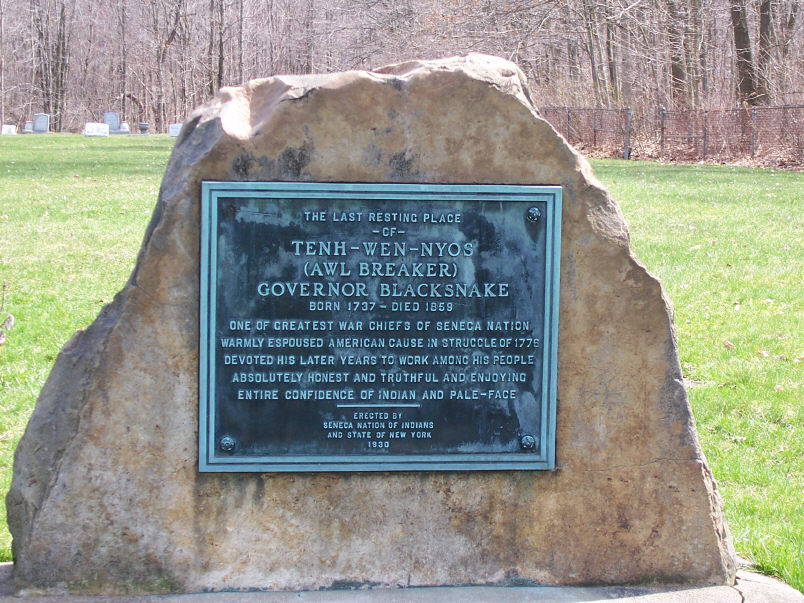
Place of Burial:
Cattaraugus County, New York
Cemetery Name:
Hillside Haven Cemetery
Thaonawyuthe, or Chainbreaker, was a Seneca war leader whose long life bridged the American Revolution, the War of 1812, and the difficult years when the Seneca Nation struggled to keep its lands and culture. His own memoirs give one of the few detailed Native accounts of this era from a Haudenosaunee perspective.
Early Life & Family
Chainbreaker was born sometime between about 1737 and 1760, probably in what is now western New York, and lived to be almost one hundred years old. He belonged to the Seneca Nation, one of the Six Nations of the Haudenosaunee Confederacy, whose homelands stretched across present‑day New York and Pennsylvania. His family connections were remarkable: his uncles included Cornplanter, a leading Seneca war captain and later diplomat, and Handsome Lake, the prophet whose religious teachings helped guide the Seneca after the Revolution. Other relatives included Red Jacket, who became famous as a powerful orator, even though his record as a warrior was less impressive.
The American Revolution
When the American Revolution began, most of the Six Nations chose to keep their long‑standing alliance with Great Britain, and Chainbreaker joined other Seneca and Haudenosaunee warriors in fighting on the British side. In August 1777 he was among the Seneca warriors who marched with the British expedition against Fort Schuyler (also called Fort Stanwix) and fought at the Battle of Oriskany, one of the bloodiest battles of the war. His memoirs describe how the Native and Loyalist forces moved from their camp to what he called “choice ground” near a small creek, planning to ambush the American militia with tomahawks, knives, and a few guns rather than artillery.
In his account, Chainbreaker remembered the fighting as brutally close and terrifying, with hand‑to‑hand combat that lasted all afternoon. He wrote that he saw “the most dead bodies” he had ever seen in his life and that the blood “made a stream running down on the descending ground,” while wounded men cried for help that never came. Although he exaggerated the size of General Nicholas Herkimer’s militia force and mistakenly claimed they had three cannons, historians still value his narrative as one of the only Native‑authored descriptions of the Oriskany battle from the British‑allied side.
Later Revolutionary War Service & Diplomacy
After Oriskany, Chainbreaker took part in several other frontier campaigns as a British‑allied Seneca warrior. He joined raids in the Wyoming and Cherry Valleys in 1778 and in the Schoharie and Mohawk Valleys in 1780, attacks that brought the violence of the war directly into American settlements. These raids were meant to punish rebel communities and protect Haudenosaunee territory, but they also deepened hatred between Native nations and American settlers. He later was called Governor Blacksnake by his white American neighbors.
When the war ended, the Haudenosaunee Confederacy was badly weakened, and the new United States forced the Seneca and other nations to sign treaties that took large areas of their land. Chainbreaker returned to the Oneida Carry area in 1784 as part of the Seneca delegation to the Treaty of Fort Stanwix, where the Seneca, Cayuga, and Onondaga were pressured to cede territory to the Americans. Later descriptions of his life note that he also met George Washington and sometimes served as an emissary or messenger in diplomacy between the United States and western Native nations, showing how a former enemy could become a negotiator for peace.
The War of 1812 & Changing Loyalties
Three decades later, during the War of 1812, Chainbreaker again went to war, but this time he fought alongside the United States rather than Great Britain. Seneca leaders were divided over which side to support, but many, including Chainbreaker, decided that alliance with the United States offered the best chance to protect what remained of their land. Already in his sixties, he joined American forces on a raid against a combined British and Native encampment near Fort George in Canada, where he later claimed that he killed two British soldiers and a Delaware warrior in battle.
This shift from fighting against American forces in the Revolution to fighting with them in the War of 1812 illustrates the complex choices Haudenosaunee communities faced in a rapidly changing world. Native leaders like Chainbreaker had to balance older alliances, new pressures from the United States, and the survival of their people, often choosing the side they believed might do the least harm to their nation.
Leadership at Allegany & Legacy
In the years after the War of 1812, Chainbreaker became a leading civil figure among the Seneca. He moved to and eventually headed the Coldspring settlement on the Allegany (Allegany) Reservation in what is now Cattaraugus County, New York, where the community continued traditional seasonal ceremonies and followed a more traditional form of Seneca religion influenced by Handsome Lake’s teachings. He also served on the central council of the reservation and remained active in Seneca political life through the 1840s, helping guide his people through land sales, pressure from state and federal governments, and debates over cultural change.
Chainbreaker lived out his final years at Allegany. An early photograph taken when he was an old man shows a weathered face, white hair hanging to his shirt collar, and what appears to be blindness in one eye, reminding viewers of the long and difficult life recorded in his war memoirs. He died on December 26, 1859, and is buried at Hillside Haven Cemetery in Cattaraugus County, New York, near the homelands he had spent his life defending. Today historians regard his dictated narrative, preserved in books like Chainbreaker’s War and Chainbreaker: The Revolutionary War Memoirs of Governor Blacksnake, as one of the earliest and most important first‑person accounts by an American Indian leader on the New York frontier.
SOURCES:
-
Adler, Jeanne Winston. Chainbreaker’s War: A Seneca Chief Remembers the American Revolution. Yardley, PA: Westholme Publishing, 2002.
-
Blacksnake, Governor. Chainbreaker: The Revolutionary War Memoirs of Governor Blacksnake as Told to Benjamin Williams. Edited by Thomas S. Abler. Lincoln: University of Nebraska Press, 1989.
-
“Blacksnake (war chief).” Research Starters. EBSCO. Accessed January 6, 2026.
-
“Chainbreaker, also known as Blacksnake.” National Portrait Gallery, Smithsonian Institution. Accessed January 6, 2026.
-
“Chainbreaker’s War: A Seneca Chief Remembers the American Revolution.” Internet Archive. Accessed January 6, 2026.
-
“Choosing Sides: Divided Loyalties in the War of 1812.” American Indian Magazine, National Museum of the American Indian. Accessed January 6, 2026.