



Last updated: January 6, 2026
Person
Sarah Kast McGinnis

National Park Service/Ranger Dan U.
Quick Facts
Significance:
Sarah crossed cultural boundaries and took real risks to shape the course of a war that divided her community.
Place of Birth:
German Flatts, British Colony of New York
Date of Birth:
1713
Place of Death:
Bath, Ontario, British Upper Canada
Date of Death:
September 9, 1791
Place of Burial:
Bath, Lennox and Addington County, Ontario, Canada
Cemetery Name:
Saint Johns Anglican Church Cemetery
Sarah Kast McGinnis was a trader and American Loyalist whose courage, language skills, and frontier experience made her an important figure in the struggle for power in the Mohawk Valley during the American Revolutionary War. Living on the 18th Century frontier, she crossed cultural boundaries and took real risks to shape the course of a war that divided her community.
Early Life and Family
Sarah Kast was born in 1713 near German Flats in the Colony of New York, to Johann Georg Kast and Anna Margaretha Feg, immigrants from the Palatinate region of Germany who had come to New York in 1710 as part of a group sponsored by Queen Anne of Great Britain. Growing up at her parents’ trading post on the frontier, Sarah spent much of her childhood among Mohawk neighbors, swimming and playing with their children and learning several Haudenosaunee dialects.In the 1740s, Sarah married an Irish fur trader whose name appears in records as Timothy McGinnis (also spelled McGinness or McInnis). Timothy became a captain in the British Indian Department and worked closely with Sir William Johnson, the Crown’s superintendent of Indian affairs in northern New York. Together they raised eight children and operated a farm and trading business near major Mohawk villages, where Sarah’s knowledge of Native languages and customs helped maintain good relations with Haudenosaunee communities.
Widowhood and the French & Indian War
During the French & Indian War, Captain Timothy McGinnis fought for the British at the Battle of Lake George in 1755. Contemporary accounts report that he led a small detachment that surprised a larger French‑Indigenous force near what became known as Bloody Pond, but he died from wounds received in the engagement. With Timothy’s death, Sarah became a widow who had to support her children and maintain the trading operation. Turning more deeply to commerce with her sons‑in‑law, she relied on her long‑standing connections with Mohawk traders and families.Sarah’s position as a widowed trader on the frontier gave her a unique role in a world where most European women were expected to remain within the household. She built trust among both Indigenous and British communities, a reputation that would later cause British officials such as Daniel Claus to depend on her in a time of crisis.
The American Revolution
When the American Revolution began, Sarah—then already in her early sixties—chose to remain loyal to the British Crown. The Patriots in the Mohawk Valley, who saw Loyalists as a threat, retaliated harshly. The rebels seized her trading post and property, burned her house, and killed her son William in the fire. In addition, Sarah, her daughter, and her granddaughter were imprisoned at Fort Dayton, where the granddaughter died and another son‑in‑law, Symon DeForest, also perished in captivity.In early August 1777, when Fort Schuyler (also known as Fort Stanwix) was under siege by British, Loyalist, and Indigenous forces. On the morning of August 6, Sarah and her daughters escaped when their guards left to fight at the nearby Battle of Oriskany. She then gathered a herd of cattle and drove them to the besieging Loyalist camps to feed the attacking soldiers and later withdrew with them to Fort Ontario.
Missions Among the Haudenosaunee
In late August 1777, Sarah and surviving family members reached a British post on Carleton Island near the head of the St. Lawrence River, entering Canada as refugees. Soon afterward, British Indian officials, including Colonel Daniel Claus, asked her to return to Haudenosaunee territory to help keep the Six Nations allied with Britain, since American leaders were attempting to win their support. Because of her background, she was well suited to this dangerous mission.During the winter of 1777–78, Sarah traveled through forest and snow from Canada to Haudenosaunee villages near the Genesee region of present‑day New York State. There, according to later retellings based on oral tradition and local memory, she saw a wampum belt sent by American General Philip Schuyler and warned community members that its message was “evil,” urging them to remain loyal to King George and to seek safety in Canada. Her efforts reportedly helped persuade many Mohawk families to migrate north, forming the core of communities that still live in Ontario today.
Loss, Petitions, & Final Years in Canada
The war cost Sarah nearly everything. She lost both her home and one son to the conflict, suffered the deaths of relatives in prison, and the permanent confiscation of her property in the Mohawk Valley. The full extent of these losses is documented in a postwar compensation claim that she submitted to the British government, preserved today in the British National Archives. In this petition, Sarah Kast McGinnis detailed the land, livestock, enslaved people, and trade goods taken or destroyed because of her Loyalist activities. She requested repayment for her services as messenger and agent among the Mohawk.Although the compensation board granted only a small payment and no formal land grant, the petition offers Sarah’s own description of her sacrifices and work for the Crown.Sarah settled permanently in Upper Canada with other Loyalist refugees. She eventually lived with her grandson, Lieutenant Timothy Thompson, in Fredericksburg Township (near present‑day Napanee, Ontario). She died there on September 9, 1791 at about age 78 and is believed to be buried in the graveyard of St. John’s Anglican Church in Bath, Ontario.
Memory & Legacy
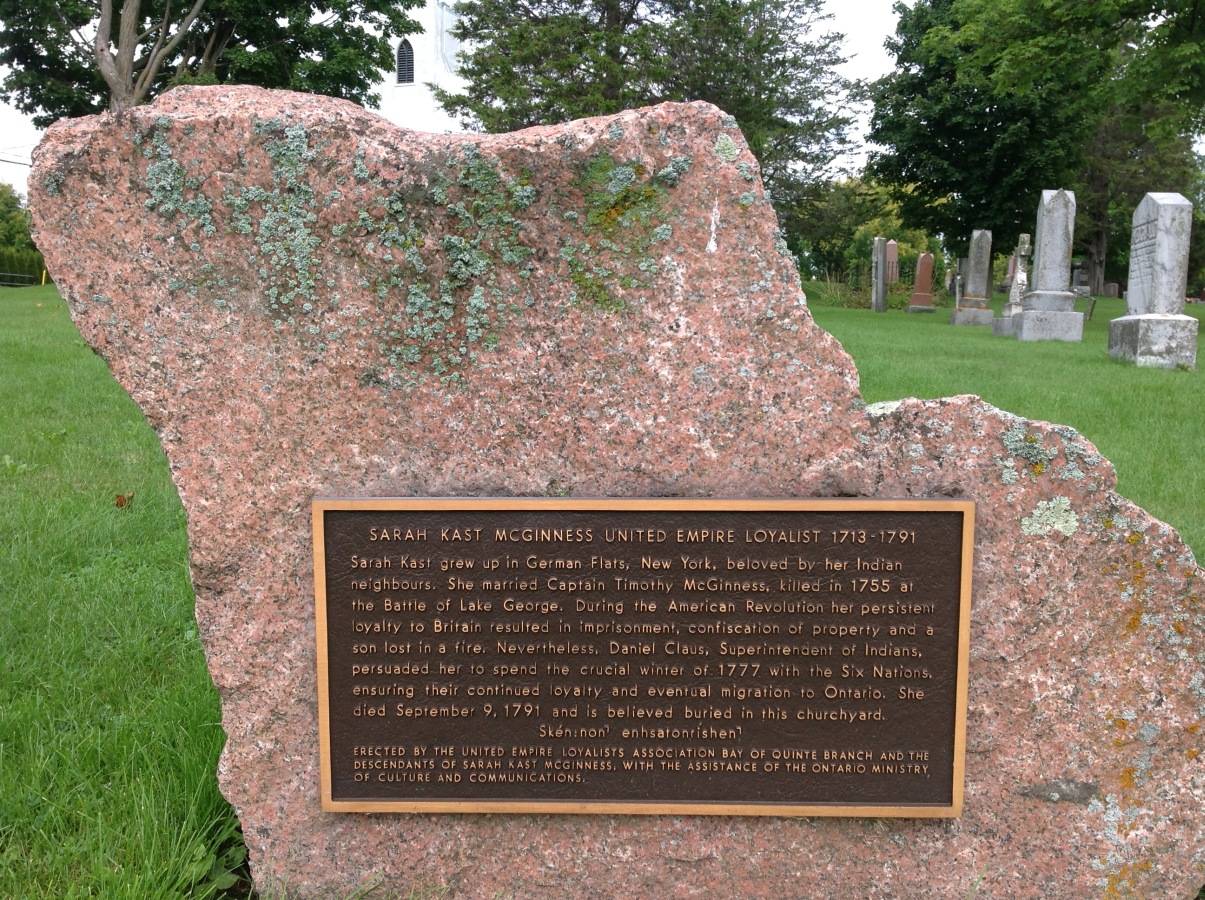
For many years Sarah’s story was preserved mostly in family traditions and local histories, but in the twentieth century descendants and Loyalist organizations began working to honor her more publicly. In 1991, the Bay of Quinte Branch of the United Empire Loyalists’ Association of Canada, together with descendants and the Ontario Ministry of Culture and Citizenship, unveiled a granite memorial with a bronze plaque in the cemetery at St. John’s Anglican Church in Bath. In 1998 an official United Empire Loyalist certificate was finally issued in her name, recognizing her as a Loyalist ancestor and further cementing her place in Canadian memory.
SOURCES:
-
Colonial Quills. “Sarah Kast McGinnis ~ Loyalist Spy.” Colonial Quills. October 27, 2019. Accessed January 6, 2026.
-
Great Britain. Audit Office. Audit Office 12, Volume 27: Loyalist Claims, Including the Claim of Sarah Kast McGinnis. The National Archives (Kew, United Kingdom).
-
“Sarah Kast McGinnis.” History of American Women. Accessed January 6, 2026. https://www.womenhistoryblog.com/2009/05/sarah-kast-mcginnis.html.
-
United Empire Loyalists’ Association of Canada. “Sarah Kast McGinness Memorial.” UELAC Monuments. March 29, 2021. Accessed January 6, 2026. https://uelac.ca/monuments/sarah-kast-mcginness-memorial/.
-
United Empire Loyalists’ Association of Canada, Bay of Quinte Branch. “The ‘Stone for Sarah’ Revisited.” Loyalist Gazette 36, no. 3 (Fall 1998): 21–22.