



 On July 11, 1866, Thomas Gold Appleton’s yacht Alice, named for his niece, Henry Wadsworth Longfellow’s eldest daughter, sailed from Nahant Massachusetts on a record-setting voyage to England. On board as part of the crew was Appleton’s nephew Charles Appleton Longfellow, who took a friend along on the trip. Also present was a crew of professional sailors hired expressly for the trip. Thomas Gold Appleton did not make the voyage on his own yacht, but rather opted for the comfort of a passenger steamer for the trip across the ocean.
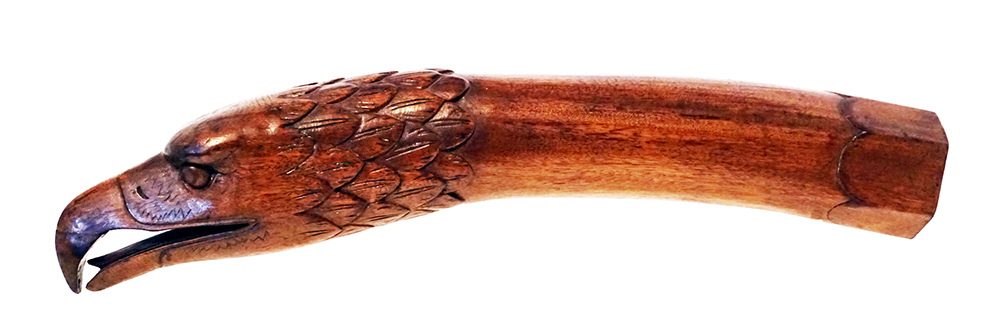
The trip was an event of some note in yachting circles of the time, as the Alice was regarded as rather small to attempt a transatlantic crossing, but she did so in record time, arriving at the Isle of Wight in 19 days, 8 hours, and 20 minutes. Thus began almost two months of pleasure cruising and participating in yacht races until the Alice was put in dry dock for the coming winter before being sailed back to Massachusetts the next spring by one of the hired sailors. While wintering in England, the yacht underwent repairs and refitting, as the cross-ocean trip had caused a considerable amount of wear and tear. Among the things repaired and replaced was the tiller handle, visible above. The end of the tiller, carved in the likeness of an eagle’s head, was removed and kept by the Longfellow family as a memento of the yacht. Ultimately it was installed above a window in what is now a guest bedroom on the second floor of the family home on Brattle Street.
Thomas Gold Appleton owned the Alice for the rest of his life, and after his death in 1884 the yacht was willed to his nephew Charles Longfellow. Charles kept it for another four years before getting himself a new yacht. What ultimately happened to the Alice is unknown, although a 1905 newspaper article about the yacht concluded with “So far as known she is still afloat on the Maine coast.”