



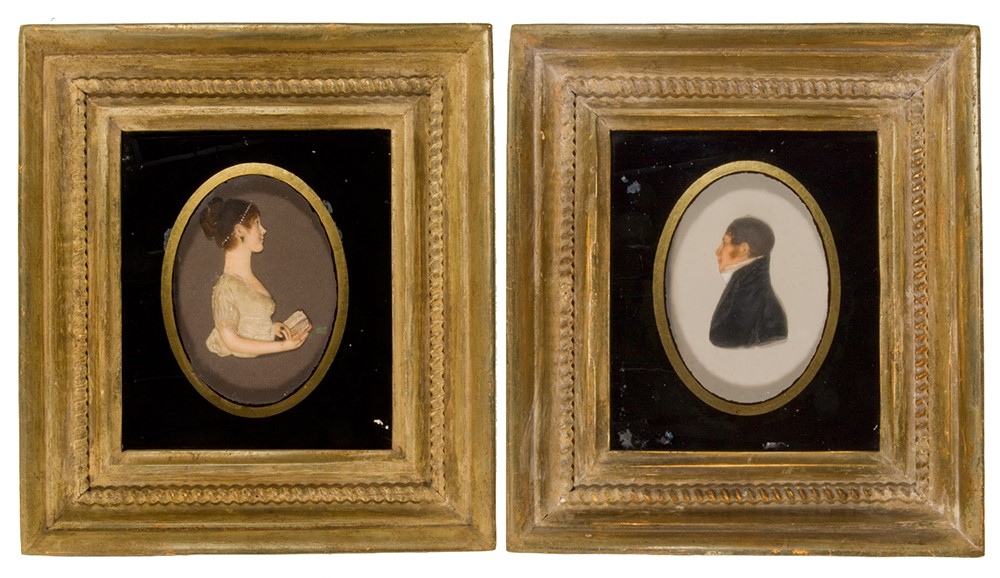
 This pair of framed wax portraits depict a woman and a man dressed in early 19th-century fashion. The wax reliefs are mounted on cardboard, set behind glass that has been painted black, except for a gilt-edged clear oval in the center through which the portrait is viewed with a gilt wooden frame. The artist is unknown, but certain aspects of the work identify John Christian Rauschner as the likely maker.
Rauschner was born in Frankfurt, Germany, in 1760. His father was a modeler who worked with stucco, and Rauschner also followed a career as a sculptor, but of a different kind. By 1799 he was living in New York City, and making a living as a portraitist whose primary medium was wax. He made several trips throughout the northeast, visiting cities from Philadelphia to Boston to seek out work. His career in America was fairly short, as he seems to have died by 1812.
Rauschner’s work was known for its high level of detail. Several characteristics of these two portraits are indicative of Rauschner’s work. One is the use of colored wax. Other wax artists of the period, of which there were not many, sometimes used white wax that was then painted, whereas Rauschner was known for using multiple pieces of different colored waxes which were pressed into a mold, with some painted details added later. The fine detail, visible upon close inspection in the subjects’ hair, as well as the pages of the book held in the woman’s hand, is also a sign of his work. Finally, the frames these two portraits are set in are likely the originals and are identical to those used with many other examples of Rauschner’s known work.
Rauschner executed portraits of wealthy and prominent people, including James Hoban, architect of the White House and contributor to the design of the U.S. Capitol. The identity of the two people portrayed in these works is unknown, as is who it was who acquired the portraits and put them in the Longfellow House. They predate Henry Wadsworth Longfellow’s arrival in Cambridge, but may have belonged to Andrew and Elizabeth Craigie, who occupied the Brattle Street mansion from the 1790s up until 1841, or perhaps they arrived at the house through Fanny Appleton’s family connections, as did many other pieces of artwork.