Drops That Filled the River – Blood, Sweat, and the Trail of Tears. 733 words.
This graphic panel is mounted at the side of a paved plaza on the side of the old State House. As you face the panel, you can see the river beyond the buildings. To the right is a low, red brick building with a long row of windows. A taller building is visible behind. To the left at the side of the plaza is a long gray stone monument with a tall rectangle in the middle topped with a semicircular piece with relief carvings.
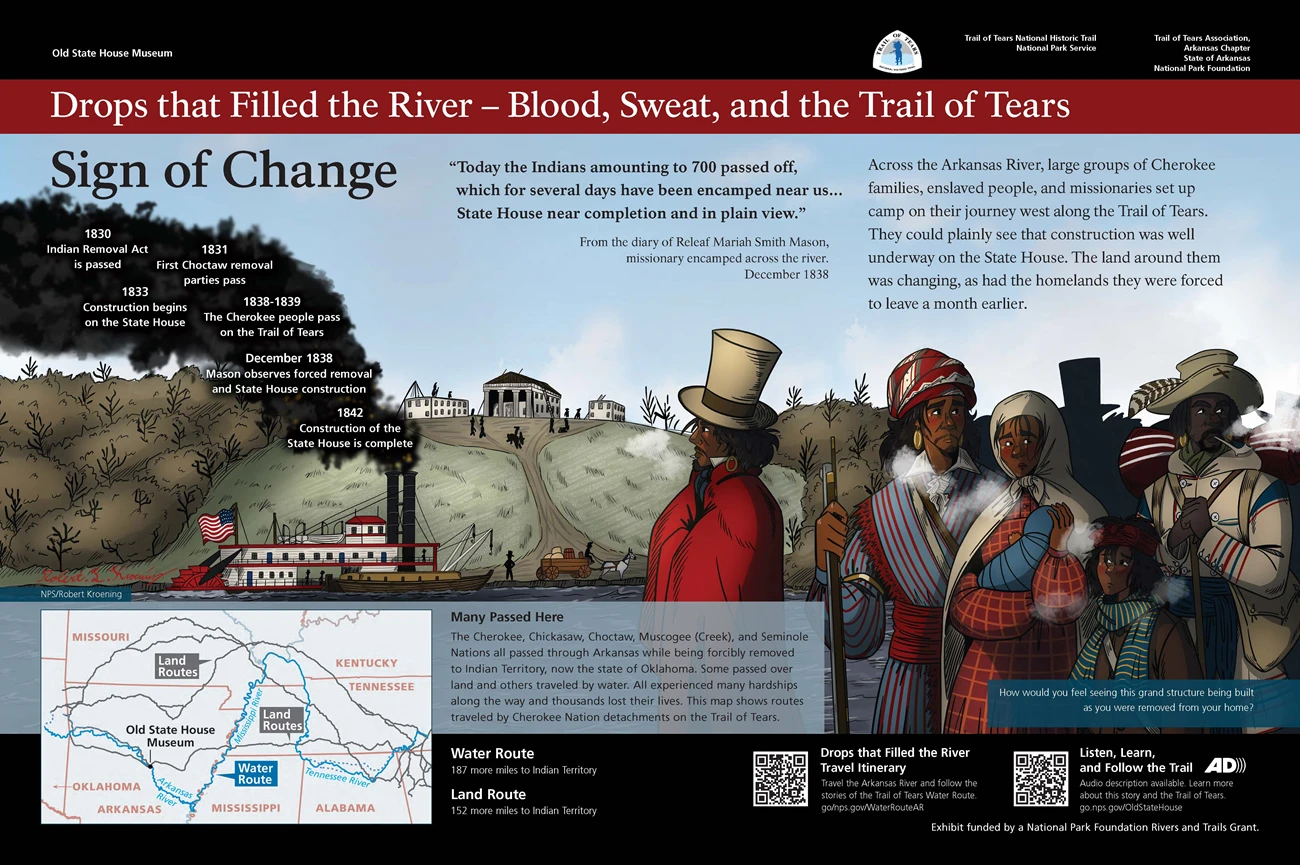
The background of the panel features a color illustration of three men, a woman holding a baby, and a young boy, all dark-skinned. The center man and woman wear bright clothes and head wrappings. The man to the left is wrapped in a red blanket and wears a top hat. The man on the right wears a brimmed hat with a feather and smokes a pipe. They stand beside a river with a paddle boat on the far shore. At the top of the hill on the far side is a large white building under construction. The caption reads, “How would you feel seeing this grand structure being built as you were removed from your home?”
At upper left is the title “Sign of Change.” Below that, white text on the plume of black smoke from the riverboat reads, “1830. Indian Removal Act is passed. 1831. First Choctaw removal parties pass. 1833. Construction begins on the State House. 1838-1839. The Cherokee people pass on the Trail of Tears. December 1838. Mason observes forced removal and State House construction. 1842. Construction of the State House is complete.” End text.
At upper center on the panel is a quote from the diary of Releaf Mariah Smith Mason, missionary encamped across the river, December 1838, which reads, “Today the Indians amounting to 700 passed off, which for several days have been encamped near us. State House near completion and in plain view.” End quote.
At upper right text reads, “Across the Arkansas River, large groups of Cherokee families, enslaved people, and missionaries set up camp on their journey west along the Trail of Tears. They could plainly see that construction was well underway on the State House. The land around them was changing, as had the homelands they were forced to leave a month earlier.” End text.
At bottom left is a map showing routes of the Trail of Tears stretching from northeast Georgia across Tennessee, and into Missouri and Arkansas, all headed to Indian Territory in modern-day northeast Oklahoma. A number of gray lines mark the various land routes. The water route in blue includes the Tennessee River across northern Alabama, up to the Mississippi River, down to the Arkansas River, then west along the Arkansas River. The location of the Old State House Museum is indicated where one land route crosses the water route at this location. Text to the right reads, “Many Passed Here. The Cherokee, Chickasaw, Choctaw, Muscogee (Creek), and Seminole Nations all passed through Arkansas while being forcibly removed to Indian Territory, now the state of Oklahoma. Some passed over land and others traveled by water. All experienced many hardships along the way and thousands lost their lives. This map shows routes traveled by Cherokee Nation detachments on the Trail of Tears. Water Route, 187 more miles to Indian Territory. Land Route, 152 more miles to Indian Territory.” End text.
At bottom right text reads, “Drops That Filled the River: Story and Itinerary. Travel the Arkansas River and follow the stories of the Trail of Tears Water Route. go.nps.gov/WaterRouteAR.” A QR code to the left of the text takes you to that web site.
Just to the right is the Audio Description icon with text that reads, "Listen, Learn and Follow the Trail. Audio description available. Learn more about this story and the Trail of Tears. go.nps.gov/OldStateHouse. Exhibit funded by a National Park Foundation Rivers and Trails Grant." There is also a QR code to take you to that web site.
Across the top of the panel is a black bar. At the left end text reads "Old State House Museum." At the right end is the logo and text for Trail of Tears National Historic Trail. Other text reads, "Trail of Tears Association, Arkansas Chapter, State of Arkansas, and National Park Foundation."
End of Description.