




Last updated: July 15, 2026
Article
Unlikely Alliances: How the San Antonio Missions Supported the American Revolution

NPS Graphic / Elyse Reed
As part of Spain’s frontier economy, the missions in San Antonio made direct contributions to the American Revolution primarily through cochineal production and cattle ranching.
The missions were religious self-sustaining communities that were maintained daily by the labor of the Native converts.
For over 10,000 years, unique Native cultures flourished in the lands of present-day Northeastern Mexico and South Texas.1 In the early 1700s, the Catholic Church of New Spain sent Franciscan friars to the Texan frontier to convert the Native population into citizens of the Spanish crown.2
The arrival of Europeans introduced diseases and conflict that threatened the survival of the Native Coahuiltecan people. Faced with the choice between life and death, many natives entered the missions in the hope of protection, exchanging their traditional culture for the Spaniards'. Along the San Antonio River, the priests established five settlements: Mission Nuestra Señora de la Purísima Concepción de Acuña, Mission San Antonio de Valero (the Alamo), Mission San José de Aguayo, Mission San Juan de Capistrano, Mission San Fransico de la Espada. These missions were self-sustaining religious communities built and maintained daily by the labor of Native converts.

Harpers Ferry Center
I believe these people see and hear better and have keener senses than any other in the world. They are great in hunger, thirst, and cold, as if they were made for the endurance of these more than other men, by habit and nature.
While the priests handled administrative and religious tasks, the Native inhabitants constructed and sustained the mission system.4 They learned to farm, ranch, and build in the European style. Native Peoples also brought their own skills into the missions such as hunting animals, managing natural resources, and making pottery. The crops they grew and the cattle they raised fed the mission's inhabitants and allowed the communities to survive throughout the Spanish colonial period. Native peoples continued to live in and around the missions even after secularization. Mission descendants continue to tell their stories and those of their ancestors.

Click here to learn more about mission descendants at the San Antonio Missions.

National Army Museum, London [7]
In 1776, American colonists cut their ties with Great Britain, signing the Declaration of Independence and establishing the United States of America.
Harsh taxes and restrictions placed by the British government caused outrage among the American colonies. The British refused to recognize their colonist’s attempts at self-governance and ignored serious complaints about their treatment. The American colonists decided that if Great Britain would not rule with their needs in mind, then Britain should not rule them at all.5
John Adams, a Continental Congressman from Massachusetts, addressed these shifts towards independence, writing that “The Revolution was in the minds and hearts of the people… This radical change in the principles, opinions, sentiments, and affections of the people, was the real American Revolution.”6
The American Colonists wrote the Declaration of Independence to document these complaints and officialize their rebellion against Great Britain. The declaration placed, “before mankind, the common sense of the subject [of American Independence], in terms so plain and firm as to command their assent”.8
They hoped that a clear explanation for the rebellion would encourage other nations to offer sympathy and aid. The Declaration of Independence changed history by serving as a model for revolution and democratic ideals which would be adapted by other revolutions across the world.9
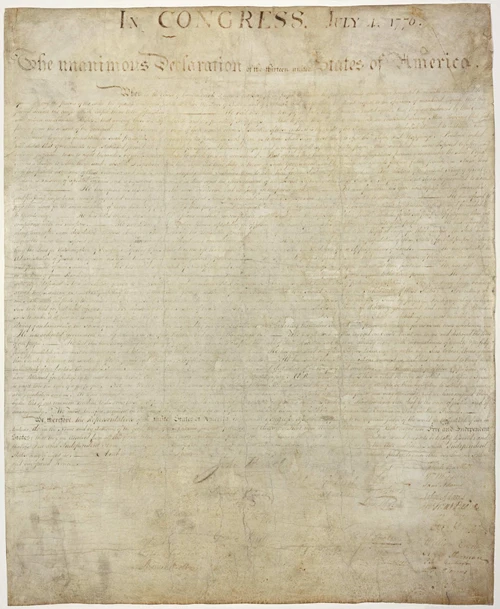
The history of the present King of Great Britain is a history of repeated injuries and usurpations, all having in direct object the establishment of an absolute Tyranny over these States. To prove this, let Facts be submitted to a candid world.
Image credit: National Archives [11]
To protect their own colonies and support the war effort, Spain sold military supplies to the American Colonists and fought against the British along the Gulf Coast.
By 1776, both American and Spanish colonists shared a sense of anger with Great Britain's presence in North America.12 Spain viewed the growth of British settlements as a threat to its territorial control.13
To protect their own colonies and support the war effort, Spain sold military supplies to the American Colonists and fought against the British along the Gulf Coast.

The Gilder Lehrman Institute [16]
General Bernardo de Galvez, Spanish governor of Louisiana and Cuba, authorized the sale of weapons, textiles, livestock, and other materials to the American colonists.14 The five missions of San Antonio contributed primarily by delivering cattle to Galvez's army in Louisiana. Records from the period indicate that the supplies and funds sent to the American colonists by Spain during the war totaled 166,980,000 reales de vellón.15
Two years after the signing of the Declaration of Independence, the Spanish colonial governor of Texas wrote to a Continental Congressman expressing Spain's support for the American Revolution. The letter provides updates on the amount of funds credited to the colonists, as well as the status of the blankets and uniforms sent by Spain. By supporting the American colonists, Spain protected its interests and replaced a strong rival with the less threatening, newly formed United States government.

The British Museum [17]
Cochineal, a Native-made dye, helped Spain support the American Colonists during the war through profits from its controlled, global trade.
Cochineal insects grow on prickly pear cacti, a plant abundant in South Texas, particularly along the San Antonio River, and Mexico.18 When mature, the bugs are scraped off, dried, and crushed into a fine red powder for use as a pigment in paints and dyes. Prior to the arrival of Spanish settlers in the 1500s, the Native Peoples of North America had been harvesting these insects for hundreds of years.
Realizing the value of such a vibrant red color to European traders, the Spaniards kept the source of Cochineal a secret from the rest of the world. It was so coveted that the Spanish government passed laws punishing anyone who tried to sneak it out of the colonies with death.19
This crimson is known in this land and there are great trade deals of it; it reaches even China and Turkey, almost everywhere it is valued and esteemed

Museum of the American Revolution | Smithsonian's National Museum of American History [24][25]
After silver, this pigment became Spain's second-largest export. It built the wealth of the Spanish Empire, which financed, donated resources, and provided military supplies to the American Revolution.21 The popularity of the red dye is clear from its use by armies on both sides. British officers used the expensive cochineal to dye their uniforms a vibrant red, earning them the nickname ‘redcoats’.
Common British soldiers used cheaper dyes, so the officers' vivid uniforms made them easy targets for the American Army.22 Additionally, cochineal dye was used by American Colonists to create the original Star-Spangled Banner, landing its iconic status as a color of the American Revolution.23

Western Horseman [26]
The Mission Natives were the first vaqueros and the cattle they tended fed both the American and Spanish forces during the Revolutionary War.
Native mission inhabitants tended cattle that provided meat, leather, and other resources to their communities. From their work on the ranches, the cowboy or vaquero culture was born. In 2001, the State of Texas House of Representatives officially recognized this contribution and declared the Coahuiltecan and other tribal mission inhabitants the first cowboys of Texas.27

National Park Service | Texas Parks and Wildlife Department [30][31][34]
By 1762, records from the missions document the prosperity of the ranches of the San Antonio missions. A mission priest, Fr. Mariano Fransicso de los Dolores y Viana, noted that the mission Natives were caring for, “1,262 head of cattle, 4,000 sheep, 145 saddle horses, and 11 droves of mares and 9 donkeys."28 During the Revolution, Spain used these resources from the San Antonio missions to supply the American colonists with the aid they had promised.29
In 1779, Gálvez ordered cattle from the County of Bexar, Texas, to be sent to his army in Louisiana.32 The cattle raised by mission inhabitants fed his troops battling the British along the Gulf Coast. A writ and decree from 1781 states that over 400 head of cattle were sent from Rancho de las Cabras, the ranch associated with Mission Espada.33 By lifting restrictions on cattle exports to neighboring regions, Galvez started the first cattle drive in Texas, creating a tradition which would continue into the late 1800s.

The Briscoe Center for American History, The University of Texas at Austin [35]
Mission Natives built structures and cultures that still exist today, and their labor was essential to the cause of American Independence.
The legacy of mission inhabitants carries on in the homes, ranches, and churches that still stand from the Spanish colonial era. The Native Coahuiltecan culture continues to be preserved by the missions’ living descendants. Artists still use the centuries-old cochineal method to dye fabric and create beautiful works of modern art. The cowboy, which began with the vaqueros at the missions, is an important part of the identity of Texas today and continues through the popularity of the rodeo across the United States.
The often-forgotten contributions of the mission Natives were essential to the success of early Texas and the fight for American independence. The reliable systems of cochineal cultivation and cattle ranching developed by the Native inhabitants of the San Antonio Missions were used to help the American Colonists fight for freedom from Great Britain, forever linking the people of Texas to the victory of the American Revolutionary War.
Glossary & Bibliography
Franciscan friars: members of a Catholic religious order started by St. Francis of Assisi, taught the Catholic faith to the Native Peoples at the missions
Continental Congressman: a member of the Continental Congress, the governing body of the American colonies through the American Revolution
South Texas: Prickly Pear Cactus is the official plant of Texas.36
Reales de Vellón: a type of Spanish currency
Cochineal: This Mexica (Aztec) name of cochineal is Nocheztli. It combines the Nahualt words nochtli (cactus fruit) and eztli (blood), translating to “blood of the cactus fruit”.37
Vaqueros: “Vaquero” is Spanish for “cowboy”.
Living Descendants: Learn more about the mission descendants, The American Indians of Texas at The Spanish Colonial Missions, at their website: AITSCM.org
Rodeo: The state sport of Texas, an activity born out of vaquero traditions where ranching skills are displayed.
[1] “Our History.” 2026. Tāp Pīlam Coahuiltecan Nation. https://tappilam.org/our-history/.
[2] Ivey, James E. 2018. Of Various Magnificence.
[3] Cabeza de Vaca, Álvar Núñez. La Relación. Translated by David Carson. 2016.
[4] National Park Service. 2025. “We’re Still Here: San Antonio Mission Descendant Stories - San Antonio Missions National Historical Park (U.S. National Park Service).” US Department of the Interior. https://www.nps.gov/saan/learn/history culture/we-re-still-here-San-Antonio-mission-descendant- stories.htm
[5] The U.S. National Archives and Records Administration. 2015. “Declaration of
Independence: A Transcription.” National Archives, November 1.
https://www.archives.gov/founding-docs/declaration-transcript.
[6] U.S. National Park Service. 2018. “Founding Fathers on the Declaration of Independence -
Independence National Historical Park (U.S. National Park Service).” US Department of the Interior, September 1.
https://www.nps.gov/inde/learn/historyculture/resources-declaration-quotes.htm.
[7] Cruickshank, Isaac. 1793. “The Auckward Squad”, 1793 | Online Collection | National Army
Museum, London.” National Army Museum, London, S W Fores.
https://collection.nam.ac.uk/detail.php?acc=1975-01-63-1.
[8] U.S. National Park Service. 2018. “Founding Fathers on the Declaration of Independence -
Independence National Historical Park (U.S. National Park Service).” US Department of the Interior, September 1.
https://www.nps.gov/inde/learn/historyculture/resources-declaration-quotes.htm.
[9] David, Armitage. 1965. “The Declaration of Independence: A Global History.” Internet
Archive. 1965. https://archive.org/details/declarationofind00armi/.
[10] National Archives and Records Administration. 2015. “Declaration of Independence: A
Transcription.” National Archives, November 1. https://www.archives.gov/founding- docs/declaration-transcript.
[11] Jefferson, Thomas. 2015. “The Declaration of Independence.” National Archives, October 30. https://www.archives.gov/founding-docs/declaration.
[12] David, Armitage. 1965. “The Declaration of Independence: A Global History.” Internet
Archive. 1965. https://archive.org/details/declarationofind00armi/.
[13] Thonhoff, Robert H. “Texas and the American Revolution.” The Southwestern Historical Quarterly 98, no. 4 1995): 511–17. http://www.jstor.org/stable/30241489.
[14] Paquette, Gabriel B, and Gonzalo M Quintero. 2019. Spain and the American Revolution: New Approaches and Perspectives. Milton: Routledge
[15] Armillas, Antonio. “El Nacimiento de Una Gran Nación: Contribución Española a La
Independencia de Los Estados Unidos de América Del Norte.” Cuadernos de
Investigación: Geografía E Historia, vol. 3, no. 1, 2026, pp. 91–98,
dialnet.unirioja.es/servlet/articulo?codigo=263303,
https://dialnet.unirioja.es/descarga/articulo/263303.pdf. Accessed 24 June 2026.
[16] Handwritten letter from Gardoqui e Hijos (firm) to Arthur Lee, April 4, 1778. (The Gilder
Lehrman Institute, GLC01450.523)
[17] Cervantes, Gomez de. Gomez de Cervantes’ Memorial and the Anonymous Pictorial
Manuscript, 1599. https://www.britishmuseum.org/collection/object/E_Am2006-Drg-210? selectedImageId=275342001.
[18] San Antonio River Authority. 2022. “Meet the Tiny South Texas Critter That’s to DYE for!” San Antonio River Authority, March 7. https://www.sariverauthority.org/blog-news/meet-tiny-south-Texas-critter- cochineal/.
[19] “A Presidio Blog Cochineal - the Tucson Presidio Museum.” 2025. The Tucson Presidio Museum - Introduce Yourself to Tucson. March 20, 2025. https://tucsonpresidio.com/a-blog-tales-from-the-presidio-san- agustin-and-fort-lowell/a-blog-tales-from-the-presidio-san-agustin-and-fort-lowell-presidio-san-agustin- blog-cochineal/.
[20] De Sahagún, Bernardino, Historia general de Nueva España, 1585.
[21] “Spain’s Covert Contribution to the American Revolution, 1778 | Gilder Lehrman Institute of American History.” 2024. https://www.gilderlehrman.org/history-resources/spotlight-primary-source/Spains- covert-contribution-american-revolution-1778.
[22] Theobald, Mary Miley. “The Colonial Williamsburg Official History & Citizenship Site: Putting the Red in Redcoats.” Research.colonialwilliamsburg.org. Accessed July 15, 2026. https://research.colonialwilliamsburg.org/foundation/journal/summer12/dye.cfm.
[23] Behring Center, The National Museum of American History. “The Star-Spangled Banner State-of-The-Flag Report” 2001. https://americanhistory.si.edu/reports/SSB2001report/pdfs/ssb_2001.pdf.
[24] Museum of the American Revolution. A Redcoat’s Uniform. 1768. Photograph by Mark Finkenstaedt. https://www.amrevmuseum.org/virtualexhibits/cost-of-revolution/pages/outfitting-an-officer.
[25] National Museum of American History. The Star-Spangled Banner. 1813. https://americanhistory.si.edu/explore/exhibitions/star-spangled-banner.
[26] Coolidge, Dane. “Red Cochran of Texas” Photograph. Western Horseman March/April 1938 Issue. Western Horseman. Accessed July 15, 2026. https://westernhorseman.com/culture/vaquero-photos/.
[27] The State of Texas House of Representatives. H.R. No. 787 Resolution: Tām Pīlam Coahuiltecan Nation. Pdf. Accessed July 15, 2026. https://tappilam.org/resolutions-proclamations/.
[28] Nps.gov. “Rancho de Las Cabras.” U.S. National Park Service. Accessed July 15, 2026. https://www.nps.gov/articles/000/rancho.htm.
[29] Jessica Nowlin and Jennifer Campbell. “Texas Contributions to the American Revolution.” ArcGIS StoryMaps. November 14, 2025. https://storymaps.arcgis.com/stories/943c475964a64d9db2f378a85ec60b52.
[30] “Mission Vaquero” Illustration. May 5, 2017. From the Texas State Historical Association: The Vaquero: The Influence of Hispanic Cowboys on Texas Ranching. https://www.tshaonline.org/handbook/entries/vaquero
[31] “Rancho de las Cabras livestock brand” NPS Graphic. U.S. National Park Service. Accessed July 15, 2026. https://www.nps.gov/articles/000/rancho.htm.
[32] Jessica Nowlin and Jennifer Campbell. “Texas Contributions to the American Revolution.” ArcGIS StoryMaps. November 14, 2025. https://storymaps.arcgis.com/stories/943c475964a64d9db2f378a85ec60b52.
[33] Croix, Theodoro de. Theodoro de Croix to Bernado de Galvez, November 24, 1779. Letter. Bullock Museum: Letter Sending Texas Cattle to Aid Spanish Troops. Accessed July 15, 2026. https://www.thestoryoftexas.com/artifacts/letter-sending-texas-cattle-to-aid-spanish-troops/
[34] “Spanish colonial style cowboy or vaquero” NPS Graphic. U.S. National Park Service. Accessed July 15, 2026. https://www.nps.gov/articles/000/rancho.htm.
[35] Croix, Theodoro de. Theodoro de Croix to Bernado de Galvez, November 24, 1779. Letter. Bullock Museum: Letter Sending Texas Cattle to Aid Spanish Troops. Accessed July 15, 2026. https://www.thestoryoftexas.com/artifacts/letter-sending-texas-cattle-to-aid-spanish-troops/
[36] Texas.gov. “Texas State Symbols.” Texas State Library and Archives Commission, n.d. https://www.tsl.texas.gov/ref/abouttx/symbols
[37] Elizabeth, Mary. 2023. “Prickly Pear Blood.” ArcGIS StoryMaps. Esri. July 28, 2023. https://storymaps.arcgis.com/stories/6b21aec14f014ccf992f53bc1ac7f9b9
“A Presidio Blog Cochineal - the Tucson Presidio Museum.” 2025. The Tucson Presidio Museum - Introduce Yourself to Tucson. March 20, 2025. https://tucsonpresidio.com/a-blog-tales-from-the-presidio-san-agustin-and-fort-lowell/a-blog-tales-from-the-presidio-san-agustin-and-fort-lowell-presidio-san-agustin-blog-cochineal/.
Armillas, Antonio. “El Nacimiento de Una Gran Nación: Contribución Española a La Independencia de Los Estados Unidos de América Del Norte.” Cuadernos de Investigación: Geografía E Historia, vol. 3, no. 1, 2026, pp. 91–98, dialnet.unirioja.es/servlet/articulo?codigo=263303, https://dialnet.unirioja.es/descarga/articulo/263303.pdf. Accessed 24 June 2026.
Armitage, David. 1965. “The Declaration of Independence: A Global History.” Internet Archive. 1965. https://archive.org/details/declarationofind00armi/.
Behring Center, The National Museum of American History. “The Star-Spangled Banner State-of-The-Flag Report” 2001. https://americanhistory.si.edu/reports/SSB2001report/pdfs/ssb_2001.pdf.
Campbell, Jennifer, and Jessica Nowlin. 2026. “Texas Contributions to the American Revolution.” ArcGIS StoryMaps, February 18. https://storymaps.arcgis.com/stories/943c475964a64d9db2f378a85ec60b52.
Cervantes, Gomez de. Gomez de Cervantes’ Memorial and the Anonymous Pictorial Manuscript, 1599. https://www.britishmuseum.org/collection/object/E_Am2006-Drg-210?selectedImageId=275342001.
Coolidge, Dane. Mexican Vaquero Cutting a Cow and Her Calf out of the Herd on the La Osa Round Up. 1910. Western Horseman. https://westernhorseman.com/culture/vaquero-photos/.
Croix, Teodoro de. 1779. “Letter Sending Texas Cattle to Aid Spanish Troops.” November 24. https://www.thestoryoftexas.com/artifacts/letter-sending-texas-cattle-to-aid-spanish-troops/.
Cruickshank, Isaac. 1793. “The Auckward Squad”, 1793 | Online Collection | National
Army Museum, London.” National Army Museum, London, S W Fores.
https://collection.nam.ac.uk/detail.php?acc=1975-01-63-1.
De Sahagún, Bernardino. The Florentine Codex. Vol. Book 11. Digital Florentine Codex, 1557. https://florentinecodex.getty.edu/book/11/folio/216v?spTexts=1&nhTexts=.
De Sahagún, Bernardino. Historia general de Nueva España, 1585.
Elizabeth, Mary. 2023. “Prickly Pear Blood.” ArcGIS StoryMaps. Esri. July 28, 2023. https://storymaps.arcgis.com/stories/6b21aec14f014ccf992f53bc1ac7f9b9.
Ferreiro, Larrie D. 2016. Brothers at Arms: American Independence and the Men of France and Spain Who Saved It. Knopf Doubleday Publishing Group. ISBN 978-1-101-87525-4.
Handwritten letter from Gardoqui e Hijos (firm) to Arthur Lee, April 4, 1778. (The Gilder Lehrman Institute, GLC01450.523)
Ivey, James E. 2018. Of Various Magnificence.
Jackson, Jack. “TSHA | Vaquero.” www.tshaonline.org, May 5, 2017. https://www.tshaonline.org/handbook/entries/vaquero.
Jefferson, Thomas. 2015. “The Declaration of Independence.” National Archives, October 30. https://www.archives.gov/founding-docs/declaration.
“Manufacturing the Stars and the Stripes.” 2024. The Great Republic. September 2, 2024. https://www.great-republic.com/blogs/news/manufacturing-the-stars-and-the-stripes?srsltid=AfmBOoozPadsBARNq_gUEXvALJjMdDDuWp1AtkFGznEbOLhG_BXwI1rS.
M. Dutton, LaVerne. “Cochineal: A Bright Red Animal Dye.” Cochineal.info, 1992. https://www.cochineal.info/.
Museum of the American Revolution. A Redcoat’s Uniform. 1768. Photograph by Mark Finkenstaedt. https://www.amrevmuseum.org/virtualexhibits/cost-of-revolution/pages/outfitting-an-officer.
National Archives and Records Administration. 2015. “Declaration of Independence: A Transcription.” National Archives, November 1. https://www.archives.gov/founding-docs/declaration-transcript.
National Museum of American History. The Star-Spangled Banner. 1831. https://americanhistory.si.edu/explore/exhibitions/star-spangled-banner.
Nester, William R. 2004. The Frontier War for American Independence. Stackpole Books. p. 182. ISBN 978-0-8117-0077-1.
“Our History.” 2026. Tāp Pīlam Coahuiltecan Nation. https://tappilam.org/our-history/.
Paquette, Gabriel B, and Gonzalo M Quintero. 2019. Spain and the American Revolution: New Approaches and Perspectives. Milton: Routledge.
San Antonio Missions National Historical Park. 2025. “Rancho de las Cabras Livestock brand.” National Park Service. May 27, 2025. https://www.nps.gov/articles/000/rancho.htm
San Antonio Missions National Historical Park. 2025. “Spanish colonial style cowboy or
vaquero.” National Park Service. May
27, 2025. https://www.nps.gov/articles/000/rancho.htm
San Antonio River Authority. 2022. “Meet the Tiny South Texas Critter That’s to DYE for!” San Antonio River Authority, March 7. https://www.sariverauthority.org/blog-news/meet-tiny-south-texas-critter-cochineal/.
“Spain’s Covert Contribution to the American Revolution, 1778 | Gilder Lehrman Institute of American History.” 2024, www.gilderlehrman.org/history-resources/spotlight-primary-source/spains-covert-contribution-american-revolution-1778.
State of Texas House of Representatives. “H.R. No. 787,” (May 10, 2001), https://tappilam.org/wp-content/uploads/2023/12/The-State-of-Texas-House-of-Representative-Tap-Pilam.pdf
Texas.gov. “Texas State Symbols.” Texas State Library and Archives Commission, n.d. https://www.tsl.texas.gov/ref/abouttx/symbols
Texas Master Naturalist. “Prickly Pear Cactus.” txmn.org. Texas Parks and Wildlife, n.d. https://txmn.org/alamo/area-resources/natural-areas-and-linear-creekways-guide/prickly-pear-cactus/..
Theobald, Mary Miley. “The Colonial Williamsburg Official History & Citizenship Site: Putting the Red in Redcoats.” Research.colonialwilliamsburg.org. Accessed July 15, 2026. https://research.colonialwilliamsburg.org/foundation/journal/summer12/dye.cfm.
Thonhoff, Robert H. “Texas and the American Revolution.” The Southwestern Historical Quarterly 98, no. 4 (1995): 511–17. http://www.jstor.org/stable/30241489.
Thonhoff, Robert H. 2000. The Texas Connection with the American Revolution. Fort Worth, Texas: Eakin Press.
U.S. National Park Service. 2018. “Founding Fathers on the Declaration of Independence -Independence National Historical Park (U.S. National Park Service).” US Department of the Interior, September 1.
https://www.nps.gov/inde/learn/historyculture/resources-declaration-quotes.htm.
Wright, Robert. 1996. “TSHA | Spanish Missions.” Www.tshaonline.org. February 1, 1996. https://www.tshaonline.org/handbook/entries/spanish-missions.
Writ and Decree, October 9, 1781, Bexar Archives (BAT, 2C45, vol. 108, 138 and 145–146).