
Yosemite Fires (Update #11)
|
October 03, 2012
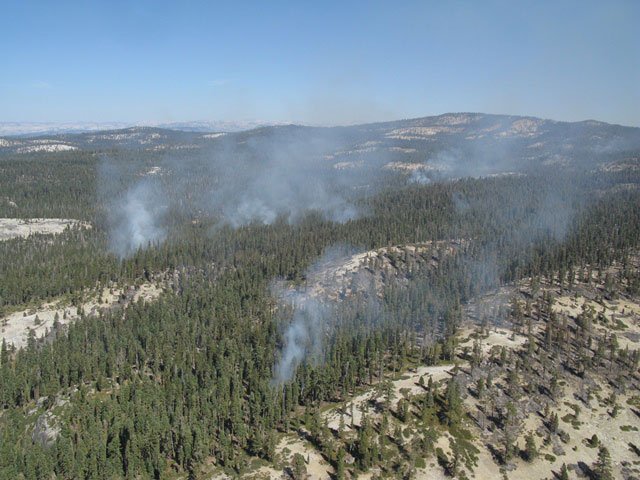
Cascade: (37 46.173 x 119 40.519; 7800'El., Mariposa Co., 6.15.12) The fire continues to show low to moderate fire activity. After recent ground and helicopter observations, the fire is at approximately 1,683 acres. Approximately 20% of the perimeter is active on the west flank and is backing down the main fork of Cascade Creek. The fire continues to creep and smolder in light brush and compact needle cast from the red fir forest. Warm weather, dry fuels and stronger nighttime down canyon winds have caused a slight increase in fire spread and behavior.
Yosemite fire crews are finishing both direct and indirect handlines to keep the fire from moving southwest into steeper portions of Cascade Creek and reduce smoke output. The fire is likely to continue spreading west/northwest into continuous red fir and lodgepole pine. The south, southeast and east flanks are showing very little fire activity and are nearly out and/or cold as the fire has burned into previous handlines, installed to check the fire spread to the southeast, granite and sparse fuels. Little future growth is predicted along those flanks. The fire will continue to be monitored. Air quality has remained in the good range with no significant health impacts in nearby smoke sensitive areas. Air quality monitors are located in the communities of Foresta, Yosemite West, Yosemite Valley, El Portal and Lee Vining. Smoke from the fire is visible in multiple areas along the Wawona, Big Oak Flat, Glacier Point and Tioga roads. The park's webcam, located at Crane Flat Helibase, captures fire images, which can be viewed at: http://ssgic.cr.usgs.gov/dashboards/WebCam.htm.
2 Comments
|
Did You Know?
The indigenous people of Yosemite Valley have used fire as a tool for thousands of years. Fire was used to encourage the growth of plants used for basket making and to promote the growth of the black oak--a sun loving species--and a staple food source for American Indians from this region.

Tim, We monitor at smoke sensitive areas closer to the fire than Jerseydale and assume these sites represent the maximum impact from the fire. Since there have been no impacts at levels above public health thresholds at these closer sites, we have been assuming no impacts at farther flung sites. Contact county air pollution officials if you think these assumptions are not correct, and we'll work with them to assess whether a change in monitoring strategy is warranted. Thanks!
You might want to monitor air quality in Jerseydale as we get considerable smoke at times.