An official website of the United States government
Here's how you know
Official websites use .gov A
.gov website belongs to an official government
organization in the United States.
Secure .gov websites use HTTPS A
lock (
) or https:// means you've safely connected to
the .gov website. Share sensitive information only on official,
secure websites.
About 50,000 of the park’s four million visitors fish each year. Fishing has been a popular recreation activity for visitors here for more than 100 years, and many people come to Yellowstone just to fish. Though angling is an anomaly in a park where the primary purpose is to preserve natural environments and native species in ways that maintain natural conditions, fishing in Yellowstone can help support preservation of native species.
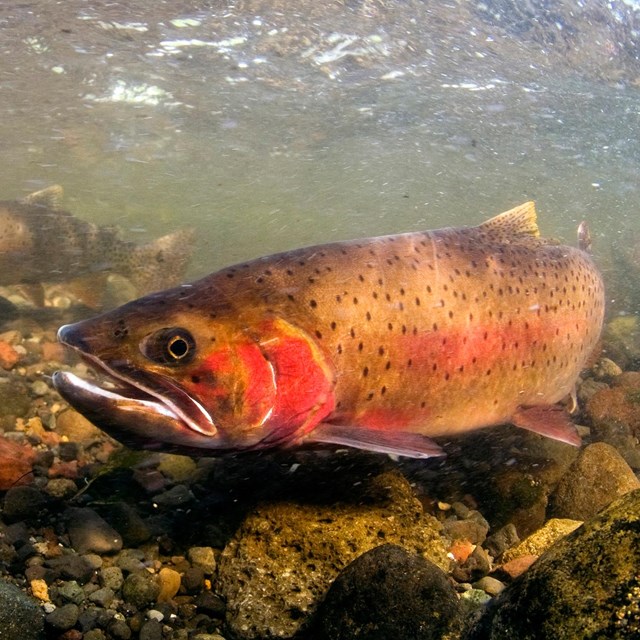
Fishing regulations in Yellowstone National Park are structured to strongly support native fish conservation goals. Cutthroat trout are the sole, native trout of the park and were the dominant fish species here prior to Euroamerican settlement. Cutthroat trout, Arctic grayling, mountain whitefish, and other native fishes are important to the ecology of Yellowstone. However, the abundance of these native fish has been reduced because of impacts by introduced nonnative fish, including brook, brown, lake, and rainbow trout. These nonnative species continue to contribute to the decline in the park’s native fish population by competing for food and habitat, preying on native fish, and degrading the genetic integrity of native fish through hybridization.
Yellowstone Fishing Regulations
Click the arrows on the right-hand side to expand each section below and learn more.
Most fishing areas in the park are available during the standard fishing season, which is from the Saturday of Memorial Day weekend through Oct. 31 each year. The following park waterways are open for fishing beyond the standard fishing season:
May 1-Oct. 31:
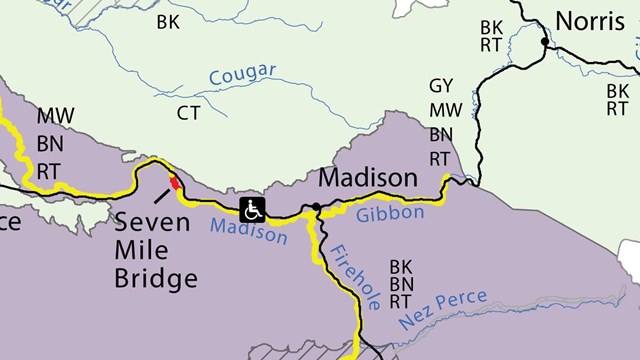
The Firehole River downstream to the confluence with the Gibbon River at Madison Junction.
The Gibbon River from the bridge on GrandLoop Road at the entrance to Norris Campground downstream to the confluence with the Firehole River at Madison Junction.
The Madison River from the Montana-Wyoming state line upstream to the confluence with the Gibbon and Firehole rivers at Madison Junction.
Year-round:
The Gardner River from Osprey Falls downstream to the confluence with the Yellowstone River near the North Entrance in Gardiner, Montana.
The Madison River from the Montana-Wyoming state line downstream to the park boundary near the West Entrance in West Yellowstone, Montana.
Exceptions are noted in each of the regional regulations.
Hours are daily from sunrise to sunset. Fishing with an artificial light is prohibited.
Some areas are closed to human entry, have trail or seasonal closures, off-trail travel and daylight hour limitations, or party size recommendations. See the Bear Management Area restrictions for specific rules and information.
Streams may be temporarily closed due to low water levels and high water temperatures to protect fish populations.
You are responsible for following all park regulations. Consult Yellowstone’s park newspaper, Camp in the Backcountry page, or rangers at visitor centers and backcountry offices to learn more.
Stay on established trails in thermal areas for your safety and to protect these fragile areas.
Do not discard fish carcasses or entrails along stream banks or the lake shore as they will attract bears.
Do not feed any animals, including birds, squirrels, and coyotes.
Bears and other wildlife may appear in areas frequented by people—even on trails, boardwalks, and along roads. Do not approach wildlife and remain at least 100 yards (92 meters) away from bears and wolves, and 25 yards (23 meters) away from all other wildlife.
Be alert—watch for bears and bear sign, like fresh tracks or scat.
Make noise in areas where visibility is limited.
Carry bear spray and know how to use it.
Avoid hiking or fishing alone. Try to stay with a group of three or more people.
Do not run if you encounter a bear.
Anglers 16 years of age or older must be in possession of a valid Yellowstone National Park fishing permit to fish in the park. State fishing licenses are not valid and aren't required.
Three-day permit: $40
Seven-day permit: $55
Season-long permit: $75
Fishing permits are available to purchase online via Recreation.gov.
Park rangers may check permits and inspect tackle, fish, creels, or other containers where fish or tackle may be stored.
Anglers 15 years of age or younger have two options:
Children 15 or younger may fish without a permit if they are fishing under the direct supervision of an adult who has a valid park fishing permit.
Children 15 or younger may obtain a free permit that must be signed by a responsible adult. With this permit, a child can fish without direct adult supervision.
With either option, the accompanying adult is responsible for the child’s actions and must ensure the child complies with all fishing regulations and provisions.
To reduce the potential for introduction or spread of aquatic invasive species, footgear with absorbent felt or other fibrous material on the soles are prohibited while fishing in Yellowstone.
Each angler may use only one rod which must be attended at all times and used for angling only—intentional snagging of fish is not allowed.
Only lead-free1 artificial lures (e.g. spoon or spinner) or flies may be used. Leaded fishing tackle such as leaded split-shot sinkers, weighted jigs (lead molded to a hook), and soft lead-weighted ribbon for nymph fishing are not allowed.
Hooks must have points that are barbless2, or the barbs must be pinched down by pliers. Lures may have only one hook with a single, double, or treble configuration. A single pointed hook is the best choice for fishing in Yellowstone. Treble hooks (3 points) can severely injure fish and are often constructed with toxic lead solder.
Each fly may have only one hook. Up to two flies may be used on a single leader (commonly referred to as “dropper,” “dry and dropper,” or “hopper and dropper”).
Except for feathers and other typical fly-tying materials, the hook must be bare. No organic or inorganic baits are allowed. Organic baits include fish or fish parts, minnows, salmon eggs, worms, insects, or foodstuffs such as bread and corn. Inorganic baits include rubber worms and plastic “twister” tails.
Scented attractants (liquid and solid baits) are illegal. Putting any substance in the water for the purpose of attracting fish (chumming) is illegal.
Exceptions
Non-toxic split-shot, sinkers, and jig heads molded with bismuth-tin, molybdenum, or tungsten are allowed. Lead core line and heavy (> 4 lb.) downrigger weights used to fish for deep-dwelling lake trout are permissible because they are too large to be ingested by wildlife.
Artificial lures are not allowed on the Firehole River, Madison River, and lower Gibbon River below Gibbon Falls. These streams are fly fishing only.
1Birds, such as loons, waterfowl, cranes, and shorebirds, are vulnerable to lead poisoning. While we can do little about natural hazards, we can minimize the effects of lead on these species. Yellowstone National Park bans most lead tackle. Terminal tackle must be lead-free. Large downrigger weights used to fish for deep-dwelling lake trout are permissible because they are too large to be ingested. 2Yellowstone has adopted a barbless hook rule to reduce handling time and injury, and improve the overall condition and appearance of fishes, especially in heavily-fished waters.
It is the responsibility of the angler to be able to identify fish by species. Unintentionally killed fish should be returned to the water so they can be consumed by wildlife.
Parkwide
All native fish must be released unharmed, including cutthroat trout, mountain whitefish, and Arctic grayling.
Native Trout Conservation Area
No possession limit for nonnative fish, including brown, brook, rainbow, and lake trout. You may harvest as many nonnative fish from this area as you want.
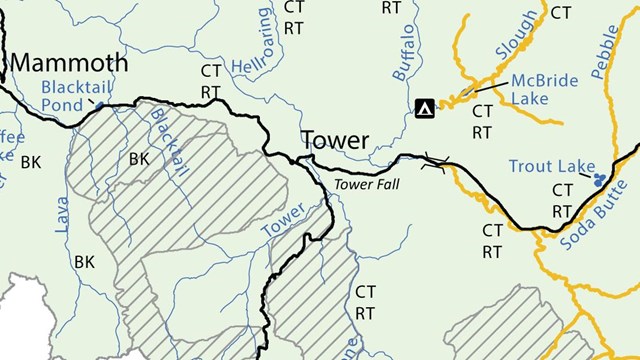
All rainbow trout, brook trout, and identifiable cutthroat/rainbow hybrids caught in the Lamar River drainage, including portions of Slough and Soda Butte creeks, must be killed—it is illegal to release them alive.
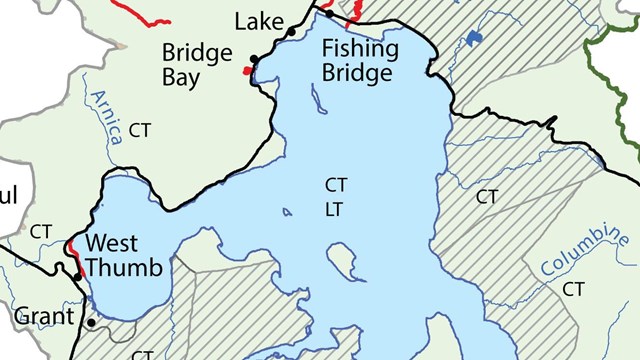
All lake trout caught from Yellowstone Lake must be killed— it is illegal to release them alive.
All smallmouth bass caught in Yellowstone Park must be killed and reported—it is illegal to release them
alive.
Nonnative Trout Tolerance Area
All native fish must be released unharmed. Possession limits exist for nonnative fish in this area. An angler must cease fishing in the area immediately after filling the possession limit.
Firehole River, Madison River, lower Gibbon River (downstream of Gibbon Falls)—possession of up to five brook trout is allowed. Catch and release all rainbow and brown trout. Whitefish are an important native species in the Madison River and they must be released.
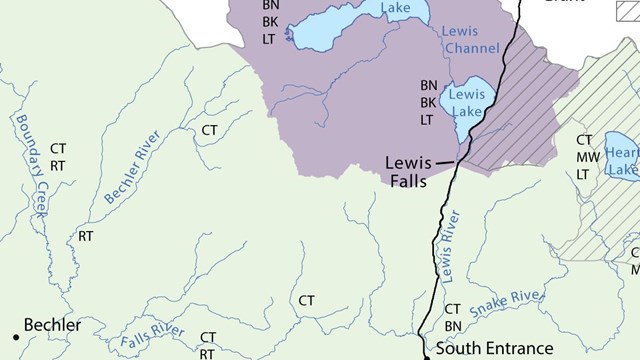
Lewis River system above Lewis Falls, including Lewis and Shoshone lakes and their tributaries— possession of five combined brook, brown or lake trout; only one of which may be a brown trout.
Skin must remain attached so the fish species can be visibly identified.
Gills and entrails may be removed in the field, but must be discarded only within the waters where the fish were caught.
Dispose of fish and/or fish entrails within the waters where the fish was caught but not within 100 feet (30.5 m) of boat ramps, docks, or backcountry campsites.
Fish can also be disposed of in park trash cans.
Fishing is restricted from all road bridges, marinas and boat docks, except from boat docks located at backcountry locations on Yellowstone Lake. Accessible fishing platforms and ramps are located near Madison Junction and at Grant Village boat launch.
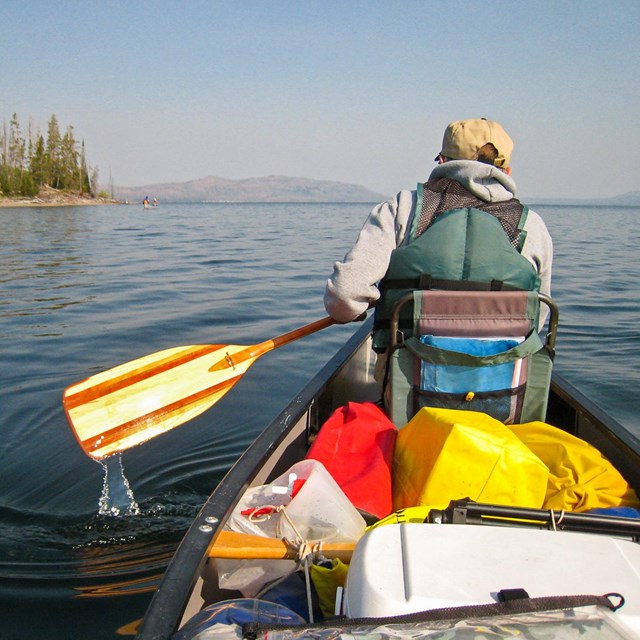
All vessels—including float tubes— require a boat permit.
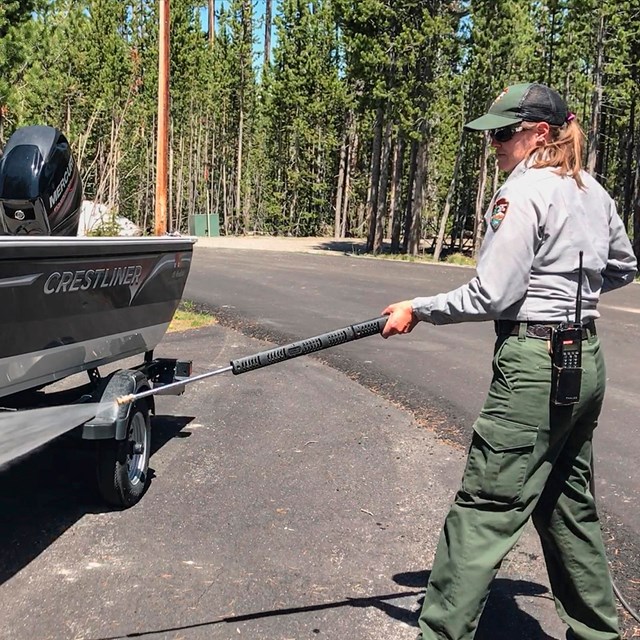
Transporting or introducing invasive species is prohibited: make sure you clean, drain, and dry boats and gear before arriving for your Aquatic Invasive Species (AIS) inspection.
All vessels also require a life vest for each passenger, and an emergency sound device such as a whistle or air horn.
All vessels must be checked by National Park Service inspectors to ensure that they are free of aquatic invasive species before entering any park waters.
To better ensure survival of hooked fish, follow these guidelines. Please help us maintain quality fisheries within the park for future generations to enjoy!
Handling
For all native fish and any nonnative fish you intend to release, bring the fish in as quickly as possible. Do not play the fish to exhaustion.
Always make sure your hands are wet if you must handle the fish. Dry hands damage a fish’s protective mucous film.
Hold the fish with one hand around the tail section and the other beneath the belly, just behind the pectoral fins.
Never grab or hold a fish through the gills unless it is already dead.
If you want a photo of the fish, make sure the photographer is ready before you handle the fish. Make it quick.
Unhooking
Unhook the fish in quiet water such as an eddy or slow spot. Do not drag the fish across land.
Use forceps or small needle-nosed pliers to quickly remove the hook.
Tackle, Lures, and Hooks
Hooks and lures typically have barbs when purchased. With small pliers you must pinch down the barbs. Without barbs more skill is required in landing and bringing in fish, but hook removal is easier and less traumatic to the fish.
Spinning lures typically have three hooks called treble hooks. With wire cutters you can snip off one of the hooks or snap one off with pliers; you also must pinch down all the barbs. Two hooks are still effective, easier to remove, and less traumatic.
If the fish is deeply hooked, cut the line, do not pull out the hook. Most fish can survive with hooks left in.
Exhausted Fish
Never just throw a fish back into the water. If a fish becomes passive, it is probably close to exhaustion.
Gently remove the hook within calm water, then lightly cradle the fish with your hands to see what it does.
If it struggles to keep itself upright, hold the fish around its tail and beneath its belly with its head facing upstream into the current.
Move the fish gently back and forth toward and away from the current. You should notice the gills opening and closing due to the rush of water. This is like giving a fish mouth-to-mouth resuscitation.
When the fish has recovered, it should swim away on its own.
Floy Tags
Park biologists are conducting a study to determine fish movement patterns and population sizes in Yellowstone Lake and several other park waters. Biologists have attached a Floy tag near the fish’s dorsal fin. The tags are typically orange or yellow in color and have a unique identification number.
If you catch a tagged fish:
Record the tag number (photo or written) and release the fish unharmed.
Note the location the fish was caught.
Call or text 406-404-4877 and report the tag number and location of catch.
If the fish accidentally died, please include that detail in your report.
Volunteer to Help Manage Yellowstone Fisheries
The activities necessary to preserve and restore native fish varies by species and drainages across the park. In order to promote the preservation of native fish in Yellowstone, the park has designated the Native Trout Conservation Area for special management. Within that area, fishing regulations are structured so that recreational anglers help selectively remove nonnative species from the area without damaging the native fishery. In some areas, anglers' harvests will help to save the native fish and the natural ecosystems they support.
Anglers have contributed to the fisheries database by reporting their catch. This information helps monitor the status of fisheries throughout the park. Since 1979, anglers have been asked to keep records on fishing trips - stream or lake visited, time spent fishing, fish species caught, lengths of fish - to help park managers understand fisheries status and track changes in specific populations. Decisions about how best to achieve native fish preservations and recovery goals must be based in sound sceintific research and consistent with the mission of the National Park Service.
During the 2024 Fishing Season, Yellowstone National Park will not be collecting angler surveys. Please check back next year for a national creel survey program that will benefit the park.
Angler groups have also lent support to management actions, such as closing the Fishing Bridge to fishing in the early 1970s. Yellowstone cutthroat trout support a $36 million annual sport fishery to the local economy. Also, money generated from fishing licenses helps fund research on aquatic systems and restoration projects.
Decisions about how best to achieve native fish preservation and recovery goals must be based in sound scientific research and be consistent with the mission of the National Park Service. In past years, a team of fishing volunteers assisted the fisheries program with several other projects. These projects included nonnative species removal, species composition, fish barrier evaluation, and injury and mortality rates of barbed and barbless hooks. Their extensive help collecting data and biological samples allows park biologists to learn about many more areas than park staff would have time to access.
Volunteer Fly-fishing Program
Again this year, a team of fishing volunteers assisted the fisheries program with several other projects in the volunteer fly-fishing program. Sponsored by Yellowstone Forever, projects include nonnative species removal, species composition, fish barrier evaluation, and injury and mortality rates of barbed and barbless hooks. The volunteer cadre's extensive help collecting data and biological samples allows park biologists to learn about many more areas than park staff would have time to access.
Review specific regulations to fishing in the southeast region of Yellowstone.
Fish Identification
The fishing map within the fishing regulations indicates known locations of fish species within the boundaries of Yellowstone National Park. It also includes descriptions and identification tips for both native and nonnative sportfish. In Yellowstone, anglers are required to return all native fish back to the water immediately, including arctic grayling, cutthroat trout, and mountain whitefish.
Harvest of non-native trout is allowed, and in some cases required, in many park waters. Please check the fishing regulations for details. It is the angler's responsibility to be able to distinguish one fish species from another, to ensure that cutthroat trout and other native species are not harmed!
Take a look at this comparison to see the differences between westslope cutthroat trout (native fish) and rainbow trout (nonnative fish). Look for: the number of spots on head, the presence of slash on lower jaw, side markings, and color on fin edges.