



|
You are viewing ARCHIVED content published online before January 20, 2025.
Please note that this content is NOT UPDATED, and links may not work. For current information,
visit https://www.nps.gov/aboutus/news/index.htm.
NPS Photo
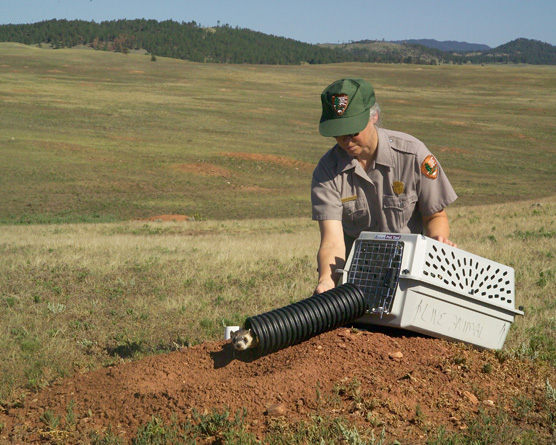
Contact: Tom Farrell, 605-745-4600 WIND CAVE NATIONAL PARK, S.D. – After a thirty-year absence, black-footed ferrets, one of the rarest animals in North America, have returned to Wind Cave National Park. U.S. Fish and Wildlife Service and National Park Service employees released seven animals in the park on July 4. The animals were captured in the Conata Basin near Wall and transported to the park on Wednesday.
“It has been thirty years since the last sighting of a black-footed ferret in Wind Cave National Park,” said acting superintendent Rick Mossman. “We hope this is the start of a self sustaining population that will restore a missing link to our mixed-grass prairie ecosystem.”
The release follows the completion of an environmental assessment this spring that called for the reintroduction of approximately 20 to 25 black-footed ferrets annually for the next three to five years. The ferrets are being reintroduced under a 10(a)(1)(A) scientific experimental/recovery permit issued under the Endangered Species Act. This permit allows experimental reintroductions to occur within park boundaries and provides mechanisms to ensure that private property interests outside the park are not impacted.
Management actions used to reintroduce ferrets and manage the prairie dog population will be consistent with the park’s recently completed prairie dog management plan that limits prairie dogs to a range of 1,000 to 3,000 acres within the park. |

Last updated: March 10, 2019