National Park Service LogoU.S. Department of the InteriorNational Park ServiceNational Park Service
National Park Service:  U.S. Department of the InteriorNational Park Service Arrowhead
Scotts Bluff National Monument Dome Rock
view map
text size: largest larger normal
printer friendly
Scotts Bluff National Monument
Nature & Science
 
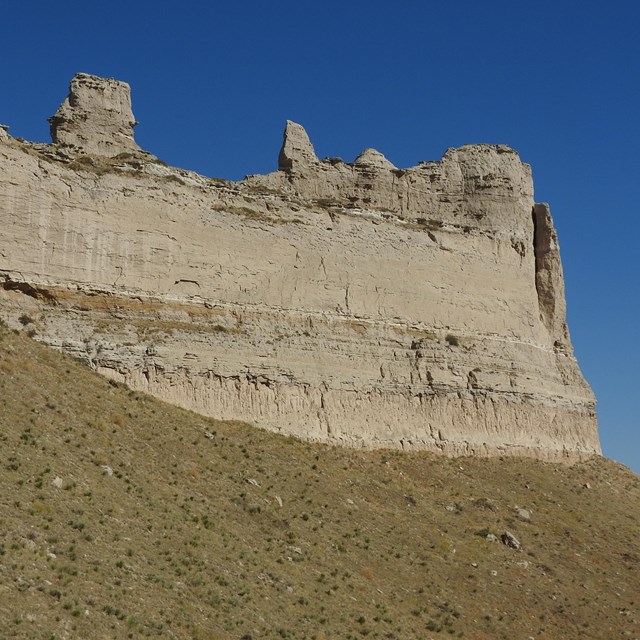
Saddle Rock from trail

NPS Photo

Geologic Layers of Saddle Rock

Scotts Bluff National Monument was established in 1919 by Presidential Proclamation primarily for its historical significance and unique geological features. While human history is the dominant theme today at Scotts Bluff, the area's natural history provides the setting in which a multitude of significant human events has transpired. Its principal natural value is the topographically diverse landscape in which the main features of the historic landscape are still preserved. 

The Monument lies within the western Great Plains in an area that was once almost continuous mixed and short grass prairie and that is now largely utilized for farming and ranching. The Monument lands encompass two large, cliff-rimmed, bluffs:  Scotts Bluff and South Bluff. Most of the land within the boundary is in native mixed-grass prairie with some previously disturbed areas harboring a variety of non-native vegetation. There is also an area of mostly barren badlands between the north base of Scotts Bluff and the North Platte River.

The landscape at the beginning of the Oregon-California Trail time period was primarily "natural" and largely "undisturbed," in a pre-European habitation sense. Euro-American emigrants arriving during the mid-nineteenth century found a landscape here that was richer in wildlife and more sparsely wooded than it is today, but the essential features of the scene -- the imposing bluffs rising from the plains -- are relatively unchanged. The effects these emigrants had on the landscape were certainly significant, but the landscape that evolved was still primarily "natural," overlain with periodic and concentrated human disturbance. The expansive plains, prominent bluffs, and the dominant prairie vegetation made up the primary elements of the landscape. The plains and bluffs suffered immediate, but relatively little long term, disturbance from the passing of the emigrants. The vegetation near the trail was probably heavily affected by the concentration of both human traffic and large numbers of livestock. The vegetation probably regenerated in a short time due to the extensive root systems of the native plants, because of nearby seed sources available on the surrounding undisturbed lands, and because natural ecosystem processes remained intact.

The region's landscape and that of the Monument are very different than they were 150 years ago. The plains and bluffs remain, but now are dotted with buildings, roads, trails, canals, and trees. A large portion of the prairie vegetation has been disturbed, now resembling a "patch work" pattern of multiple disturbance events of various levels of intensity, size, and recovery. A significant portion of the lands surrounding the Monument have been converted to farmland or residential areas; therefore, nearby native seed sources are scarce. Many of the natural processes that helped shape the landscape, such as grazing by bison and other native fauna, and naturally ignited fires, are now gone or severely limited. Climatic influences and erosion still take place, but in some places the natural erosion rate may be accelerated by human-caused impacts.

William Henry Jackson
Got Jackson?
Scotts Bluff houses the largest collection of William Henry Jackson's artwork in the world
more...
Scotts Bluff's biodiesel shuttle vehicle
Ride the free shuttle!
We drive so you don't have to
more...

You are exiting the National Park Service website

Thank you for visiting our site.

You will now be redirected to:

We hope your visit was informative and enjoyable.

Historic photo of construction on one of the vehicular tunnels on the summit road at Scotts Bluff National Monument

Did You Know?
The CCC (Civilian Conservation Corps) built nearly every structure at the Scotts Bluff National Monument in the 1930's - the summit road, Saddle Rock Trail, the visitor center, the maintenance barn, and a residence now used for administration.
more...

Last Updated: January 16, 2012 at 13:45 MST