
• Hikers on Granite Pass in Rocky Mountain National Park/NPS photo by John Marino

    Rocky Mountain

    National Park Colorado

  • Bear Lake Road Reconstruction Project

    Major construction work on Bear Lake Road in 2012 & 2013 includes mandatory use of park shuttles May 29-Oct 9 between 9 am–4 pm, delays, and some night closures. More »

Butterfly Families

For a complete list of the park's documented butterfly species, click here.

Hesperiidae (The Skipper Family)

 
a photo of a Snow's Skipper butterfly (Paratrytone snowi)

R. Bray

Snow's Skipper (Paratrytone snowi)

Skippers are in the Hesperiidae family. They look and fly like moths. They have hooked antennae. In the park, most species are small and black or earth-toned.

 
Papilionidae (The Swallowtail Family)
 
a photo of a Western Tiger Swallowtail (Papilio rutulus)

R. Bray

Western Tiger Swallowtail (Papilio rutulus)

Swallowtails are large and strong fliers with trailing tails. Four species are commonly seen in the park in patterns of black and yellow. Look for them in the montane life zone.


a photo of Rocky Mountain Parnassian (Parnassius smintheus)

R. Bray

Rocky Mountain Parnassian (Parnassius smintheus)

An exception in the park Swallowtail family is the Rocky Mountain Parnassian, which lacks a tail and is found in all the park's life zones: montane, sub-alpine and alpine. It can often be seen in numbers on the tundra, flying across Trail Ridge Road.
 
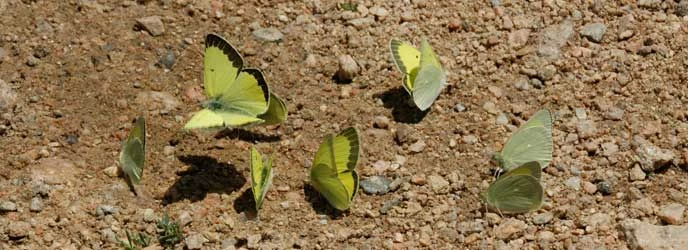
Pieridae (The Sulphur and White Family)
 
a photo of Alexandra's Sulphur butterfly (Colias alexandra)

R. Bray

Alexandra's Sulphur (Colias alexandra)

The Sulphur and White Family has 12 species commonly found in the park. They are mostly medium in size and hard to tell apart. Their colors range from yellow to orange to white.
 
Lycaenidae (The Gossamer Wing Family)
 
a photo of a Greenish Blue butterfly (Plebejus saepiolus)

R. Bray

Greenish Blue (Plebejus saepiolus)

The Gossamer Wing Family consists of small butterflies, many brightly colored. They are high to low elevation species. There may be more than 15 species of blues found in the park. Seven are common, and their upper sides are hard to tell apart.
 
Ruddy Copper (Lycaena rubidus)

R. Bray

Ruddy Copper (Lycaena rubidus)

Coppers are another group in the Lycaenidae family. Four species of coppers fly in the park. The male Ruddy Copper flies in July and August in the montane and lower sub-alpine. Other members of the Lycaenidae family in the park include the elfins and the hairstreaks.
 
Nymphalidae (The Brushfoot Family)
 
a photo of a Weidemeyer's Admiral butterfly (Limenitis weidemeyerii)

R. Bray

Weidemeyer's Admiral (Limenitis weidemeyerii)

Brushfoot Family members have four walking legs instead of the usual six. Their other two legs have evolved into brushes used to taste-test host plants and to clean their proboscis. This family is the biggest group in the park, and they exploit a range of plant shapes, sizes, and colors. Look for the Weidemeyer’s Admiral flying in mid-to late summer along the Fern Lake and Wild Basin trails.
 
a photo of a Dotted Checkerspot butterfly (Poladryas arachne)

R. Bray

Dotted Checkerspot (Poladryas arachne)

The Dotted Checkerspot is one of the Crescent and Checkerspot sub-groups of the Nymphalidae family. It flies in open sunny meadows from July through mid-August.
 
a photo of a Mormon Fritillary butterfly on a yellow flower

R. Bray

Mormon Fritillary (Speyeria mormonia)

The Speyeria or Greater Fritillaries are another group in the Nymphalidae family. Most have beautiful silver spots on the undersides of their hind wings. Look for the Mormon Frittillary along the Poudre Trail near Milner Pass.
 
a photo of a Green Comma butterfly (Polygonia faunus)

R. Bray

Green Comma (Polygonia faunus)

Anglewings or Commas are represented in the park by several species. All have scalloped edges to their wings. They over winter as adults, unlike most butterflies that pass the winter in the egg, caterpillar, or chrysalis stage.
 
a photo of a Monarch butterfly (Danaus plexippus)

R. Bray

Monarch (Danaus plexippus)

Monarchs are the most recognized butterfly in the park, but among the least frequently seen. Their host plant, Showy Milkweed, is not common ni the park. Most years, only a few monarchs are seen flying within our boundary.

 
(text by S. Mason)

Did You Know?

a photo of a spider web

Hummingbirds use spiderwebs to bolster their nests, which are the size of a walnut shell. Hummingbird eggs are the size of a Tic-Tac breath mint.