
National Park Service LogoU.S. Department of the InteriorNational Park ServiceNational Park Service
National Park Service:  U.S. Department of the InteriorNational Park Service Arrowhead
Presidio of San FranciscoCavalry barracks, built 1902
view map
text size:largestlargernormal
printer friendly
Presidio of San Francisco
Architecture: Mission Revival (1910 - 1940)
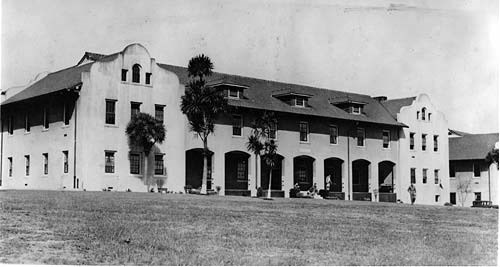
Building 1204, a barracks at Fort Winfield Scott, circa 1930.
National Park Service, GGNRA
Constructed in 1912, Building 1204 was a barracks at Fort Winfield Scott. Photo taken 1924-1938.
 
The Mission Revival style grew from the desire to base architectural design on the southwest's regional historic influences—namely Spanish colonial history—rather than importing design influences from the east coast. By the early 1900’s, the style was popular in the western United States and was adopted by the Army in its construction of the Fort Winfield Scott barracks. As evident in Building 1204, Mission Revival is characterized by silhouetted shapes that mimic old Spanish missions, with large flat stucco surfaces often punctuated by deep windows and door openings. Exterior surfaces in Mission Revival are usually devoid of ornamental detail; however, the gable and hip roofs are typically sheathed in striking red clay tile.
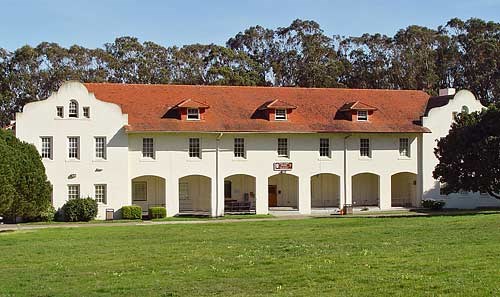
 
A barracks at Fort Scott today.
National Park Service, GGNRA
A barracks at Fort Scott today.
 
Fort Point, once called  

Did You Know?
In 1882, the fort now known as Fort Point was given the name "Fort Winfield Scott", a name it retained for four years before being downgraded to a sub-post of the Presidio. In 1912, the name was reused for the new coast artillery post at the Presidio, today's Fort Scott.

Last Updated: March 05, 2009 at 16:34 EST