
|
abbotts lagoon coastal dune restoration project includes: Abbotts Lagoon Coastal Dune Restoration Project Dune Restoration in the SeashoreProject Construction Began in 2011 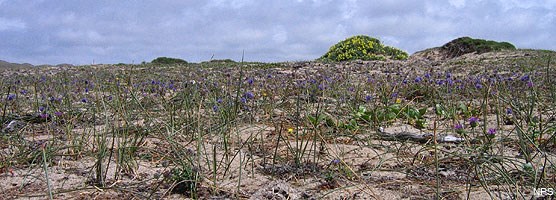
After more than a decade of planning, in February 2011, the Seashore began its largest dune restoration project to date to remove up to 120 acres of non-native invasive European beachgrass (Ammophila arenaria) and iceplant (Carpobrotus spp.) from a 255-acre area just south of Abbotts Lagoon. The Abbotts Lagoon Coastal Dune Restoration Project is restoring natural dune processes and function to a system that is home to at least 11 threatened and endangered, but whose ecological value has been severely imperiled by the rapid spread of species once planted to stabilize dunes for adjacent development. In fact, the rapid spread of beachgrass, which now dominates almost two-thirds of the Seashore's dunes, may have brought two federally listed species to the brink of extinction within the park (See background information below). Construction of Phase I began in February 2011 and extended into August 2011. The Seashore hired Hanford ARC (Sonoma, Calif.) as the construction contractors responsible for both initial mechanical and hand removal. Winzler & Kelly Engineers (San Francisco, Calif.) were hired to manage the construction process. The Seashore provided extensive environmental monitoring during the restoration project to ensure that impacts to valuable natural resources such as western snowy plover (Charadrius alexandrinus var. nivosus), California red-legged frog (Rana draytonii), Myrtle's silverspot butterfly (Speyeria zerene myrtleae), Tidestrom's lupine (Lupinus tidestromii), beach layia (Layia carnos), and many other native dune plant and animal species were minimized to the maximum extent possible (See What Was Done During Project Implementation to Protect Sensitive Resources? for more details). Part of project planning involved disseminating information to the public so that park visitors and residents knew what to expect during construction. This included postings on trailhead signs for temporary closures of beach areas directly adjacent to construction activities. Construction of Phase I of the Abbott's Lagoon Coastal Dune Restoration Project included the following components:
However, while successful, mechanical removal of European beachgrass and iceplant was also highly expensive ($25,000 to $30,000/acre) due to the depth of excavation required (from 6 to 9 feet) to bury rhizome and biomass-contaminated material with a sufficient "cap" of clean sand (3 feet), so that buried materials could not resprout readily. In fact, cost was the reason that only approximately 80 of the 120 acres were restored during Phase I. The Seashore wanted to build upon these ecologically successful dune restoration efforts by expanding restoration southward, but NPS managers realized that a more cost-effective methods would be required if dune restoration efforts were to continue. In 2011, the Seashore researched methods used by other agencies and organizations. Many of these projects have used a combination of fire and herbicide to successfully treat these invasive species. In fact, the mixture of glyphosate with imazapyr has been particularly successful in treating almost 80 to 90% of the European beachgrass with as little as one to three treatments, resulting ultimately in much lower total amount of herbicide applied. To develop the best methods for cost-effectively treating European beachgrass in the park, the Seashore decided to do an experimental study using one of the other alternatives evaluated in the EA. After receiving the necessary permits, the park treated some of the remaining unrestored areas using backpacks with spot application of herbicide. This project--Phase II--was implemented in fall 2011, and monitoring indicated that more than 95% of the beachgrass was eradicated after only one treatment, while many of the adjacent native plants--such as coyote brush (Baccharis pilularis) and mock heather (Ericameria ericoides)--were either not affected or quickly rebounded. A number of plants have been observed growing in treated areas, including yarrow (Achillea milleflora), bracken fern (Pteridium aquilinum), seaside daisy (Erigeron glaucus), and bush lupine (Lupinus arboreus). Remaining plants were re-treated in 2012 prior to and after the plover nesting season by either hand removal or spot herbicide application. In 2012, some additional unrestored areas were treated, using information provided by the 2011 study (Phase III). Treatment involved use of backpacks with spot application of 2% glyphosate and 1.5% imazapyr. In addition, some of the Phase II areas were mowed once any follow-up treatment had been finished to determine whether biomass removal improves and/or speeds up colonization by native dune plant species: European beachgrass decomposes very slowly. Other methods used by state parks for reducing beachgrass biomass--and improving herbicide efficacy--include controlled burning of plots prior to herbicide treatment, but that was not included as part of this experimental project due to the fact that more recent restoration efforts showed that treatment could be just as effective without burning. Retreatment of the relatively small amount of regrowth in Phase III and Phase II areas was conducted in 2013 and 2014. After the mechanical restoration, the park conducted some small-scale revegetation experiments to try and determine whether the restoration process could be "jump-started." Revegetation included both plots where seeds were sown, as well as transplanting of American dunegrass (Leymus mollis) into foredune areas. Many of the seed plots were lost during dry winter conditions and high spring winds (more discussion below), but the transplants have persisted. The park has also conducted pre- and post-restoration monitoring to evaluate restoration effectiveness in restoring native dune vegetation communities, natural dune processes and topography, and habitat quality for endangered species such as Tidestrom's lupine, beach layia, Western snowy plover, and Myrtle's silverspot butterfly. In addition, the park hopes to see increases in the numbers of these species, both within the Project Area and within the park. So, what have we observed in terms of how successful restoration has been so far?
ReferencesCampbell, C. 2012. Monitoring Western snowy plovers at Point Reyes National Seashore, Marin County, California. 2012 Annual Report. Natural Resource Technical Report NPS/SFAN/NRTR. October 2012. Campbell, C. in press. Draft - Monitoring Western snowy plovers at Point Reyes National Seashore, Marin County, California. 2013 Annual Report. Natural Resource Technical Report NPS/SFAN/NRTR. Campbell, C. in press. Draft - Monitoring Western snowy plovers at Point Reyes National Seashore, Marin County, California. 2014 Annual Report. Natural Resource Technical Report NPS/SFAN/NRTR.Hughey, L. 2012. Monitoring Western snowy plovers at Point Reyes National Seashore, Marin County, California. 2011 Annual Report. Natural Resource Technical Report NPS/SFAN/NRTR. December 2011. Johnson, W. C. 2013. Abbott's Lagoon Dune Restoration Project: Dune Movement Assessment. Point Reyes National Seashore, Point Reyes Station, CA. Minnick, S. and L. Parsons. In prep. 2X1 plot vegetation sampling - 2011. Pardini, E. A., and T. M. Knight. 2013, February 20. Memo: Benefits of dune restoration at Abbotts Lagoon to two federally listed endangered species, Tidestrom's Lupine and Beach Layia. Pardini, E. Professor. Washington University, St. Louis, MO. Personal communication dated August 11, 2014.
|
Last updated: August 1, 2021