
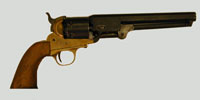
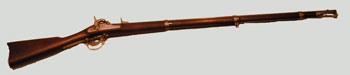
RegimentA regiment is a unit of the army. A regiment was a military unit composed of ten companies, each of 97 men and 3 officers. However, this organization was seldom, if ever, up to full strength. RevolverThe revolver was a popular weapon among cavalrymen in the Civil War. They fired paper wrapped cartridges, using copper percussion caps to ignite the charge. The revolver, though valued for a quick firing rate, was not always a dependable weapon. They were accurate only at very short range which meant they were useful only in close actions. Such actions were not commonplace for cavalry soldiers in the Civil War, and particularly in the siege warfare seen at Petersburg. Rifled MusketThis term, adopted in 1855, designated those shoulder arms that retained the outside dimensions of the old smoothbore muskets but had rifled barrels. While the smoothbore muskets fired a solid round shot, the rifled muskets fired a minnie ball. The rifled muskets had more speed when fired, and could do greater damage to the unlucky soldier who was wounded in battle.
Rubber BlanketEvery soldier was issued a rubber blanket, often called a gum blanket. Soldiers would often lie on the rubber blanket to sleep at night, with the rubber side facing the ground. The rubber side would keep them dry if the ground was wet. They would cover themselves with the issued wool blanket. |


Last updated: February 26, 2015