
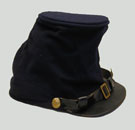
Forage CapThe forage cap was commonly worn by soldiers during the Civil War. The wool forage cap was mass produced in 1861, with visors of roughly cut pieces of leather that rapidly assumed a curved shape. The sides collapsed so that the top tended to incline forward. Soldiers who wanted to determine the possible line of fire at their trench walls would hold their guns above the trench walls with their hat resting on the muzzle. If a rifle was fired at what appeared to be their heads, soldiers would know it was not safe to move about the trenches. Fortification
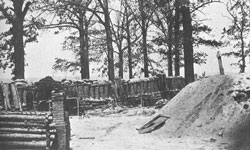
A form of earthworks, fortifications were works erected to defend a position or place in the lines. The permanent fortifications existing at the outbreak of the war were massive structures of bricks or stones, carrying cannon in covered gun positions called batteries. At Petersburg, soldiers built the fortifications from dirt and wood, materials that were readily available. Fraise
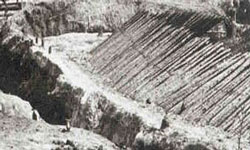
A palisade of sharpened wooden stakes that were either horizontal or slightly inclined. The points of a fraise were supposed to be seven feet above the bottom of the ditch, and were not to project beyond the foot of the scarp lest they give shelter to any attackers who could reach the ditch. Fraise were most common among Union soldiers at Petersburg. Friction PrimerAll cannons of the North and South were fired by a friction primer, a device that was simple and quick to use, yet extremely effective. It consisted of two small brass tubes, a serrated wire, friction composition, and fine, black powder. In use, the wire was hooked to the lanyard and the long tube inserted into the vent. A steady, quick pull on the lanyard dragged the serrated wire across the friction composition igniting it and setting off the black powder which flashed down the tube and vent, firing the cannon. |

Last updated: February 26, 2015