




Dennis & Pam Klein, NPS Marmoteers Olympic Marmot - Marmota olympusNuzzling, playing, chirping, feeding together; the Olympic marmot is quite possibly one of the most social and gregarious mammals on the peninsula. Marmots are rodents; they belong to the squirrel family and evolved during the Pleistocene Epoch. Some folks call them "rock chucks" or "whistle pigs". There are 15 recognized species of marmot worldwide, all in the northern hemisphere, with six species in North America. The Olympic marmot however, is only found in the Olympic mountains and nowhere else (it's endemic). Identification:Marmots are a housecat-sized rodent with a long, bushy tail. Adults can weigh 15 pounds or more before they enter hibernation in September or early October. Olympic marmots have widely varying coat colors, unlike their other American counterparts. The young are usually dark gray but the adults are often brownish in color, but may be yellow or tan colored with a variety of patch colors when they emerge from hibernation in the spring, and almost black in the fall. Family groups of one adult male, one or more adult females, and several cohorts of young share a home range of 1/2-acre to five acres. In any given year, about 30 percent of adult females produce litters of 1-6 pups. Pups initially stay close to their burrows when they emerge in late July, but by mid-August, they can be seen wrestling and chasing each other in enthusiastic play. Marmots have a sharp, piercing whistle that warns others of intruders or potential predators, and notifies hikers that they are in marmot territory. Habitat:Marmots occupy mountain meadows above 4,000 feet. Although they are found throughout the Olympic Mountains, they are rare in the wetter southwest areas of the park. About 90 percent of Olympic marmot habitat is protected within Olympic National Park. In the 1990s and early 2000s, Olympic marmot numbers declined, at least partly due to predation by non-native coyotoes. Marmots and their habitat are also expected to be sensitive to climate change. In recent years, marmots have also disappeared from some of the driest meadows in the northeast Olympic Mountains. In response to these concerns, in 2010 the park initiated a volunteer monitoring program to record the presence or absence of marmots in many meadows throughout the park. Diet:Olympic marmots prefer fresh, tender, flowering plants such as lupine and glacier lilies. In May and June, they will eat roots and may even gnaw on trees. They can double their body weight in the summer and use stored fat during a seven to eight month hibernation. Marmot EcologyMarmots are supremely adapted to living on cold, windswept grasslands and exposed mountain slopes where snow covers the ground for all but a few short months. They forage on grasses, sedges, and herbaceous plants. They dig burrows in which they shelter from predators and weather, bear and nurse their young, and hibernate for up to 8 months per year. The body temperature of a hibernating marmot drops to <40F, while the heart rate may drop to 3 beats per minute. Marmots do warm themselves up every 10 days or so but do not eat or drink during hibernation.Marmots have an unusually "slow" life history for rodents. Olympic marmots can live into their teens and do not reach reproductive maturity until age 3 or older. The average age of first reproduction for females is 4.5 years. Among reproductive-age Olympic marmots, about 35% of females wean young in an average year. Litters of 1-6 pups first come above ground in late July or early August, and about half of these young die by the following spring. The long maturation period, low rate of reproduction, and relatively hight rate of juvenile mortatlity combine to make adult females particularly valuable to a marmot population - it can take years to replace one that is killed. The death of several breeding-age females can have serious long-term effects on the population. 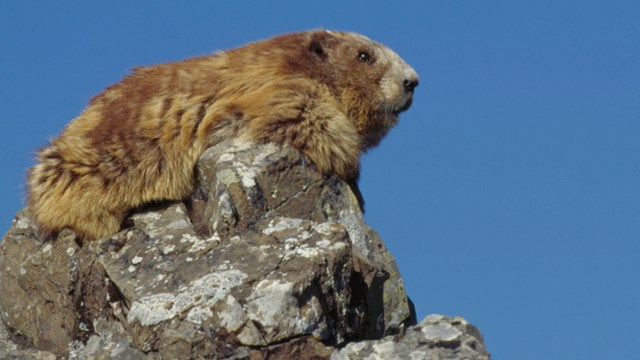
Marmot Monitoring Volunteers
Marmot monitoring in Olympic happens with the help of teams of volunteers. Learn more about their work or how to participate. 
Marmot Research, Reports, and Links
Learn more about the research on Olympic Marmots. 
Olympic NP Animals
Olympic is home to a wide variety of animals from mammals to mollusks and much more. Learn about them here. |
Last updated: March 24, 2026