



|
From the massive glaciers descending from its peak to the stunning array of wildflowers in its subalpine meadows, Mount Rainier provides a wide variety of opportunities for experiencing nature. Use the links below to discover the rich landscape of the mountain. 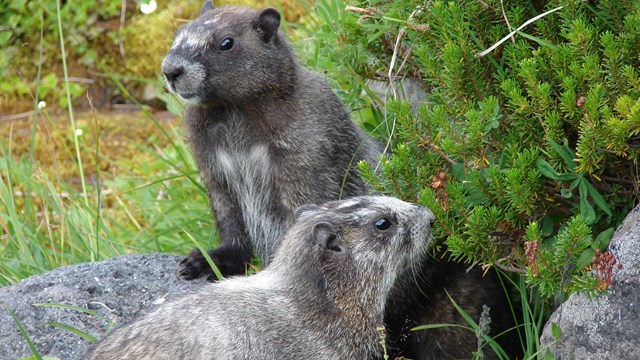
Animals
Discover all of the animals that call Mount Rainier home! 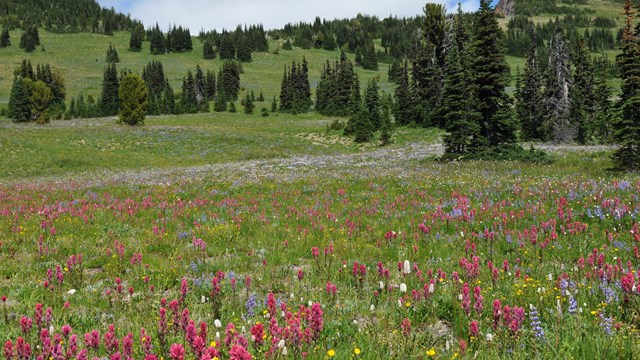
Plants
Climate and elevation vary greatly in the park, creating a wide range of habitats supporting an extensive number of plant species. 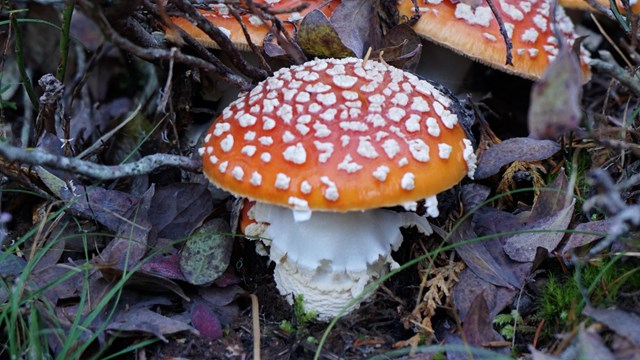
Mushrooms & Other Fungi
Fungi plays an essential role in Mount Rainier's ecosystems. Many, but not all, fungi species produce mushrooms. 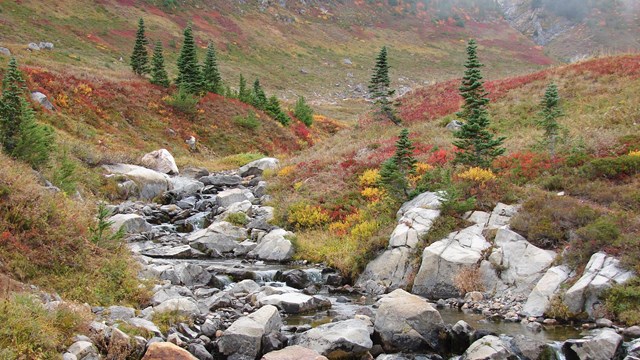
Environmental Factors
From air and water quality to climate change, the park closely monitors the environmental factors impacting the mountain. 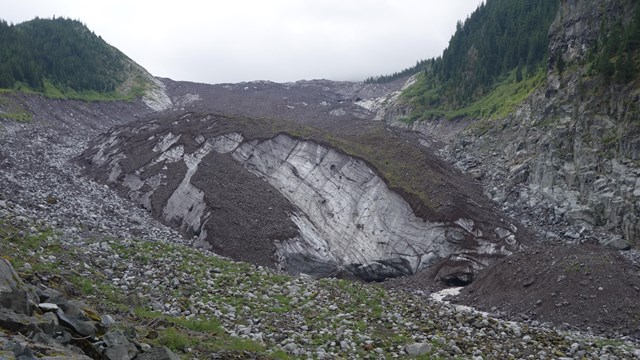
Natural Features and Ecosystems
Glaciers, volcanoes, and so much more! 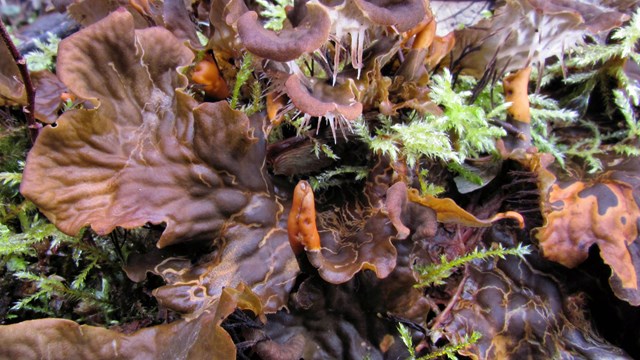
Lichen
Learn about the varieties of lichen found in the park. 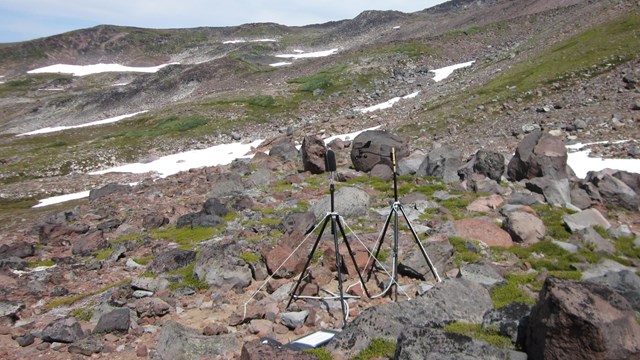
Soundscapes
Discover the sounds of Mount Rainier! Different ecosystems, animals, and human uses create a variety of soundscapes within the park. 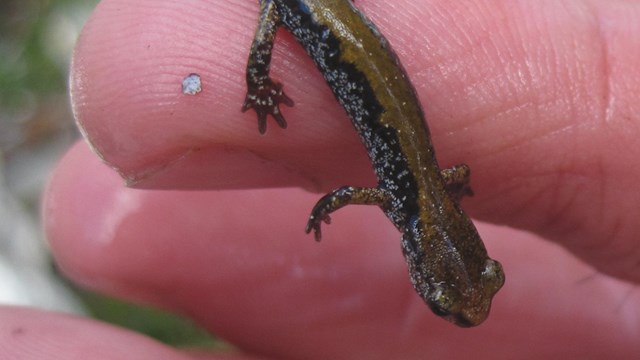
Ongoing and Past Research
Explore articles about past & ongoing scientific research in the park, including wildlife studies, volcano monitoring, and more! 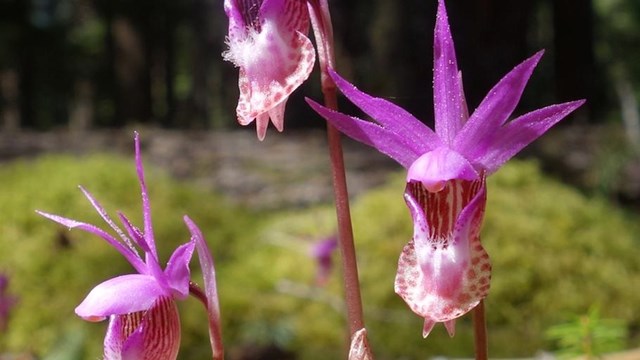
Nature Guides
Learn about the plants, animals, geologic features, and more that make up Mount Rainier National Park through these online nature guides. North Coast and Cascades Science Learning Network Learn more about the environment of Mount Rainier and the Northwest Region. Also, make sure to check out their impressive video series. Inventory and Monitoring at Mount Rainier The North Coast and Cascades Network also manages all the inventory and monitoring studies carried out in Mount Rainier National Park, which includes surveys of elk, landbirds, landscape dynamics, glaciers, water quality, mountain lakes, forests, subalpine vegetation, and climate. Transcript
Changing Times – Transcript
Narrator 1: What is it that we really enjoy about national parks? The outdoor experience? Viewing wildlife and wildflowers? The dramatic scenery? Nature? The Wilderness? In 2016, the National Park Service celebrates its Centennial. One hundred years of ensuring quality outdoor experiences that make a national park so different from any other natural area. By preserving the quality of the park’s natural resources, Mount Rainier National Park strives to bring enjoyment of this place to all for generations to come. Over the last century or more, how we treat park resources has drastically changed with a better understanding of the impacts of human use and the implications of past resource management approaches. Narrator 2: Mount Rainier became the nation’s fifth national park in 1899, 17 years before the National Park Service was created in 1916. Those early years saw an explosion of growth and recreation in the fledgling park. By 1904, developments in transportation brought a new visitor to the park, the day user. Day users quickly outnumbering the dedicated outdoorsmen, campers, and climbers that first explored the park. During these early years, park administrators focused not so much on protecting the natural resources that were attracting so many new visitors, but on building facilities to support those visitors. Day users were not as satisfied with roughing it in tents, so hotels and day lodges were built in the subalpine meadows. Roads were carved through the old growth forest with bridges stretching across glacier-fed rivers. One major threat to this new development was fire, which also destroyed the beautiful forests that appealed to visitors. Instead of managing fires as a natural part of forest systems, it became a primary goal to stop all forest fires in the park completely. In 1907, Superintendent Allen started developing the trail system primarily to allow rangers to get to forest fires faster in order to fight them. Ironically an improved trail system also brought more people, one of the main causes of fire, to Mount Rainier’s forests. Practices that hurt the park’s natural environment also included the logging of trees that were dead, damaged, or too old, removing an essential component of forest ecosystems. Old trees serve as nurse logs, feeding the next generation of forest saplings, and provide food and homes for insects and animals. Large predators like bears and mountain lions were hunted and several mining claims were allowed to operate on park land. Narrator 1: Though these policies are seen as harmful to the environment today, they were the first attempts to protect the park’s resources according to the knowledge of the time. Narrator 1: The creation of the National Park Service in 1916 brought new order and stability to Mount Rainier. The first park naturalist was hired, rangers became professionalized and capable of enforcing park regulations, and landscape, road, and sanitation engineers worked to improve and expand park facilities. Views in managing natural resources also started to shift. Instead of just using resources, administrators started to think of how they could protect resources. Narrator 2: As views of managing park resources changed, so did views of wildlife management. Hunting of predator species was halted in 1924 in part due to a growing understanding and appreciation of wildlife as part of the natural environment. However, wildlife viewing was also growing as a popular park attraction- sometimes at the cost of the animal’s health and the visitor’s safety. Early park administrator’s also believed they needed to “correct” the natural lack of fish in Mount Rainier’s many lakes and started stocking them with fish. The understanding that lakes could have healthy ecosystems without fish was not realized for decades to come. Other policies of the previous era were not as quick to change. A wave of fires in the park during the late 1920s reinforced the policy of completely suppressing all forest fires. However, the study of how to best fight forest fires led to some of the first scientific research conducted in the park. Other early research included the first glacier surveys in the 1920s, with yearly glacier recession surveys starting in 1933. More and more visitors flocked to see the wildflower meadows, often camping, horseback riding, and hiking with little regard to trampling vegetation. During the 1930s, park concessioners even built a golf course in the Paradise Valley. This growing impact of visitors on subalpine meadows sparked the first plant and meadow surveys in the park in the 1940s and ‘50s. Narrator 1: Visitors and administrators started to see Mount Rainier National Park not just as a place for recreation, but also as a place for education. People started coming to the park to learn, leading them to think about the value of Mount Rainier’s natural resources in a new light. --- Narrator 1: The Wilderness Act of 1964 introduced the idea of recreational carrying capacity, the “levels of recreational use an area can withstand while providing a sustained quality of recreation”. People realized that the natural beauty that so attracted them to places like Mount Rainier was being damaged by human use and required protection if it was to be maintained. This view brought another shift in the management of Mount Rainier National Park. Narrator 2: Due to the Wilderness Act, the park was zoned for different types of use. The “front country”, with buildings, roads, and car camping, was less protected than the more pristine “backcountry” where the goal was to minimize human impact. This allowed for a balance in the goals of the park, permitting visitor recreation but also protecting the park’s natural resources as much as possible. Limiting visitor use wasn’t possible in certain areas, like Paradise and Sunrise. Decades of visitors left their mark on the park’s delicate subalpine meadows, leaving them a shadow of their former glory. If future visitors were to enjoy the same quality of experience as those first visitors to the park, the meadows needed to be restored. The first park greenhouse was built in 1974, allowing thousands of new plants to be restored in areas damaged from visitor overuse. Additional legislation in the 1970s, including the Clean Air Act, the Clean Water Act, and the Endangered Species Act, also brought a new resolve and dedication to scientific research in the park. From the 1970s into the 1980s, scientists coming to the park started to study mountain goats, reptiles, amphibians, endangered birds like the spotted owl, and other species. A study of native fish finally led to the end of stocking park lakes in 1972. Mount Rainier is also a volcano. During this time a partnership with the United States Geologic Survey led to the first comprehensive study of the mountain’s volcanic activity and geologic history. The policy towards forests fire finally started to change as well. Instead of preventing all fires, Mount Rainier National Park started allowing some natural-caused fires to exist. Fires started by people, or fires that could harm people or property, were still suppressed, but this was the start of a new way of thinking of wildfire as a natural part of a dynamic ecosystem instead of solely as a destructive force. One of the largest changes in resource protection was a growing awareness and involvement of visitors themselves. Volunteers started to assist with rehabilitation efforts and wilderness education. Visitor advocates encouraged the protection of Mount Rainier’s natural beauty, and worked to preserve it alongside park administrators. Narrator 2: Many of the challenges facing natural resource protection at Mount Rainier National Park today have existed throughout the park’s history. From the first visitors coming on foot or horseback to the thousands coming to the park today, human use continues to have the greatest impact on park resource conditions. The park greenhouse grows thousands of native plants every year from seeds collected within the park. Using those plants, the meadow restoration program maintains subalpine meadows in the park’s most-visited areas, an effort that will continue as long as visitors come to experience the meadows. Advancements in technology, particularly in mapping, tracking, and data collection, allow scientists to better understand and monitor the complex ecosystems of Mount Rainier. Instead of focusing on isolated species, Mount Rainier National Park joined the National Park Service Natural Resource Inventory and Monitoring Program. Created in 1998, the program manages the long-term study and protection of park ecosystems across the country. Determined to maintain Mount Rainier’s native environment, park scientists also work to detect and control invasive species, animals and plants that can be harmful to naturally occurring species. The park is also planning for the future in order to best protect natural resources from new challenges. One of the most important considerations is climate change. Changing climate conditions have the potential to drastically alter the park’s environment, affecting everything from glaciers, water resources, and air quality, to the distribution and long-term survival of plant and animal species. Visitor education and involvement will continue to be key in mitigating future threats and protecting the park’s natural resources. Narrator 1: It’s easy to look back at the mistakes of the past and wonder why people didn’t do things differently. Why would past park administrators allow meadow damage or hunting? Did they not care or did they just not know better? Throughout the park’s history, visitors, rangers, and resource managers deeply valued the mountain’s environment and managed it to the best of their knowledge at the time. Today we, too, constantly strive for ways we can do better, just as people in the park’s history strove to do better. This park, its wilderness, forests, plants, and animals all still exist because of the work they did to preserve it. We are the future generation able to enjoy a quality outdoor experience because of the work of past generations. We can also make sure we are not the last generation to enjoy Mount Rainier’s amazing natural resources, but that they continue to be preserved and celebrated by future generations.
Visit our keyboard shortcuts docs for details
How did we go from cutting down trees and hunting bears to restoring meadows and reintroducing lost species? This year, as we celebrate the National Park Service Centennial, we reflect on over a century of protecting the natural resources of Mount Rainier National Park. However, many policies of the past were very different from those of the present. Discover how Mount Rainier National Park became the park it is today, and learn how we plan to protect Mount Rainier National Park into the future for the enjoyment of all. |
 |
|
Last updated: March 31, 2021