



|
Richard L. Proenneke's cabin at Upper Twin Lake stands out for the remarkable craftsmanship that reflects his unshakable wilderness ethic. He built the cabin using only hand tools, many of which he fashioned himself. 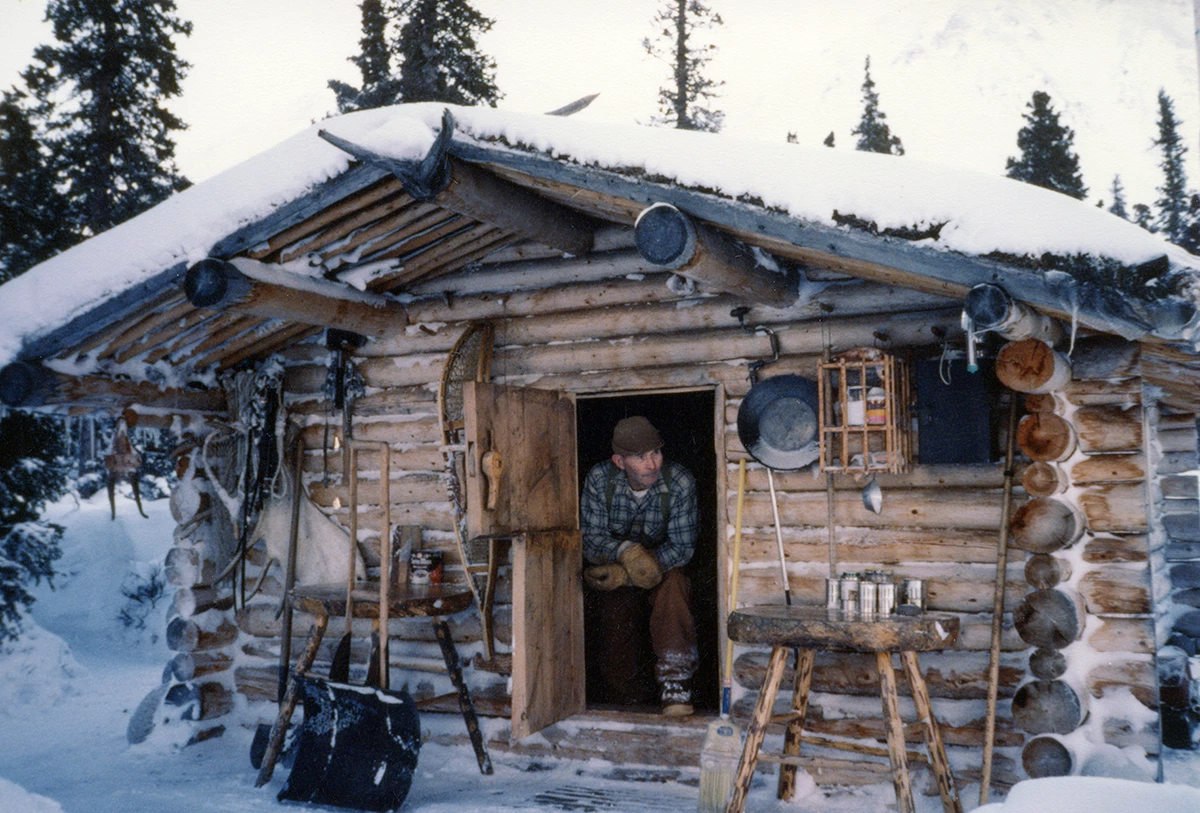
NPS photo taken by Richard Proenneke and donated by Raymond Proenneke
Richard Proenneke built his cabin during the summers of 1967 and 1968 using mostly local materials and simple hand held tools. For many of these, he brought in steel parts and made the handles with local wood. When tools broke, he chose to repair them, rather than to buy new replacements. While his cabin is neither the first nor the largest ever built in the Alaskan Bush, it does stand out for his remarkable craftsmanship in building it, and the fact that he filmed the entire construction process.

NPS Photo / Molissa Udevitz Cabin The cabin is a roughly 12-foot by 16-foot structure built of peeled, round spruce logs, carefully saddle notched at the corners. It has a gable roof made of spruce poles, covered by sod and moss.There are three windows. One on the west side, 23 inches by 14 inches, is a single thin plastic panel. The other western window, also thin plastic, is the largest in the cabin, measuring 26-inches by 30-inches. Along the east wall is a 26-inch by 15-inch window. The handmade Dutch door includes beautifully worked wooden hinges and a wooden lock. A beach stone fireplace rises from the south wall. Proenneke had originally covered his cabin and woodshed-outhouse with moss that he obtained within 25 yards of his site. However, moss requires a great deal of moisture to sustain itself on a roof and the relatively dry Twin Lakes environment was not conducive to that. Over thirty years Proenneke added more moss, dirt, and grass seed to his roof resulting in a thin amalgamated mat of all three components. In keeping with his wilderness values, Proenneke lived in this cabin for 30 years without electricity, running water, a telephone, or other modern conveniences. 
NPS Photo/ Kevyn Jalone Cache The log cache, or raised storage shed, is located eleven feet south of the cabin. It is 6-feet by 4-feet, built of peeled locally harvested spruce logs that are saddle notched. The cache sits on 9-foot poles. Proenneke accessed the cache with a ladder he hand crafted using local materials. Traditional Athabascan caches in the region sit on much shorter poles, but they are typically located in busy villages where the activity of people and dogs help to keep wildlife away. Knowing that he would be alone in the wilderness, Proenneke chose to build his cache on taller poles to help decrease the odds of a bear breaking in. The tin wrapped around the poles is designed to prevent smaller rodents from climbing all the way to the top. 
NPS Photo Woodshed / Outhouse Proenneke located his combined woodshed/outhouse approximately 45 feet east of the cabin. It is made of peeled locally harvested spruce poles, saddle notched at the south end and nailed to corner posts at the north end. The structure is modeled along the lines of an Adirondack shelter, with a slanting shed roof. Proenneke stored many of his tools, along with the wood pile he never let dwindle too low, in this shed. The eastern third of the shed contains a 33-inch wide outhouse complete with a half-moon carved through the door. 
NPS Photo / Kent Miller National Register of Historic Places The cabin and outbuildings were listed on the National Register of Historic Places in 2007. The site is recognized nationally for its stature as an excellent and well-known example of an Alaskan bush log cabin. It is also recognized for Richard Proenneke's voice in the preservation of wilderness in Alaska. Proenneke's interests, talents, and circumstances made him influential in shaping and educating the public about the wisdom of conservation of our natural world. 
Explore Lake Clark's Museum Collection
View Lake Clark's entire online museum collections which includes some of Richard Proenneke's belongings. 
Proenneke's Wilderness Ethos
From hunter to conservationist - explore the evolution of Richard L. Proenneke's wilderness ethos. 
Richard Proenneke Site Photos
View images of the Richard Proenneke Site and the immediate surrounding area. 
Proenneke: the Man, the Myth, the Legend
The source of Sam Keith's book "One Man's Wilderness: An Alaskan Odyssey," Proenneke embodies humanity's fascination with wilderness. 
Visit Richard Proenneke's Cabin
Plan your trip to the home of one of Alaska's foremost wilderness icons. 
Virtual Tour of Upper Twin Lake
View images of Proenneke's cabin and of the beautiful Twin Lakes area where he built his wilderness home. |
 |
|
|
Last updated: December 19, 2018