



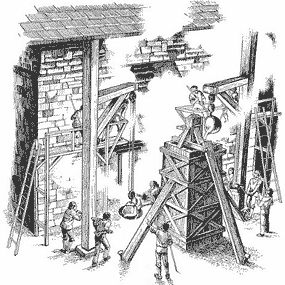
NPS Illustration In 1771 Hopewell Furnace went into blast for the first time. By that same year America was well on the way to revolution. America's iron industry was then producing some 15% of the world's supply of iron, more than was being smelted in Great Britain. Among the leaders of the revolutionary movements, which would result in independence, were her ironmasters, including Mark Bird. By 1775 he had served on numerous committees and other bodies preparing for war with England. His role was enhanced through such in-laws as James Wilson, George Ross (ironmaster of the Mary Ann Furnace) and George Read, all future signers of the Declaration of Independence. Once fighting began, Mark Bird served as both Militia Colonel and as a Deputy Quartermaster General. As the latter, he helped obtain badly needed supplies for George Washington's forces both before and during their stay at Valley Forge. However, his most important contribution to the war effort was as owner and ironmaster of Hopewell Furnace. From 1775 to early 1778 (when France entered the war against Great Britain) the Americans had to look primarily to furnaces like Hopewell for iron cannon, shot and shell. Yet none of these sites had ever before cast ordnance. In spite of the difficulties of "learning by doing," the iron industry met the challenge. Hopewell alone produced 115 cannon for the Continental Navy, some of which were used aboard the frigate Randolph and gunboat Delaware. Even more importantly, Hopewell provided shot and shell to the Continental Army and Navy throughout the war, including 10-inch mortar shells used to help win the final major battle at Yorktown, Virginia. 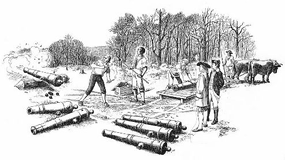
NPS Illustration At the end of the summer of 1777, a British army invaded Pennsylvania from the upper Chesapeake Bay. On September 11, 1777, these British troops defeated but did not destroy Washington's army at the Battle of Brandywine. The British commander then played upon Washington's fear for the munitions producing furnaces of Warwick, Reading and Hopewell by moving his forces through what are now Chester and Montgomery counties so as to threaten the furnaces as well as the supply depot in Reading. Outmaneuvering the Continentals, the British were able to take Philadelphia by the end of the month without having to fight another major battle. During this time Washington's main force came within three miles of Hopewell. Troopers of the 4th Continental Dragoons visited the furnaces along French Creek to prevent munitions from falling into British hands. Among those serving in this unit was Captain Craig, future husband of Mark Bird's oldest daughter, Charlotte. It was also during this time, according to tradition, that Hopewell workers buried several "great guns" near the furnace to save them from possible capture by the Redcoats. In the end, however, Hopewell was spared any visit by the King's troops. By early 1783 the war was over, but victory was to have a heavy price for Hopewell Furnace. Mark Bird was unable to collect money due him from the now bankrupt Continental Congress. In spite of this, like a number of other ironmasters, Mark Bird borrowed heavily to invest in new iron making ventures. When the resurgent British iron industry flooded the unprotected American market with inexpensive goods, Bird and his partners lost everything. Thus, confidence in the new nation's future led to the ruin of many of those responsible for its independence.
|
Last updated: February 16, 2025