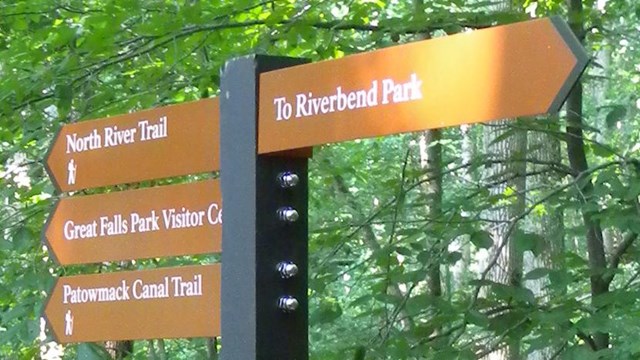
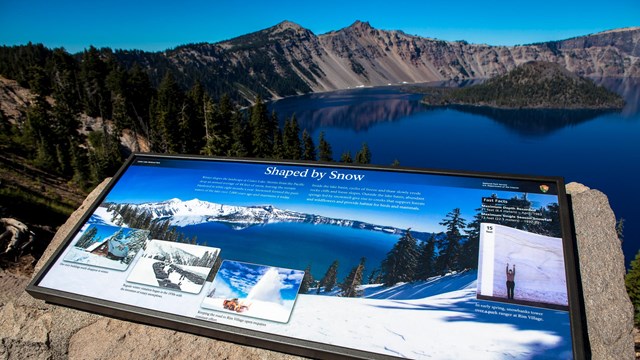
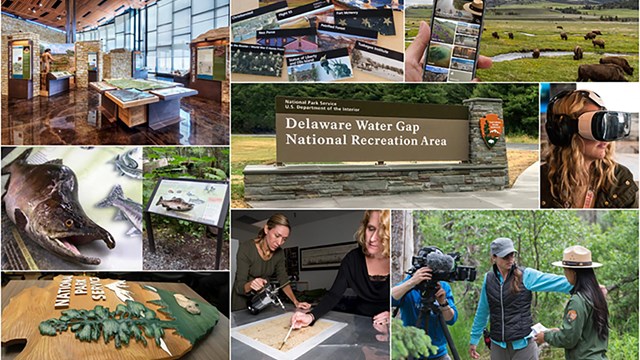
Wayside exhibit at Lawnfield, home of President
Garfield at James A. Garfield National Historic Site, Ohio.
Wayside exhibit at George Washington Birthplace
National Monument, Virginia.
|
|
About the Program
The Wayside Technical Assistance/Rehab Program focuses on small wayside
projects for which parks
have available funds and well-developed content, typically draft
text and graphics. The goal of the program is to speed the delivery
of wayside exhibits while ensuring that NPS editorial, design, and
production standards are maintained.
2009 Schedule for Submission
The deadlines for submission of the application form and accompanying resource packages are as follows, depending on your wayside exhibit submission request:
- January 2, 2009 - for all wayside projects that include new map development.
- January 15, 2009 - for all wayside projects that require planning, design, and fabrication within the same fiscal year.
- June 1, 2009 - for wayside projects that require only planning/design or fabrication only.
Note: Parks that require original art will need a two-year cycle for completion: one year for art development and the second year for wayside design and fabrication.
Digital Images
Over the past few years, parks have been submitting digital images
in their resource packages. In many instances, however, these images
cannot be enlarged adequately for use on the waysides and can affect
acceptance into the program. Therefore here are some guidelines
to follow:
Taking digital photographs: When taking photographs
digitally it is important to use a camera that will give the best
results. Below is a list features to look for when purchasing a
new camera or using your existing model.
- 6.3MP (megapixel) or above, minimum requirement.
- Images should be captured in raw format (maximum
jpg or tiff if raw is not available).
- Digital SLR (changeable lenses) recommended (see list of digital
cameras below).
The cameras below all fill the requirements listed above. They
range in price from $800 - $8,000.
- Canon Digital Rebel, 10D, 20D, 1D, 1Ds
- Nikon D70, D100
- Kodak DCS Pro SLR/c, DCS Pro SLR/n, DCS Pro 14n
Scanning your own photograph, artwork or other graphics:
If you are sending a scanned image of an original graphic (slide,
transparency, negative or photograph) then it must be scanned to
the final size it will appear on the wayside panel. Since, typically,
that decision has not been made yet, the image should be scanned
as if it were going to be 36” (final size) on the panel at
200dpi. For example, a 35mm slide should be scanned at an optical
resolution of 2618% at 200dpi (no interpolation).
Most desktop scanners do not have the capabilities to capture that
much data, which is why when possible we recommend the original
slide or print be sent to HFC for scanning.
For more detailed information, see Standards for Digital Image Files (December 2006 - PDF).
Who to Contact
If you are interested in acquiring wayside exhibits through the
program, first review Park Responsibilities
and Selection Criteria below. If you feel that the program is appropriate
for your project or you need more information, please contact program
manager Susan Haines (phone: 304-535-6033; email:
Susan_Haines@nps.gov). Susan can help you initiate the project, secure a cost estimate,
and guide you to its completion.
How to Apply
After discussing your project with the program manager, submit
a Wayside
Technical Assistance/Rehab Application (PDF)
and an HFC
Direct Charge Authorization Form (PDF),
along with your resource package (text, graphics, sketch and site
location photo). The resource package is described in the Park Responsibilities
section below.
Once the application form and resource packages have been submitted and reviewed, you
will be contacted to discuss the project’s details.
HFC Assistance
Combining a park’s subject expertise, Harpers Ferry Center’s
experience in wayside editing and design contracting, and the vendor’s
technical capabilities helps to ensure that the exhibits produced
are consistent with a park’s needs and with NPS Graphic Identity
Program standards. Learn more about the
NPS Graphic Identity Program »
Park Responsibilities
The Technical Assistance Program requires that a park be willing
to make a significant investment of time and effort in planning
its exhibits. As the subject matter expert, the park is responsible
for preparing draft text for each wayside, acquiring support graphics,
preparing maps (HFC can supply suggestions for map contractors),
and sketching a rough layout that reflects the exhibit’s interpretive
intent. These items (text, graphics, maps, rough layouts, and a
photo of each wayside site location) constitute the resource packages
from which the exhibits are developed. A sample resource package
is available on request. Please note: If original art is needed,
a two-year cycle is required to review the complexity of the project.
(See Schedule for Submission section above for more details.)
See our online Technical Assistance Case Studies for Zion
National Park Overlook Exhibit and Zion
National Park Trailhead Exhibit.
Selection Criteria
Several factors will be considered when determining if a project
is suitable for the Technical Assistance Program.
- All proposed exhibits should be consistent with the park’s
overall wayside exhibit goals. If a parkwide wayside exhibit proposal
(an approved list of wayside exhibit subjects, locations, and purposes)
does not exist, you will be encouraged to develop one before acquiring
exhibits that may not be appropriate to long-term interpretive goals.
- Resource packages for each exhibit should be complete at the time
of submission. Digital images must meet Standards for Digital Image Files (December 2006 - PDF).
- Submissions should be limited to no more than six exhibits.
The intent of the program is to provide a rapid response on projects
of limited size. Larger projects are better accomplished through
traditional planning and design procedures and by contacting Harpers Ferry Center. Contact Us »
- Project funding must be secured by the park. A completed HFC Direct
Charge Authorization Form must be on file. In addition to
funding fabrication costs, parks are responsible for editorial and design service costs. Cost estimates for these services will be developed by HFC and provided to the park for use on the HFC Direct Charge Authorization Form (PDF).
- Projects that require the creation of original art and/or maps
will be reviewed for their complexity and appropriateness.
Advantages of the Program
The Technical Assistance/Rehab Program has several advantages over trying
to secure wayside exhibits on your own:
- HFC will COR editorial and design services through an approved IDIQ wayside exhibit contractor.
- Each wayside exhibit is designed to meet NPS message project
standards.
- HFC will conduct quality assurance reviews to ensure NPS identity standards for design are met and HFC style and editorial standards are satisfied.
- Each HFC IDIQ wayside exhibit contractor has been carefully selected and trained to provide
products consistent with the quality required by the National
Park Service.
- The use of HFC IDIQ wayside exhibit contractors eliminates the need for parks to write
technical specifications and work descriptions, or to conduct
competitive procurements.
- Wayside exhibits produced under the program carry the same manufacturers’
warranties that were negotiated to cover other waysides that the
center produces—warranties that protect the park from manufacturing
defects or from premature product failure.
- Production files for wayside exhibits produced through the
program can be stored and maintained by HFC’s wayside exhibit
archives. These files can be retrieved when parks need replacement panels.
|
|
TABLE OF CONTENTS:
Wayside Exhibits »
CASE STUDIES:
Zion National Park Overlook
Exhibit »
Zion National Park Trailhead
Exhibit »
RELATED LINKS:
NPS Graphic Identity Program »
PDF DOCUMENTS:
Wayside
Technical Assistance/Rehab Application »
HFC
Direct Charge Authorization Form »
Standards for Digital Image Files »
Help With PDF »
|