"I’ve been 40 years
discovering that the queen of all colors is black."
—Auguste Renoir
"You can’t break the rules until you
know how to play the game."
—Ricky Lee Jones, Danny’s All-Star
Joint |
|
Design
A grid is the backbone of the system. It helps organize the placement
of text and illustrations in a consistent manner so there is no
need to redesign basic components for every new job. This frees
the park staff to concentrate on subject matter.
Site bulletins should not look like a book, or a magazine, or be
confused with the park newspaper or the full color park brochure.
Information is organized vertically in columns, with major subjects
divided into sections that run across the sheet. This simple horizontal
structure helps the reader access information with a minimum of
time and effort. Three graphic devices help define the horizontal
arrangement: the black title band at the top, the 3-point divider
bars, and the main titles with their distinctive bold typeface.
Because the text is lighter in tone than the black horizontal elements,
a sharp division occurs between titles and text, a contrast that
makes it easier for readers to find and use information. This approach
also simplifies the layout process.
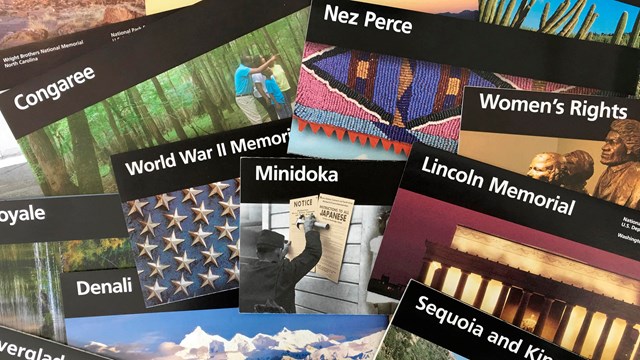
The system is designed to be printed on white paper with black
ink. This creates a highly readable publication that reinforces
its identification with the National Park Service graphic system.
The black appears more dense and rich, it offers a distinguished,
straightforward, no nonsense look, and it offers the greatest visual
contrast. Use of colored paper or colored ink reduces legibility
of the text and the impact of the piece and is not recommended.
Full color can be used but is usually prohibitively expensive. Spot
color can be effectively used to enhance maps and illustrations.
The appearance of the entire unfolded page, as well as the cover
presentation when folded, should be considered during the basic
design. The system also makes use of white space to open up the
appearance of the entire page, making it more appealing to readers.
Avoid the temptation to fill all available space. A rule of thumb
is: one-third text, one-third art or photos, and one-third white
space.
The simplicity and effectiveness of the system are based on these
design elements. Therefore, to maintain consistency, it should be
used as designed. While the system makes some basic design decisions,
most are left to the creativity of the park staff. However, the
system needs to be learned and practiced before breaking the rules.
See "The Creative Process" (Information
Design, p. 1).
The general ideas to keep in mind when designing with this system
are:
- Let the system make as many design decisions for you as possible.
- Use the grid as a tool to help you with the rest.
- Strive for horizontal arrangement.
- Keep it simple and open.
- Eliminate the unessential.
|
|
TABLE OF CONTENTS:
Publications »
PARK-PRODUCED PUBLICATIONS:
1 Introduction »
2 Using a Design System »
3 Getting Started »
4 Design
5 The Grid »
6 Typography »
7 Choosing & Using Illustrations »
8 Maps »
9 Production »
10 Printing »
11 Care & Upkeep »
12 Using the Templates »
13 Bibliography »
PDF DOCUMENTS:
Information
Design, Tools & Techniques for Park-Produced Publications »
Help With PDF »
|