Harpers Ferry Center staff reviews a new park
brochure. |
|
The description of the production process that follows
is necessarily simplified:
Scheduling: After the park and Harpers Ferry Center
agree to produce a new brochure, the project is normally added to
HFC’s program for the following fiscal year. The project is
typically slated for planning and research during the first year
and production and printing in the next year. A handbook takes an
average of two years to produce. Because of the widely varying degrees
of complexity and scope of the projects, any one brochure or handbook
may take less time—or it may take longer. We are trying to
compress the two-year brochure process into a 12- to 18-month schedule.
Where commissioned artwork is involved, a job becomes more complicated
and is difficult to complete in a short time period.
Planning: The first thing the park does is to
fill out our “Background Report for a New Park Publication.”
Here the park identifies for us critical elements such as audience,
themes, mapping needs, illustrations, etc. We use the report to
see what the park thinks and as a preliminary outline in planning
the project. The editor at this point will also request relevant
research materials from the park. The HFC team members begin researching
the subject and discussing various ways of approaching it. We work
closely with you to determine the intent, thematic content, and
level of visitor-use information for the publication. We also ask
you about potential artwork and photography sources to support those
elements. Background Report for a New Park
Publication »
Visiting the park: Sometimes, rather than relying
on mail, e-mail, and telephone to plan the brochure, the HFC team
will schedule a trip to the park, at your convenience, to work through
the design stage of the project. This reduces the time involved
in a project and allows the park staff to get actively involved
at an earlier stage. This also allows us to familiarize ourselves
with the site—see it from the visitor’s point of view—and
consult with the park staff. Often the editor will already have
a broad outline that will serve as a starting point for the conversation.
The visit usually occurs when decisions have been made about such
things as the focus of the publication and the level of technical
explanation required, the brochure size, mapping, photography subjects,
and whether or not original art will be needed. Frequently the map
size will influence the size of the brochure. The larger-sized brochures
are more expensive to produce, and paper costs are higher.
This is the opportunity for the Harpers Ferry Center team to gather
any additional resources—map materials, reproducible prints,
contemporary photographs, reference materials, etc.—needed
for the project. On occasion the designer will bring along a laptop
computer and produce a preliminary design on the spot, while the
editor produces a first draft of the text. More typically, the team
returns to Harpers Ferry Center, where the designer comes up with
a proposed design and the editor produces the draft text.
Designing the brochure: The project designer creates
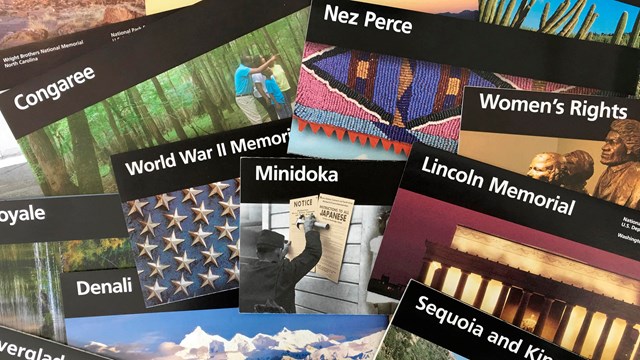
a design proposal based on the unigrid system. (See the brochures
section for a discussion of the unigrid system.) Some pictures may
already be available for placing in the design; other graphic elements
will be represented by blank windows or substitute pictures. The
subjects of all the text and graphic sections are specified. Sometimes
we can include a draft text at this stage. Picture captions will
have to await the final selection, but they, too, will be submitted
for park review. Brochures »
Park approval of design: All these elements go
into the design proposal, which we send as a printout for your evaluation
at least twice during the course of the project. Sometimes to speed
up the review process we send you a digital file of the design by
e-mail. This is furnished as an Acrobat PDF file. We find that in
some cases it is best to present the proposed design personally,
either with a trip by HFC team members to the park or by park staff
to HFC. The park reviews the proposed design and responds with a
memo from the park superintendent to the HFC Associate Manager for
Media Development, either approving the design or requesting further
discussion.
Pulling it all together: Upon approval of the
design, all team members can move ahead in their areas: The editor
begins writing the final text and gathering historic pictures and
photos. If the existing contemporary photos of the park are poor
or not available, we commission a photographer to provide new photos.
If there is to be an original illustration, the designer commissions
an illustrator to create it. The illustration contract specifies
stages for completion of the artwork. A typical sequence is: preliminary
sketch, finished sketch with color sample, and final color rendering.
The cartographer begins creating the map(s), keeping in close contact
with the park as questions arise.
Park approval of text: We send the design to the
park with the text in place. At this stage some pictures may be
placed in the design. The map proof, illustration sketches, and
photographs may also be in place. If not, they will be sent separately
for the park’s review or incorporated in the final review
printout.
Park approval of graphic elements: Illustration
sketches and final renderings are sent to park for review as they
are completed. Map proofs may also be sent.
Final park approval: A final printout with all
elements in place is sent to the park for formal approval to print.
Printing: The job is sent to the printer for printing.
Printing takes on average three months for delivery to the park.
|
|
TABLE OF CONTENTS:
Publications »
IN DEPTH:
Brochures »
Background Report for a New Park Publication »
|