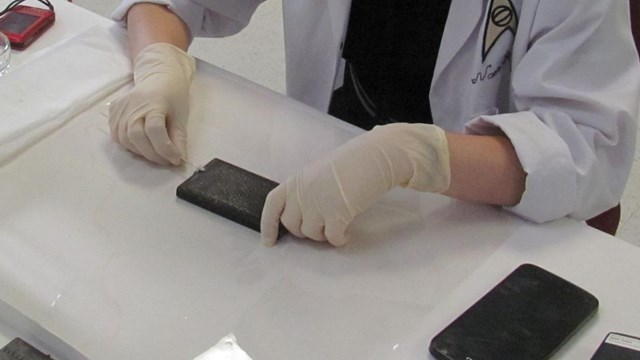
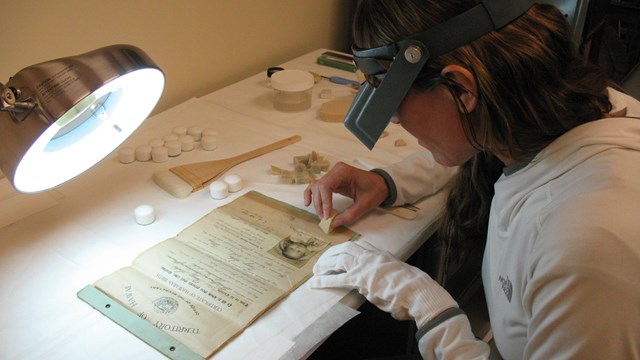
Textile lab intern assists conservation staff with
project work.
Textile lab intern operates dye machine to color
match repair fabrics to objects.
Summer intern presents a summary of her work to
conservation staff. |
|
The National Park Service manages important cultural,
natural and recreational resources. Harpers Ferry functions as a
central conservation resource for the museum collections in the
National Park Service and offers training opportunities in artifact
conservation. HFC staff provide a wide range of technical services
and expertise necessary for long-term preservation of NPS collections.
These diverse collections range from fine art to ethnographic materials
to mineral and archaeological collections and archives. Our treatment
of artifacts for exhibition in the parks includes technical examination
and scientific analyses. Collections reside at park sites and the
conservators advise park and administrative staffs on issues of
collections care and exhibition requirements and also perform systematic
collection assessments. Harpers Ferry Center helps coordinate park
exhibit design and production, artifact conservation, and interpretive
media needs. HFC has the facilities and expertise to implement a
range of interpretive projects for national parks.
Staff and Facilities
The Artifact Conservation group is located in Charles Town, West Virginia,
five miles west of Harpers Ferry. Eight specialized laboratories
are equipped to study and identify materials by means of optical
microscopy, microchemical analysis, and Fourier-transform infrared
spectroscopy. A technical library supplements the large historical
research library at Harpers Ferry Center.
Archaeology Laboratory
Most of the artifacts treated in this lab are metal. Along with
Civil War buttons and buckles, more unusual items treated have included
Spanish coins from a 16th-century shipwreck off Padre Island, and
2,000-year-old copper artifacts from the Hopewell culture at Mound
City. Some organic materials, but few ceramics, are treated.
Decorative Art Objects Laboratory
This laboratory treats decorative arts and historic objects including
glass, ceramics, stone, metal, and ivory as well as composites including
gilded pieces. The lab has treated rare firearms, porcelains which
belonged to Robert E. Lee, and Bartholdi’s original plaster
model of the Statue of Liberty.
Ethnographic Laboratory
More than 28,000 Native American ethnographic objects are located
in park collections. Among the items treated in this lab have been
personal effects from historic personages, such as the ceremonial
shirt of Chief Red Cloud.
Paper Laboratory
The millions of paper artifacts in the National Park Service collections
include artwork, manuscripts, maps, photographs, and books. Many
of these remain in the context of their original historic home or
building.
Scientific Research & Analytical Support Laboratory
Research and analysis on National Park Service artifacts is performed
using such methods as optical microscopy and microchemical testing,
colorimetry, thin-layer chromotography, Fourier-transform infrared
spectroscopy, metallography, and paint cross-section analysis. The
technical information gained from these analyses support interpretive
programs in the parks.
Textile Laboratory
Diversity characterizes the textiles treated by this lab. Noteworthy
pieces have included a signed and dated 1858 silk patchwork quilt,
the banner carried along Pennsylvania Avenue at the head of a group
of 5,000 women demanding suffrage, and important embroidered samplers.
Wooden Artifacts Laboratory
Wooden artifacts as varied as a high-styled Chippendale secretary
or a 55-foot-tall totem pole treated in situ in Alaska reflect the
range of objects conserved here. Furniture from the homes of numerous
prominent Americans, including Presidents Lincoln, Garfield, Roosevelt
and Truman, are among the objects treated.
Internship and Training Opportunities
The Artifact Conservation group at Harpers Ferry Center offers three
types of training opportunities: third and fourth year graduate
internships and summer work projects. Laboratory supervisors, who
make the decision to accept students, seek to match the needs of
the students with those of the laboratory and its work load.
Third and Fourth Year Conservation Graduate Internships
Students are assigned to a specific laboratory and participate
in the ongoing work of Harpers Ferry Center, including the exhibit
process, artifact treatments, systematic surveys, and lab administration.
HFC follows general internship guidelines of the graduate programs.
Initial inquiries are made by the graduate advisor. Students should
submit a letter of interest accompanied by a curriculum vitae in
the Fall of the year preceding the internship. Personal interviews
are scheduled and completed by February 15, with notification of
selection by March 15.
Summer Work Projects
Eight-week summer work projects are available for second year conservation
interns. These projects can include collection re-housing and survey
work at a park or artifact treatment under the close supervision
of the conservator. Laboratory supervisors develop projects designed
to meet the specific needs and interests of the student.
Applications
Interested persons can apply by letter expressing area of interest
accompanied by a curriculum vitae. Make requests for additional
information regarding these conservation training opportunities
by contacting John Brucksch (address: Harpers Ferry
Center, Media Assets, P.O. Box 50, Harpers Ferry, WV 25425-0050;
phone 304-535-6142; email: John_Brucksch@nps.gov).
Harpers Ferry Region
The historic Harpers Ferry region of West Virginia is located approximately
65 miles northwest of Washington, D.C. Commuter trains run regularly
from several towns in the area to downtown Washington. Charles Town,
where the Division is located, is a growing community, centrally
located for services and shopping. The area offers a reasonable
cost of living and affordable housing. Directions
to Harpers Ferry Center »
|
|
TABLE OF CONTENTS:
Artifact Conservation »
RELATED LINKS:
Directions to Harpers Ferry
Center »
Frequently Asked Questions »
|