Above:
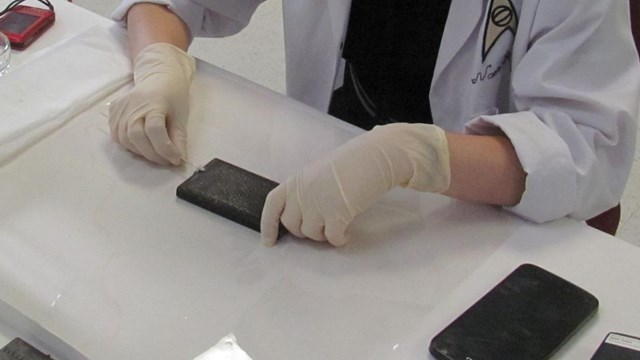
Conservation of the "Chief Shakes" pole, performed as
part of the Carved Pole Preservation course produced by Al Levitan,
Wooden Artifacts lab, in partnership with the Wrangell Museum, Wrangell,
Alaska. NPS conservators taught preservation skills to native carvers
and museum staff from the U.S. and Canada.
Right:
HFC conservator discusses collections management with visitors from the National
Parks of Chile. |
|

Artifact Treatment
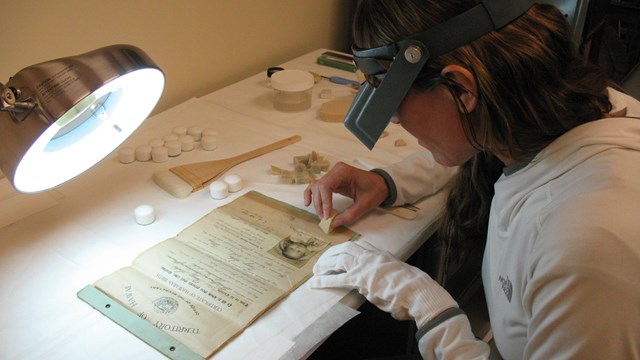
A wide range of artifact treatments takes place in our conservation
laboratories. The conservators will also travel to park sites for
some treatment projects. Our Conservation
Facilities section describes our seven treatment laboratories.
Our Conservation Treatments section
provides examples of the variety and scope of our work.
Technical Assistance
Staff is available to join a collection management team and help
a park create a Collection Management Plan. The conservators also
perform Collection Condition Surveys documenting the condition and
treatment needs of individual objects in park collections. The resulting
report will help to prioritize treatments, make recommendations
to improve long term preservation of collections, and develop cost
estimates for budget documents.
Preventive conservation seeks to retard or prevent serious deterioration
of collections caused by inadequate storage or display techniques,
improper environmental conditions, or poor handling. An emphasis
on preventive care will minimize the need for conservation treatment.
Staff can provide information, assistance and direct park staff
to additional resources on all aspects of a preventive conservation
program. We can help you:
- Know the causes of object deterioration
- Recognize active deterioration
- Monitor and control the collection environment
- Initiate an Integrated Pest Management Program (IPM)
- Provide guidance on artifact handling, storage, and display
- Develop housekeeping or preventive care plans
Integrated Pest Management (IPM) assistance is provided by our
IPM coordinator. Help is available to establish an IPM program at
your site or if you want to use a database to track your existing
program. For more information, go to our Frequently
Asked Questions »
Disaster and emergency response planning, advice, and information
is available. Our staff recently responded to disaster situations
caused by Hurricane Isabel at Cape Lookout National Seashore and
flooding conditions at Jamestown National Historical Site. Their
on-site expertise significantly helped to recover collections. We
can also help park staff identify hazards, assess risk, and develop
response measures.
Training Opportunities
The conservation staff regularly conducts courses and workshops
in the curatorial care of museum collections. These training sessions
are held at Harpers Ferry Center or in field locations. Training
is available on any of the topics covered in the Museum Handbook,
Part 1. The experience can also be tailored to the specific needs
and issues of a park site.
Our class methods promote an appropriate and practical preservation
approach to museum collections, whether in storage or on exhibit.
The sessions use hands-on and problem-based learning to achieve
course objectives.
See our course description for Training
Topics in Artifact Preservation (PDF)
For information on how to schedule or develop a training activity
at your site, contact us (telephone: 304-535-6139; email: HFC_Conservation@nps.gov).
Internships
Internships are also offered to conservation students at the graduate
level. Graduate students entering the field of conservation come
to HFC to work in a laboratory for either a summer or a full year.
These internships are offered to students in recognized training
programs and are organized through a cooperative agreement with
their graduate school. Year-long advanced internships are also available
to graduates. Students can also be sent to park sites during a summer
internship for re-housing projects.
Learn more about our Training Opportunities
for Conservators »
Technical Studies & Research
Our conservators have a wide range of experience, interests, expertise
and contacts. In tandem with an expanding conservation science program,
analytical support services are available. These services provide
information about artifacts that enhance their presentation and
interpretation. Current capabilities include:
- Optical microscopy/photomicrography for fiber identification
- Wood analysis
- FTIR (Fourier transform infrared spectroscopy)
- Radiographic analysis
- Paint cross-section analysis
Exhibit Conservation
Exhibit Conservation is the preservation specialty that focuses
on practical techniques that protect museum collections while on
display. It includes information necessary for exhibit specialists
to ensure a preservation-responsible approach to planning and design.
Learn more about Exhibit Conservation »
|
|
TABLE OF CONTENTS:
Artifact Conservation »
IN DEPTH:
Training Opportunities for Conservators »
RELATED LINKS:
Conservation Facilities »
Conservation Treatments »
Exhibit Conservation »
Frequently Asked Questions »
PDF DOCUMENTS:
Training
Topics in Artifact Preservation »
Help With PDF »
|