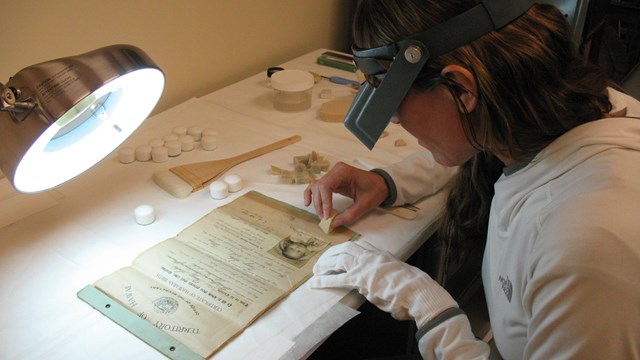
FTIR analysis of unknown furniture finish in the
Scientific Research & Analytical Support Laboratory. |
|
What types of analysis are you currently capable
of doing in-house?
We are currently set up to perform Fourier transform infrared (FTIR)
spectroscopic analysis on organic materials. We have available a
research grade polarized light microscope for identification of
pigments and minerals.
What kinds of information can I get from FTIR analysis?
FTIR can aid in the identification of both organic and inorganic
materials. Organic materials include such things as coatings, adhesives,
dyes, paint binders, natural resins, oils, waxes, fibers, and synthetic
and natural polymers. Inorganic materials such as pigments, fillers,
minerals, corrosion products, and salt efflorescence can also be
identified.
Will there be any other types of analyses available at a later
date?
Yes. The following methods of analysis will be available within
a year:
- Paint cross-section analysis
- Metallographic analysis
- Thin-section petrography
- Thin-layer chromatography
- Microchemical spot testing and identification
- Color measurement
- Ultraviolet fluorescence microscopy for fluorochromic staining
analysis
Where can I have analyses such as scanning electron microscopy-energy
dispersive X-ray analysis (SEM/EDAX), gas chromatography, atomic
absorption, inductively coupled plasma spectroscopy or other such
“high-tech” tests done?
We are hoping to make available results from some of these types
of analyses by partnerships with local government agencies, academic
institutions, and private institutions.
Are there any analyses you perform which can be done without removing
a sample from the object in question?
Unfortunately, there are a limited number of analytical methods
which are capable of performing what we call “non-destructive,
non-invasive” analysis. These methods are often prohibitively
costly. For example, X-ray fluorescence analysis is extremely useful
in identifying the elemental composition of a huge array of materials
including paint pigments, metals and alloys, glazes, and photographic
image metals. The only methods available are microscopic examination,
which is generally performed by one of the Division’s conservators,
and surface color measurements.
How much sample do I need for an analysis and what form should
that sample take?
The amount of sample needed for a particular analysis depends upon
the analytical method used and the sample handling requirements
of that method. It is best to consult with the scientist in making
decisions regarding removal of samples for analysis. Decisions such
as whether or not to remove a sample, and, if a sample can be removed,
how much and what type of sample is required are best made in collaboration
with the scientist. There are times when it is inadvisable to remove
any sample at all. Such ethical decisions require dialog between
the client, conservator, and scientist prior to sampling of an object.
Once a decision has been made to remove a sample for analysis,
how should the sample be handled?
The best sample holders are the relatively inert materials such
as glass vials, microscope slides with wells (covered with a coverslip
or a flat microscope slide), or aluminum foil. Containers that should
be avoided if possible are: plastic vials, gelatin capsules, ziploc
bags, parafilm-covered containers or other plastic film materials.
It is always best to ask the scientist what would be the most appropriate
sample handling/mailing technique.
Why does one have to be so particular about the type of container
used for mailing and/or storage?
Materials such as glass and aluminum foil do not leave any residues
that could possibly contaminate the sample and become evident during
analysis. Gelatin capsules can leave protein residues, which could
complicate an infrared analysis or a binding medium analysis. Many
plastics such as vials, ziploc bags, and parafilm covers may contain
plasticizers that can penetrate into the sample and confuse the
analytical results. If in doubt as to the suitability of your available
sample containers, you can consult the scientist to make the appropriate
choice for mailing or storing your sample.
What kinds of information does the scientist need before analysis
is performed?
The more information that can be provided about an object the better.
Information such as prior treatments (materials used, etc.), storage
and exhibition conditions or other handling history can afford useful
information about possible materials identification. Any information
about possible components is also helpful. For example, you have
a textile thought to have been traded to the US by Peru and you
are interested in the red dye used on this textile. This information
can help narrow the possibility of materials to look for in an analysis.
What if no information is available?
This is occasionally the case. When no information is available,
the analysis can become quite time-consuming and costly, or, at
worst, little or no information will result from that analysis.
Therefore, it is very important to provide as much information as
possible prior to requesting an analysis.
How quickly can I have the results?
Different methods take different amounts of time. It takes longer
to obtain results when little or no prior information about the
object or sample is available. If a sample preparation method is
complicated, then it will take longer to obtain the results. For
example, if you request paint cross-section analysis including photomicrography
of that sample, the results can take up to a month. How you would
like the results reported can affect the length of time it takes
to get the results. A quick verbal report over the phone is; of
course, much quicker than if a formal report is required. |
|
TABLE OF CONTENTS:
Artifact Conservation »
|