Small portion of Horn Island, Mississippi, closed to entry due to discovery of asbestos and possible other bio hazards. Click on more for map and press release.
More »
Park Closures
Restrooms, and Visitor Center closures due to the impact of Seqestration.
More »
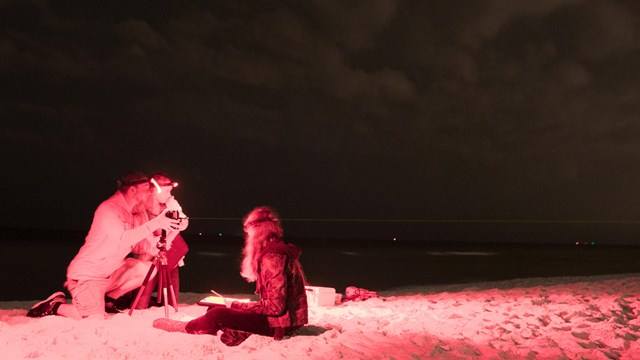
In the aftermath of the Deepwater Horizon Oil Spill in the summer of 2010, more than 700 sea turtle nests along the gulf coast are being carefully excavated and relocated across the Florida peninsula to be hatched and released in the Atlantic. Watch and listen as biologists at Gulf Islands National Seashore describe and demonstrate their participation in this massive environmental undertaking.
“Helping Sea Turtles Through an Oil Spill” Running Time 03:37 (Producer and Videographer: Jay Elhard, Denali National Park and Preserve, Alaska)
Speakers: Monica Hardin, Biological Science Technician Mark Nicholas, Biologist Both of Gulf Islands National Seashore, Florida district
HARDIN: “We try to start right at first daylight. Not necessarily, we don’t wait until the sun comes up. But we do want to be able to see without lights on the beach whenever we start. “We ride on the beach early in the morning to look for turtle tracks to see if any turtles came up and nested last night. “Sometimes the turtles, for whatever reason, will lay very, very close to the water, sometimes even below the high tide line. And in those cases we will actually relocate the nest to a dune area. “We don’t like to relocate. We try not to. But when the turtles basically nest almost in the water, they won’t survive.”
NICHOLAS: “There is some pressure to move nests in that we know our beaches are going to flood from time to time. And our beaches are so low because we’ve take so many hurricane hits over the last several years that the island is almost just like a sand bar. So we know if we get any type of tropical system coming, we’re going to lose nests. So if a nest is laid very close to the water, we go ahead and move it to a higher area. “Since there are so few nesting females in the area, each nest is just that much more important. So we try to follow every nest, from the time it’s laid until the time it’s hatched, and get all of the hatchlings into the gulf. “Basically with all of the oil that’s out in the Gulf of Mexico, we’re pretty certain putting them out there is not a good idea. “Every nest in northwest Florida and Alabama, they are all going to be pulled out of the ground at around day fifty, put into those coolers, and transported to the east coast. “Over by Cape Canaveral and Merritt Island there’s a facility over there that’s going to hold them until they hatch, and then they’ll release them on the east coast. “It’s a pretty big undertaking, because the total I think is supposed to be somewhere around seven hundred nests that will be moved. “The thought is that by leaving them until day fifty it reduces the chance of mortality on the embryos as you’re moving them. But it also allows them to imprint, if they are imprinting while in the egg, it’s giving them more time to imprint on this area. With the hopes that, if they’re released in the Atlantic, they’ll actually still – if they’re female – twenty to thirty years from now they’ll hopefully come back to this area to nest on these beaches again.”
HARDIN: “Turtles have been in serious decline over the p ast several years. With all of the beach development, and people visiting the beach more, and living on the beach more, we’re pretty much taking away their habitat.”
NICHOLAS: “Our populations are already low in northwest Florida, just specifically talking about Loggerheads. So of course we could be removing one whole year of recruitment. “The mortality rate on hatchlings, everything wants to eat them – from birds, to crabs on the beach, to the fish. So the mortality rate on them is very high. When we start factoring in light pollution, and turtles going the wrong way, and some never even making it into the gulf … “What’s at stake? It’s whether or not our kids, and their kids are going to be able to see sea turtles nesting out on that beach twenty, thirty, forty years from now. So …”
HARDIN: “I love working with the protected and endangered species. I like being a part of helping another, you know, one more species make it.”
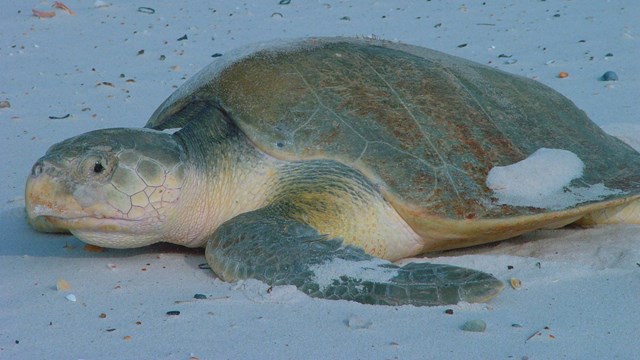
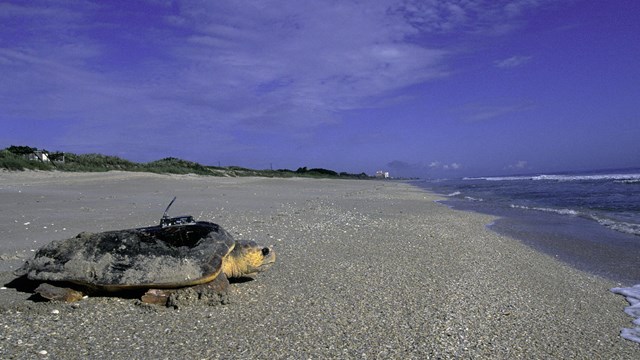
Female loggerhead heading back to the Gulf after laying her eggs, Florida District.
Sea turtles are large, air-breathing reptiles that live in our oceans. Only female turtles return to the beach to nest. Florida has nearly 1,200 miles of coastline which attracts about 90% of sea turtle nesting.
There are four species of sea turtles that nest on the beaches of Gulf Islands National Seashore. The most common are loggerheads (Caretta caretta). In addition the park also has nests from green sea turtles (Chelonia mydas) and few Kemp's Ridley (Lepidochelys kempii). In 2000, the park documented it's first leatherback (Dermochelys coriacea) turtle nest.
In response to the Deepwater Horizon oil spill in the Gulf of Mexico, the National Park Service and U.S. Fish and Wildlife Service in cooperation with state wildlife agencies are translocating sea turtle eggs from nests to the Atlantic Coast in Florida.
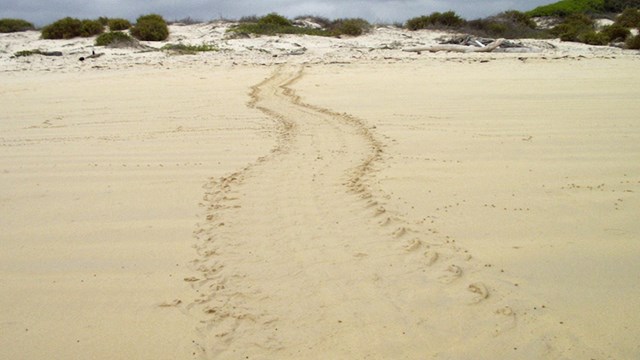
Loggerhead turtle tracks on the beach, Florida District.
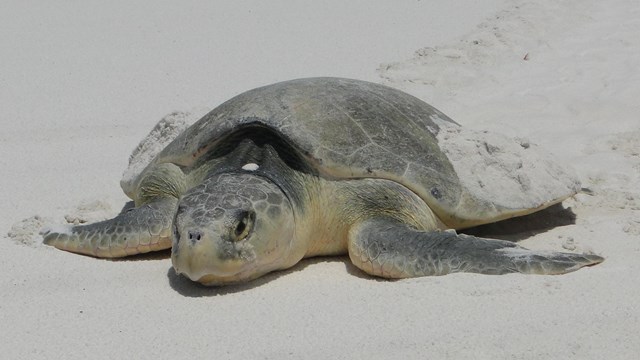
During nesting season, which runs from May to September, female turtles crawl onto the beach to nest. The females dig a body pit with their powerful flippers and then lay their eggs. To protect the nests staff and volunteers conduct early morning turtle patrols in search of turtle tracks. Because all sea turtles are protected animals the nests are documented and protected by roping off the area around the nest and posting sea turtle nesting signs.
Loggerhead nest, Florida District.
Life as a sea turtle is challenging. A few of the obstacles they must overcome include loss of nesting habitat, trash in the water that might be mistaken for food, and becoming trapped in disgarded fishing line. Light pollution from developed areas along the coastline can cause baby sea turtles to become disoriented. Instead of crawling towards the water, hatchlings turn toward the artificial light where they become prey for land animals, get run over by cars, or die during the day from sun exposure.
You can be a part of sea turtle conservation by following some simple tips! Please dispose of plastic bags, balloons and trash in designated trash containers. Recycle or properly dispose of excess fishing line. Take your beach chairs, coolers, and other beach gear with you when you leave. These items interfere with nesting females. Please don't forget to fill in large holes that have been dug in the sand. Adult or baby sea turtles can fall into them and become trapped. Concerned coastal residents and businesses can participate in turtle friendly beach programs that help reduce light pollution. Sea turtles can survive if we learn to share the beach.
Did You Know?
Gulf Islands National Seashore's Fort Massachusetts, on West Ship Island 12 miles off the Mississippi coastline, was covered by the 30-foot storm surge from Hurricane Katrina on August 29, 2005. The fort has been reopened to the public.