Lord Charles Cornwallis
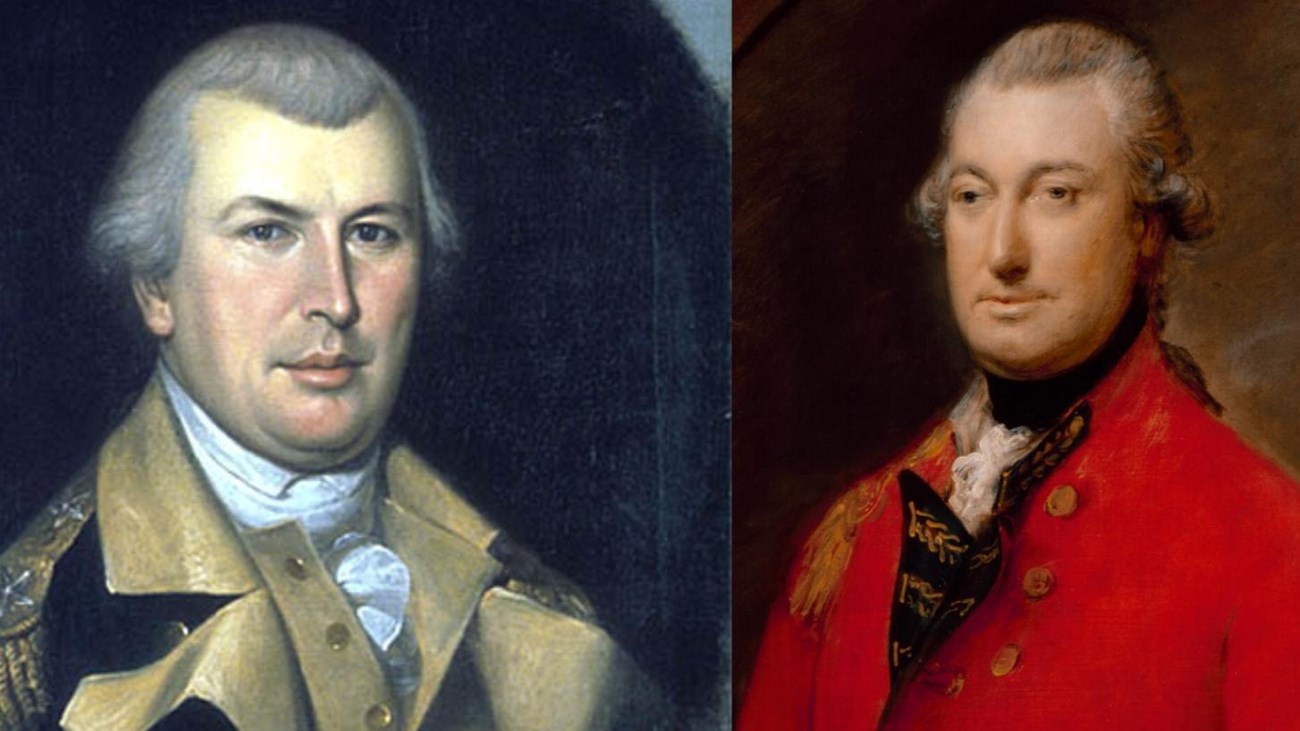
Charles Cornwallis was born in 1738 into an old and distinguished English family. Young Charles was schooled at Eton where an injury in a sports event left him with a permanent cast in one eye. After Eton he entered the military school of Turin in Italy. At the age of seventeen he was commissioned an ensign in the elite Brigade of Foot Guards and was at the famous battle of Mindenin 1759 during the Seven Years War. He was soon promoted to captain in the 85th Regiment of Foot. In 1760 he was elected for the first time to the British Parliament starting a lifetime career in government and the military. He was commissioned Lieutenant Colonel of the 12th Regiment of Foot and commanded a battalion in this unit at the Battle of Vellinghausen in July 1761. In 1762 he became the Second Earl Cornwallis following the death of his father and assumed his seat in the House of Lords. Although politically a Whig, he possessed enough court favor to obtain several important appointments by the monarchy. He became Aide-de Camp to King George III in 1765 and then was promoted to a colonelcy in the 33rd Regiment of Foot in 1766. In 1769 he accepted the government post of joint vice-treasurer of Ireland. A year later he became Constable of the Tower of London and in 1775, when war seemed inevitable in the American colonies, Lord Charles, Second Earl Cornwallis, was promoted to the military rank of Major General in the British Army.
While in Parliament, Cornwallis disagreed with many of the harsh acts that he felt were to punish the American colonies. When the American Revolution began in April 1775 and despite his opposition to the policies that had caused it, Earl Cornwallis dutifully accepted the King’s call to a command of troops in the colonies. Serving under the command of Sir Henry Clinton, Cornwallis led British forces in the battle of Long Island in August 1776. Here, his military leadership and skills routed General George Washington’s rebel army out of New York City. However, Cornwallis’s failure to defeat Washington in the battles of Princeton and Trenton in the winter of 1777 brought forth a severe reprimand from Clinton. But, in the fall of 1777, as a divisional commander under General William Howe, he fared better in the battles of Brandywine and Germantown.
In January 1778 he returned to England to accept a promotion to Lieutenant General. In April he sailed back to America to become second in command to Clinton, now Commander in Chief in North America. Cornwallis personally led the British attack on Washington’s line at the Battle of Monmouth, New Jersey. Here, in the blazing heat of June 1777, his forces struck a hard blow against the American right wing under the command of Washington’s talented subordinate, Major General Nathanael Greene.
In December 1778 Cornwallis returned to England again. His wife, Jemima, whom he loved very dearly, was ill and dying. For almost a year after her death, he remained at home with his two children. Still grieving, Cornwallis returned to duty in America with the expectation of replacing the vain Clinton. When the fire of war began to shift to the South, Cornwallis accompanied Clinton’s army to South Carolina. After the fall of Charleston in May 1780, Clinton left Cornwallis to hold that important port city and restore crown authority to the South. His plans for recruiting an army of loyalists and conducting a campaign that would secure British authority became the basis of British strategy in the Southern Campaign of 1780-81. Initial British success at Camden and the establishment of bases throughout South Carolina led the British to enter North Carolina in the fall of 1780. After British reversals at Kings Mountain and Cowpens, Cornwallis and his small British army found itself on the offensive in the late winter of 1781 chasing the wily opponent Nathanael Greene across North Carolina into Virginia. Exhausted and hungry after two months of chasing Greene, Cornwallis’s army retired to Hillsborough, NC, eager to destroy the rebels on their return. On March 15 the two armies clashed at Guilford Courthouse. Forcing the rebels from the field, Cornwallis’s smaller army suffered 27% casualties. Leading his now crippled army from the Piedmont to the coast of North Carolina, Cornwallis decided at Wilmington to march them north to join British forces holding tidewater Virginia. After a summer of campaigning and fighting, Cornwallis’s army fortified the river port of Yorktown. Besieged by the allied French and American forces under George Washington, Cornwallis was forced to accept their terms of surrender on October 19.
Doomed in history as the general who lost the American colonies, Lord Cornwallis’s career was not damaged. He was paroled to New York City where, in May 1782, he was exchanged for American diplomat Henry Laurens and returned to England. After the Treaty of Paris in 1783 Cornwallis faced a vengeful Henry Clinton who used the press to blame him for the British defeat. In 1786 he left Great Britain to accept the government post of governor-general of India where he won recognition as a soldier and a capable colonial administrator. Lord Cornwallis was made a marquis by King George III in 1793 and returned to England in 1794. In 1797 he was sworn in as Commander in Chief and Governor-General of Ireland. An aging and ill Cornwallis was recalled to India in 1805 where at the age of 66, after a lifetime of service to king and country, he died.