
• Gettysburg National Military Park

    Gettysburg

    National Military Park Pennsylvania

History & Culture

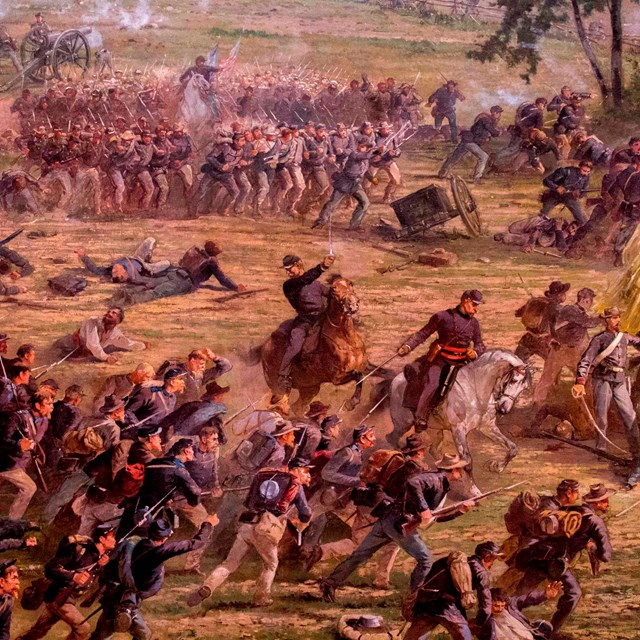
The Gettysburg Cyclorama.
The "High Water Mark of the Rebellion".
(National Park Service)
 

THE BATTLE OF GETTYSBURG

Fought during the first three days of July 1863, the Battle of Gettysburg was one of the most crucial battles of the Civil War having occurred at a time when the fate of the nation literally hung in the balance. Often referred to as the "High Water Mark of the Rebellion", it was the culmination of the second and most ambitious invasion of the North by General Robert E. Lee and his "Army of Northern Virginia". The Union "Army of the Potomac", long the nemesis of Lee's army in Virginia, met the Confederate invasion at the Pennsylvania crossroads town of Gettysburg. Under the command of Major General George Gordon Meade, the Union army fought with a desperation not always seen before on other battlefields. Despite initial Confederate success, the battle turned against Lee on July 3rd, and with few options remaining to him, the general ordered his army back to Virginia. The Union victory at the Battle of Gettysburg resulted not only in Lee's retreat to Virginia but an end to the hopes of the Confederacy for independence.

 
Surgeons at Camp Letterman

Surgery at Camp Letterman.

(Library of Congress)

The battle brought devastation to the residents of Gettysburg. Every farm field or garden was a graveyard. Churches, public buildings and even private homes were hospitals, filled with wounded soldiers. The Union medical staff that remained were strained to treat so many wounded scattered about the county. To meet the demand, Camp Letterman General Hospital was established east of Gettysburg where all of the wounded were eventually taken to before transport to permanent hospitals in Philadelphia, Baltimore and Washington. Union surgeons worked with members of the U.S Sanitary Commission and Christian Commission to treat and care for the over 20,000 injured Union and Confederate soldiers that passed through the hospital's wards, housed under large tents. By January 1864, the last patients were gone as were the surgeons, guards, nurses, tents and cookhouses. Only a temporary cemetery on the hillside remained as a testament to the courageous battle to save lives that took place at Camp Letterman.

 
The National Cemetery at Gettysburg.

The Soldiers' Monument in the center of the Soldiers' National Cemetery at Gettysburg.

(National Park Service)

Prominent Gettysburg residents became concerned with the poor condition of soldiers' graves scattered over the battlefield and at hospital sites, and pleaded with Pennsylvania Governor Andrew Curtin for state support to purchase a portion of the battlefield to be set aside as a final resting place for the defenders of the Union cause. Gettysburg lawyer David Wills was appointed the state agent to coordinate the establishment of the new "Soldiers' National Cemetery", which was designed by noted landscape architect William Saunders. Removal of the Union dead to the cemetery began in the fall of 1863, but would not be completed until long after the cemetery grounds were dedicated on November 19, 1863. The dedication ceremony featured orator Edward Everett and included solemn prayers, songs, dirges to honor the men who died at Gettysburg. Yet, it was President Abraham Lincoln who provided the most notable words in his two-minute long address, eulogizing the Union soldiers buried at Gettysburg and reminding those in attendance of their sacrifice for the Union cause, that they should renew their devotion "to the cause for which they gave the last full measure of devotion.."

 
Entry to the park in 1900

Work of the War Department Commission included the formal entrance to Hancock Avenue on the Taneytown Road.

(National Park Service)

In 1864, a group of concerned citizens established the Gettysburg Battlefield Memorial Association whose purpose was to preserve portions of the battlefield as a memorial to the Union Army that fought here. The GBMA transferred their land holdings to the Federal government in 1895, which designated Gettysburg as a National Military Park. A Federally-appointed commission of Civil War veterans oversaw the park's development as a memorial to both armies by identifying and marking the lines of battle. Administration of the park was transferred to the Department of the Interior, National Park Service in 1933, which continues in its mission to protect, preserve and interpret the Battle of Gettysburg and the Gettysburg Address to park visitors.

 
Gettysburg handbook by Fred Tilberg

(NPS)

For additional publications about Gettysburg National Military Park and it's history as well as the story of other national parks and historic sites, visit the National Park Service History Web Page.

Other publications of interest:

"The Origin and Evolution of the National Military Park Idea" by Ronald Lee (1973)

 
Bombardment of Fort Sumter

THE CIVIL WAR: 150 YEARS
The official web site for the Civil War Sesquicentennial Commemoration. Check here for news and events going on in your national parks to commemorate the 150th Anniversary of the Civil War.

 
Confederate flag over Sumter


A CIVIL WAR TIMELINE
Major Events of the Civil War from 1861 to 1865


JOURNEY THROUGH HALLOWED GROUND
Explore vibrant landscapes and historic sites in the historic corridor from Gettysburg, Pennsylvania, to Monticello, Virginia!

Did You Know?

Abraham Lincoln (Library of Congress)

Asked to provide "a few appropriate remarks", President Abraham Lincoln's Gettysburg Address is recognized today as one of the greatest speeches of his presidency.