
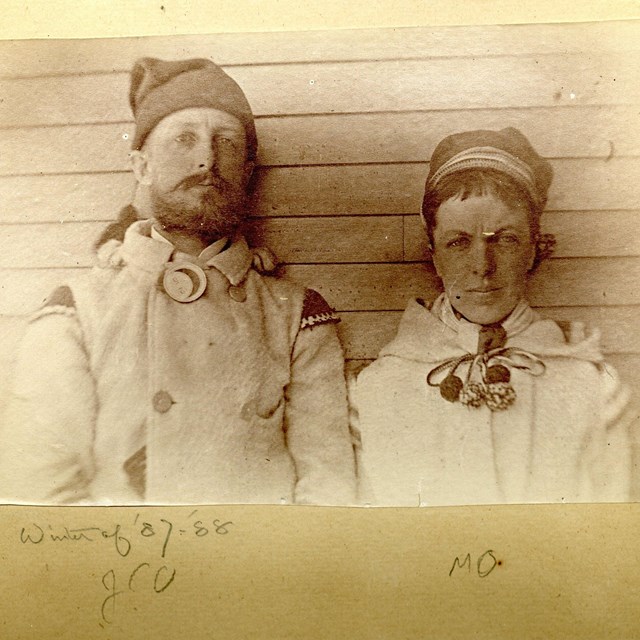
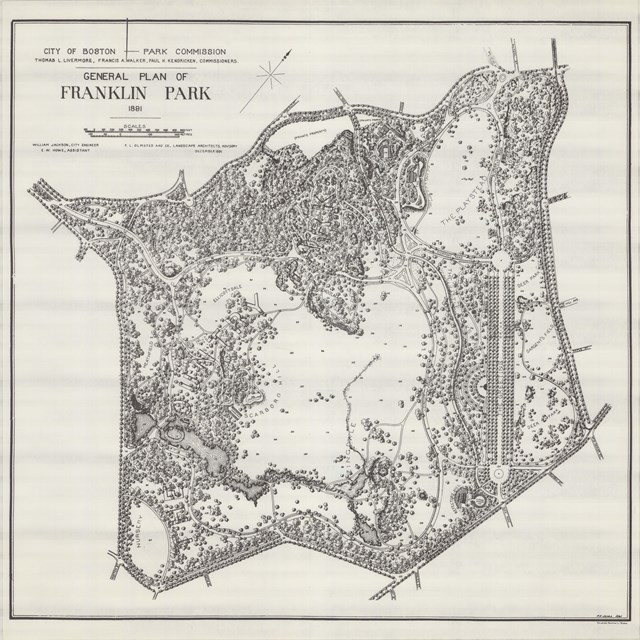
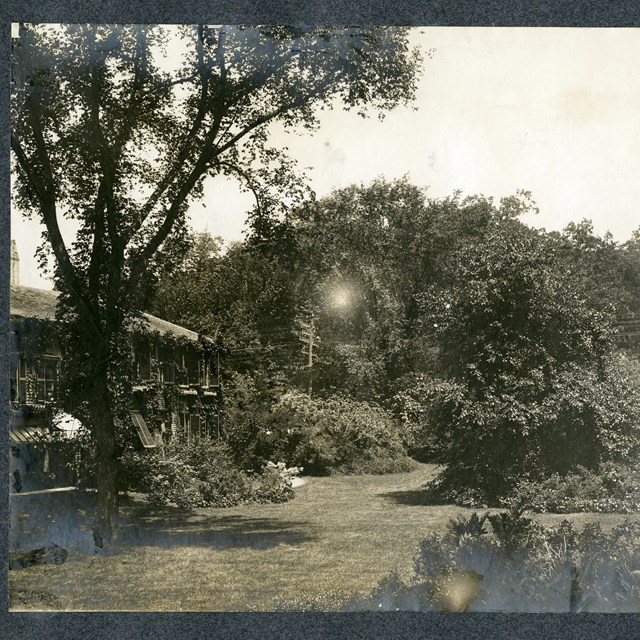
Above: Plan of Riverside, one of Olmsted’s most celebrated suburbs, 1869. Below: Employees of the Olmsted Brothers landscape design firm, at this point operated by his son, Frederick Law Olmsted Jr. and stepson, John Charles Olmsted, 1903. Below right: carte-de-visite of Olmsted, 1893. All images are courtesy of the National Park Service, Frederick Law Olmsted NHS.
Olmsted was a true renaissance man whose many interests and ceaseless flow of ideas led him into experimental farming, writing and publishing, public health administration, preservation, and urban and regional planning. With other reformers, he pushed for the protection of Yosemite Valley. His 1864 report on the park was the first systematic justification for public protection of natural areas, emphasizing the duty of a democratic society to ensure that the "body of the people" have access to natural beauty.
In what he created and what he preserved for the future, Olmsted's legacy is incalculable. The informal natural setting he made popular characterizes the American Landscape. Beyond the hundreds of parks enjoyed by millions of people, Olmsted and his firm set the standard for hospital and institutional grounds, campuses, zoos, railway stations, parkways, private estates, and residential subdivisions across the country. Olmsted's principles of democratic expansion and public access still guide and inspire urban planners. From the broadest concepts to the smallest details of his profession, the sign of Olmsted's hand is everywhere in our lives.