|
|
|
|
 |
| view map |
 |
|
|
|
|
|
|
Fort Stanwix National Monument
History & Culture
|
|
|
|
|
|
 |
|
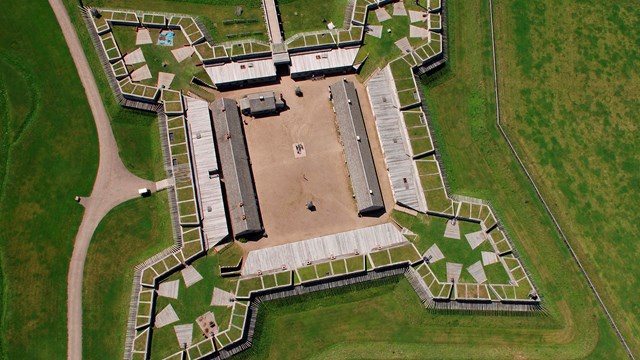
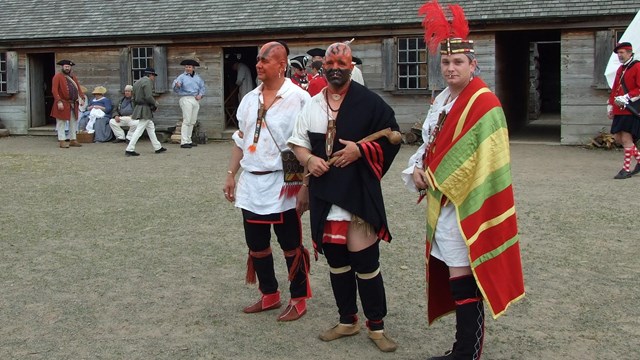
Known as "the fort that never surrendered," Fort Stanwix, under the command of Col. Peter Gansevoort, successfully repelled a prolonged siege, in August 1777, by British, German, Loyalist, Canadian, and American Indian troops and warriors commanded by British Gen. Barry St. Leger. The failed siege combined with the battles at Oriskany, Bennington, and thwarted a coordinated effort by the British in 1777, under the leadership of Gen. John Burgoyne, to take the northern colonies, and led to American alliances with France and the Netherlands. Troops from Fort Stanwix also participated in the 1779 Clinton-Sullivan Campaign and protected America's northwest frontier from British campaigns until finally being abandoned in 1781.
Timeline will be displayed here
 |
1758
|
The Building of Fort Stanwix
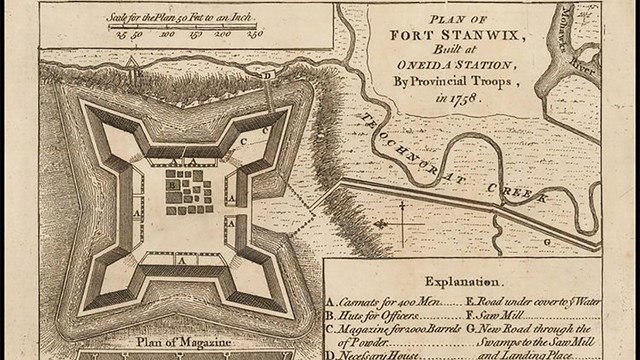
Built by the British in 1758, to protect the Oneida Carry area from French attack during the French & Indian War. It was named for British commander, Gen. John Stanwix. About 2,000 to 12,000 men worked on the site; primarily from New York & New England.
|
| |
 |
1768
|
The Boundary Line Treaty is Signed
In 1768, Sir William Johnson, Superintendent of Indian Affairs, brought the various leaders of the Six Nations and other eastern Indian nations together to settle land disputes establish a clear line between colonial settlements and Indian land.
|
| |
 |
1774
|
The British Abandon the Fort
By this time, the fort's importance had once again diminished, and the regular garrison consisted of only a half pay British officer and a handful of men. By 1774, except for a local trader, the fort was abandoned and in great disrepair.
|
| |
 |
1776
|
Americans occupy, repair, & rename old fort as Ft. Schuyler
With the beginning of the Revolution in 1775, American leaders recognized the importance of the Oneida Carry area. In 1776 the old fort was repaired & renamed in honor of Gen. Philip Schuyler. Col. Dayton & the 3rd NJ Regiment garrisoned it.
|
| |
 |
08021777
|
British Lay Siege to American Fort Schuyler
In August of 1777, the fort successfully withstood a 21-day siege by a mixed force of British, German, Canadian, Loyalist, and Indian forces. This helped make possible the American victory at Saratoga in the fall of 1777.
|
| |
 |
1779
|
The 1st NY Regiment & Van Schaick Raid Against the Onondaga
This expedition left the afternoon of April 18, 1779 and did not return until the 30th, by which time the destruction of the Onondaga villages had been completed. This was part of the larger Clinton-Sullivan Campaign. Not one party member was lost.
|
| |
 |
1781
|
Flood & Fire Destory the Fort
In the spring of 1781, a combination of heavy spring rains and fire destroyed a good deal of the fort & rendered it indefensible. The Americans then abandoned the fort.
|
| |
 |
1784
|
Treaty & Land Transaction of 1784 is Signed
The U.S. gave peace to the Six Nations, while recognizing the allegiance of the Oneida & Tuscarora Nations. They then established a reservation for the Six Nations. The Six Nations ceded land west & north of the boundary line negotiated in 1768.
|
| |
 |
1788
|
1788 – 1794, Treaties & Land Transactions Signed by New York State & the Six Nations
These treaties opened land for settlers & speculators. Also, interests in lands were given by the state to veterans of the American Revolution. In future years towns, cities, & canals were built the lands ceded by the Oneida, Onondaga, & Cayuga Nations.
|
| |
 |
1794
|
A Blockhouse is Constructed
In 1794 the State of New York built a blockhouse for storing military supplies on the parade ground of the old fort. By 1815 it was already in disuse.
|
| |
 |
1830
|
The City of Rome Builds Over the Remains of the Fort
In the 1830s the last remains of the Ft.Stanwix were covered over by increasing development, bringing the fort's history to a close. However, with the fort gone canals, railroads, & new industry allowed the Oneida Carry area of New York to flourish.
|
| |
 |
08061927
|
The Sesquicentennial Celebrations of the Campaign of 1777
These historic plays and re-enactments took place across the State of New York, in Rome, Oriskany, and Saratoga. Cmdr. Robert Byrd attended the one in Rome speaking of how proud he was to stand near the grounds of Fort Schuyler.
|
| |
 |
08211935
|
The Fort Stanwix Act is Signed
After years of work by citizens of the City of Rome, NY, President Franklin D. Roosevelt signed the Wagner-Sisson Bill on August 21, 1935, to establish Fort Stanwix National Monument "for the benefit and inspiration of the people."
|
| |
 |
1963
|
1960s - Urban Renewal / Rome Donates Land to National Park Service
The 1935 act establishing Fort Stanwix as a national monument used an interesting clause that stated that if the site were to be developed, the property &/or the money to purchase the property had to be donated. This didn’t happen until the early 1970s.
|
| |
 |
1970
|
1970-1973, Archeological Investigations Begin
Fort Stanwix Archeological (Excavation) Unit. One of the later features of the fort is this bakehouse with its fireplace and oven. Approximate Year: 1970. These are only a fraction of the volunteers who showed up to unearth the remains of Fort Stanwix.
|
| |
 |
1973
|
Construction Begins on the "New" Fort Stanwix
After many years of waiting, planning, and archeological excavations the City of Rome, NY and the National Park Service began rectruction of Fort Stanwix/Schuyler in 1973.
|
| |
 |
03121976
|
Fort Stanwix National Monument Opens for the Nation’s Bicentennial
The mission of Fort Stanwix National Monument is to preserve the location & objects associated with the military, political, & cultural events that occurred at the site & provide opportunities for visitor understanding & appreciation of these events.
|
| |
 |
08212010
|
The 75th Anniversary of Fort Stanwix National Monument
The history of Fort Stanwix & the City of Rome are inseparably intertwined due to the passion the people of Rome have for their local history. One that has profound affects on national & international history.
|
| |
| | |
|
 |
|
You are exiting the National Park Service website
Thank you for visiting our site.
You will now be redirected to:
We hope your visit was informative and enjoyable.
|