
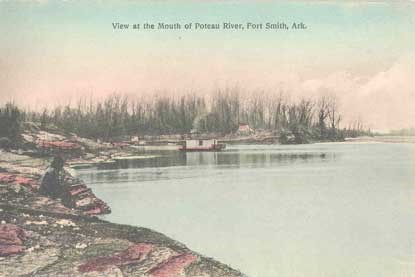
Fort Smith, Ark. (south of the Belle Point landing) To view a larger image of the postcard in a new window, click here. Fort Smith was the highest navigable point on the Arkansas River when it was established in 1817. The first soldiers arrived by keelboat with their ordnance, commissary and quartermaster supplies. The river was not always a dependable mode of transportation as water levels fluctuated. It was not until 1822 that the first steamboat arrived at Fort Smith. By the mid-19th century, the garrison at Fort Smith drew its supplies from New Orleans and St. Louis. The Arkansas River steamers such as the J.R. Thompson, Swallow, and Comet delivered barrels of salt pork, flour, sugar, and stacks of bacon at the Belle Point warf, near the confluence of the Poteau and Arkansas Rivers. 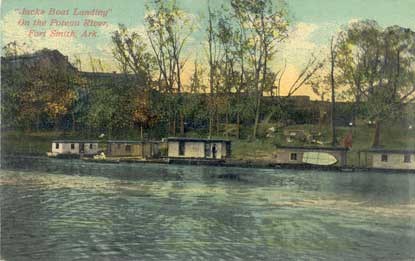
On the Poteau river, Fort Smith, Ark. To view a larger image of this postcard in a new window, click here. Jack's Boat Landing is believed to be the rock landing of Belle Point, where the first soldiers of Fort Smith disembarked in 1817. In the distance, on the left-hand side is the Quartermaster Storehouse of the second fort. To view additional postcards of Fort Smith, click on the small images on the right. To return to the main Postcards of Fort Smith page, click here. |
;)
;)
Last updated: April 10, 2015