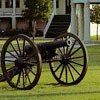
Title: Thunder Wagons: Artillery and Fort Scott Soldiers
Type of Program: Education Program
Venue: Vicinity of artillery shed
Audience: Elementary Students
Tangible Resources: Cannon, Limber, Rounds, Friction Primer, Accoutrements, Cannoneers
Intangible Concepts:
Teamwork - The cannoneers functioned as a team. Each cannoneer had a specific task to perform in firing the cannon. Failure to perform certain tasks meant the cannon would not fire. Failure to perform others would render the operation unsafe, leading to possible injury and death.
Intimidation - The cannon was used as a weapon of intimidation and fear. Dragoons used it to intimidate Indians along the Oregon Trail, particularly the Pawnee. The mere presence of artillery often served as a deterrent. Artillery barrages could be an important psychological factor during battles. Even if not physically hurt during battle, the noise, presence, and damage caused could unnerve soldiers and send them running from the battlefield.
Functioning, Operation - Different types of cannons were used for different purposes. Each type played an important function in defending our nation and helping to advance the objectives of the commander in chief. Similarly, different types of rounds were used for different purposes depending on the target. Regardless of the type of artillery and round used, each cannon required basic steps of loading and firing to operate successfully.
Transportation, Mobility - Some artillery pieces were designed to be permanently affixed in one location. Others were intended to be moved around for use on the field of battle. Successfully transporting these artillery pieces into battle and maneuvering them and aiming them just right could mean the difference between victory and defeat.
Universal Concepts:
Power, Might, Strength - The army that successfully managed their artillery had great advantage on the field of battle or on campaign. A successful artillery barrage or assault could help assure victory. Victory on the field of battle reflected an army’s strength and military might.
Theme:
Artillery at Fort Scott itself was used strictly for ceremonial purposes, but soldiers stationed at Fort Scott participated in campaigns and battles where the army successfully used artillery to demonstrate their military might . Artillery became a key to the growing power of the United States in the nineteenth century.
Goals:
To describe the functioning of the cannon and each of its parts
To describe the various duties of each cannoneer.
Take the students through a mock firing.
To show how the artillery was used in the protection of the frontier.
Objectives:After participating in this program, the students will be able to:
Name three types of rounds fired out of the gun.
Name the duties of at least two Cannoneers.
Give at least one instance when the gun would be fired at Fort Scott and one instance when it was used to help soldiers protect the frontier.
Suggested Activity:
Run a mock artillery drill, choosing a few of the students to be on the cannon crew.
Safety Information:
Students should not climb or sit on artillery piece.
Students should use caution when handling artillery implements and should refrain from
handling shot.