|
 |
  |
|
|
|
|
Death Valley National Park
Reptiles
|
|
|
|
|
|
 |
|
| Horned lizards are very well camouflaged. |
|
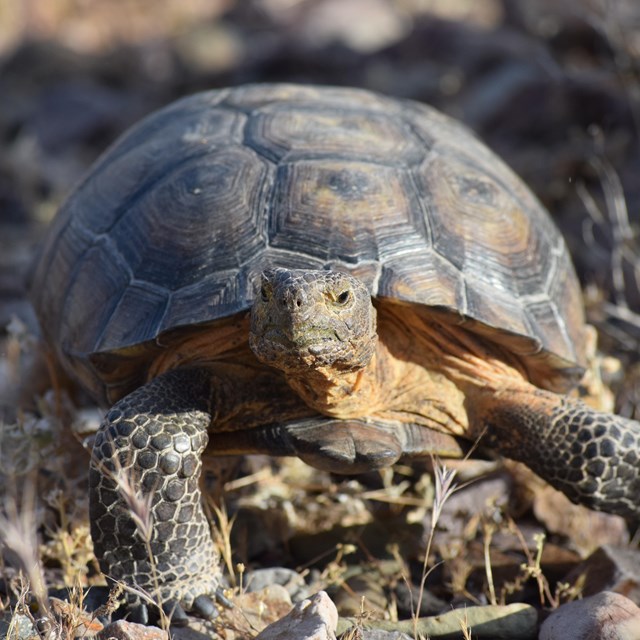
- desert tortoise
Gopherus agassizii
(A threatened species)
Found in the flats and surrounding foothills from 1500 to 3500 feet; lives in burrows.
- desert banded gecko
Coleonyx variegatus variegatus
Nocturnal; valley floor to 3500 feet.
- desert iguana
Dipsosaurus dorsalis
In and around mesquite hummocks and other similar locations with fine sandy soil; in low canyons and washes up to 3000 feet.
- chuckwalla
Sauromalus obesus
Areas of large rocks and boulders on alluvial fans and in canyons; throughout Death Valley up to 5000 feet; Towne Pass, Dante's View road, Titus Canyon.
- zebra-tailed lizard
Callisaurus draconoides
Sandy and gravelly areas near dunes and in washes; common on roads in morning in spring , summer, and fall.
- mojave fringe-toed lizard
Uma scoparia
Found in the Ibex Dunes in Death Valley, this lizard is restricted to sandy habitats with fine to very fine grained sand. The fringe-toed lizard has specially adapted fringes on its toes that allow it to run across sand at speeds up to 10 miles per hour. This lizard can also "swim" underneath soft sand to find cooler temperatures.
- collared lizard
Crotaphytus bicinctores
Among rocks in hilly areas and washes, on slopes; from 1000 to 5000 feet.
- leopard lizard
Gambelia wislizenii
Valley floor to 3600 feet on alluvial fans, in canyons and washes with scattered vegetation.
- desert spiny lizard
Sceloporus magister magister
Rocky slopes and canyons from 3500 to 7000 feet around vegetation.
- great basin fence lizard
Sceloporus occidentalis biseriatus
Rocky areas over wide elevation range; rock outcrops, canyons, near springs.
- sagebrush lizard
Sceloporus graciosus
From sagebrush through pinyon-juniper up to 10,500 feet.
- desert side-blotched lizard
Uta stansburiana
Throughout Death Valley below 5000 feet in gravelly and rocky areas. Active on warm days all year.
- western brush lizard
Urosaurus graciosus graciosus
Low desert in and around creosote bush and mesquite.
- southern desert horned lizard
Phrynosoma platyrhinos calidiarum
Sandy, gravelly areas; low desert to over 5000 feet.
- desert night lizard
Xantusia vigilis vigilis
In and near Joshua trees; under debris; near Dantes View, over 9000 feet in Panamint Mountains.
- western skink
Eumeces skiltonianus skiltonianus
Moist areas with good cover in pinyon-juniper.
- western red-tailed skink
Eumeces gilberti rubricaudatus
Found in isolated populations in Hanaupah and Johnson Canyons in the Panamints.
- great basin whiptail
Cnemidophorus tigris tigris
Dry sandy area with sparse vegetation; rocky areas of upper washes; meaquite thickets and vegetated areas of Greenwater Valley and Harrisburg Flats.
- panamint alligator lizard
Elgaria panamintina
Panamint and Grapevine Mountains above 3500 feet.
- western blind snake
Lepotyphlops humilis
Nocturnal; under rocks, among roots on brush covered slopes; from below sea level to 4000 feet.
- rosy boa
Lichanura trivigata
Low foothills and canyons below 4500 feet; in sandy and gravelly habitats.
- western leaf-nosed snake
Phyllorhyncus decurtatus perkinsi
Nocturnal; sandy and gravelly soil; rocky foothills.
- coachwhip (red racer)
Masticophis flagellum piceus
Sandy mesquite hummocks; gravelly desert; rocky foothills.
- striped whipsnake
Masticophis taeniatus
Willow Creek in Black Mountains; Hunter Spring in Cottonwood Mountains.
- desert patch-nosed snake
Salvadora hexalepis hexalepis
Rocky and sandy areas from lower slopes and washes up to Towne Pass
- desert glossy snake
Arizona elegans eburnata
Nocturnal; in sandy or gravelly areas.
- great basin gopher snake
Pituophis melanoleucus deserticola
From rock-strewn desert foothills into mountains.
- California king snake
Lampropeltis getuls californiae
Panamint Mountains from Emigrant Canyon to Wildrose; Daylight Pass.
- western long-nosed snake
Rhinocheilus lecontei lecontei
Nocturnal; Aguereberry Point, Towne Pass, Daylight Pass.
- western ground snake
Sonora semiannulata
Sandy or fine gravel to over 4000 feet; Wildrose Canyon, Greenwater, Daylight Pass.
- mojave shovel-nosed snake
Chionactus occipitalis occipitalis
Sandy areas in the southern half of Death Valley; frequents dunes, washes, sandy flats, and rocky hillsides where there are sandy gullies.
- Nevada shovel-nosed snake
Chionactus occipitalis talpina
Sandy areas in the northern half of Death Valley; frequents dunes, washes, sandy flats, and rocky hillsides where there are sandy gullies.
- Utah black-headed snake
Tantilla planiceps utahensis
Nocturnal; Panamint Mountains.
- California lyre snake
Trimorphodont biscutatus vandenburghi
Rocky areas; sea level to over 4000 feet.
- desert night snake
Hypsiglene torquata
Many habitats from below sealevel to over 5000 feet.
- panamint rattlesnake
Crotalus mitchelli stephensi
Below sealevel to over 7000 feet, usually in foothills and mountains.
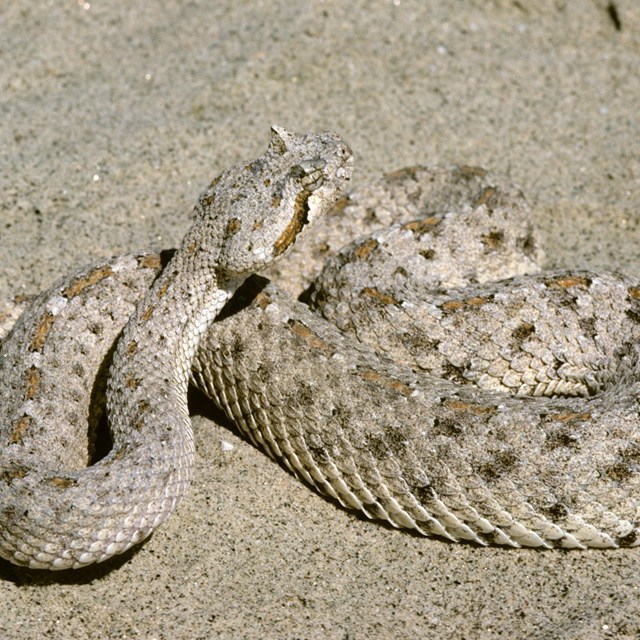
- mojave desert sidewinder
Crotalus cerastes cerastes
Nocturnal; mesquite hummocks; from below sea level to 4500 feet.
- mojave rattlesnake
Crotalus scutulatus
Chiefly inhabits upland desert and mountain slopes but ranges from sea level to 8,000 feet. Considered rare in Death Valley and restricted to the southern half of the park.
| | |
|
 |
|
|
|
|
|
 |
|
Did You Know?
Death Valley is home to more than 1000 species of plants and more than 50 of those are endemics, found nowhere else in the world.
more...
|
|
|
|
Last Updated: June 19, 2008 at 19:40 EST |