



Last updated: April 15, 2021
Place
Fort Marcy
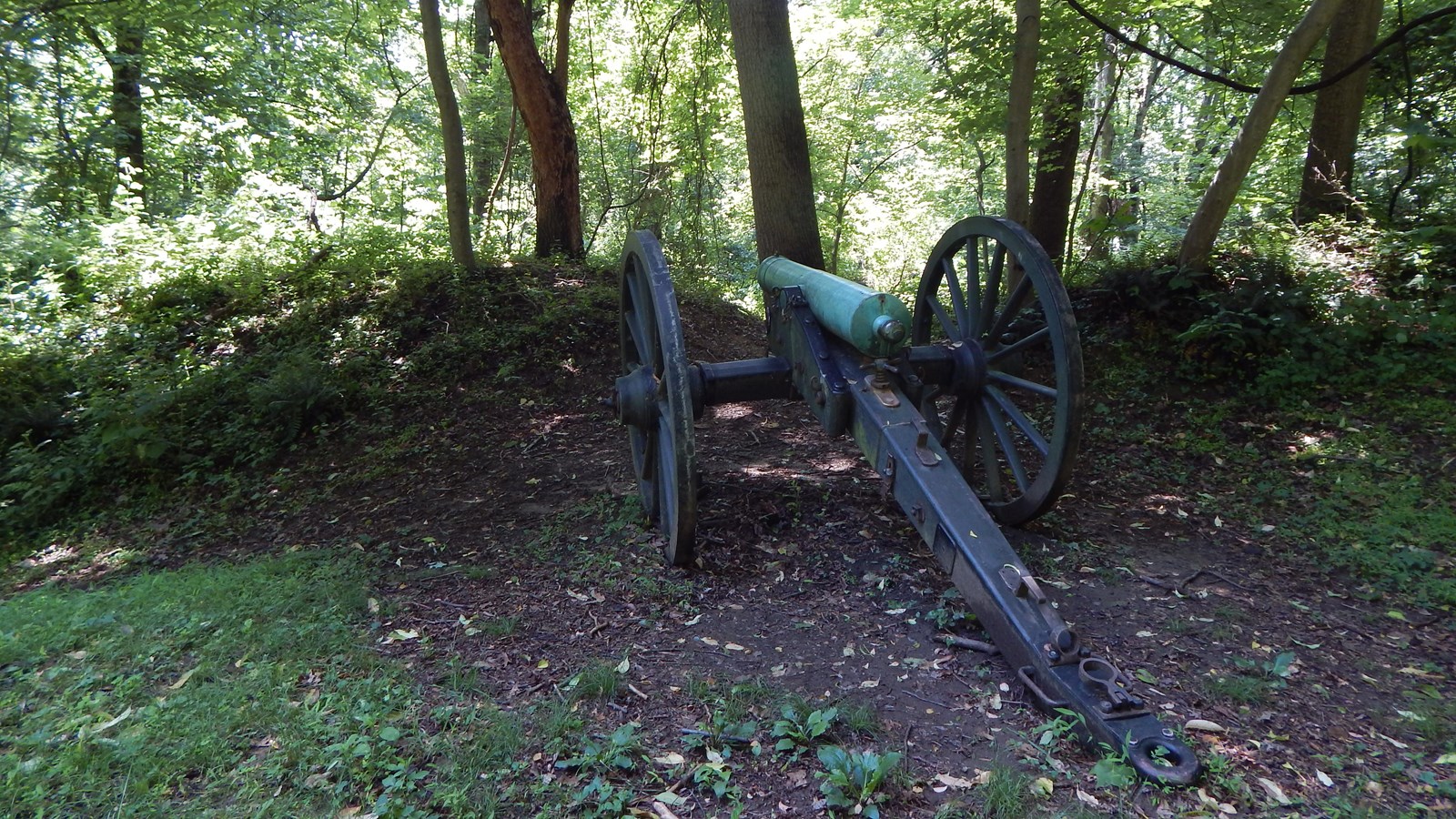
NPS/S.Phan
Quick Facts
Location:
McLean, Virginia
Significance:
Civil War Fort
Designation:
National Park
Amenities
5 listed
Historical/Interpretive Information/Exhibits, Information, Parking - Auto, Picnic Table, Trailhead
Fort Marcy and nearby Fort Ethan Allen, among other batteries on the northern bank of the Potomac River, were built to protect Leesburg Pike and Chain Bridge. Construction began in 1861. When Fort Marcy was completed, it had a perimeter of 338 feet and mounted 18 guns, a 10-inch mortar and two 24-pounder Coehorn mortars.
The hill on which the fort is located was known as Prospect Hill. Originally the fort was called Fort W.F. Smith after Major General William F. Smith, the troops of whose division began construction of the work. His division crossed Chain Bridge on the night of September 24, 1861, and immediately commenced construction of Fort Marcy and Fort Ethan Allen. The 79th New York Highlanders, the 141st Pennsylvania and the Iron Brigade also helped complete the work in the fall of 1862. A force of about 500 contrabands were employed. The 152nd New York worked on the entrenchments, which are still in a very good state of preservation. The site of Fort Marcy is near the location where the famous, but bloodless duel between Henry Clay and John Randolph was fought in 1826.
The fort was not entirely completed until the fall of 1862. It is a relatively undisturbed fort and was named in honor of a native of Massachusetts, the Honorable Randolph B. Marcy, a distinguished soldier, father-in-law, and Chief of Staff to Gen. George B. McClellan. Detachments of the 4th New York Heavy Artillery, 3rd Pennsylvania Heavy Artillery and the 130th Pennsylvania infantry were among the troops that performed garrison duty here during the war. An interesting incident of history is that the body of troops, which afterwards became famous, and the "Iron Brigade" was originated at this fort in the summer of 1861. It was composed of the 19th Indiana, the 2nd, 6th and 7th Wisconsin Regiments. The 24th Michigan was added to the brigade soon after the battle of South Mountain. These regulars remained together until the close of the war.
After the Civil War ended Fort Marcy was returned to its original owners, the Vanderwerken family. The land remained in the Vanderwerken family until after World War II, when the DeLashmutt family purchased the property.
"Thoughts on Fort Marcy," is a poem written by Lillian Money-Read that was published in the The Washington Post, April 12, 1936. The poem is an eloquent tribute to not only Fort Marcy, but the other forts in the Defenses of Washington system that have, over time, been covered by deciduous forests of American elm, yellow-poplar, and white ash. Today these remnant earthworks are a silent reminder of the protective shield that surrounded the nation’s capital during the Civil War years.
Thoughts on Fort Marcy by Lillian Money-Read:
The woodland drips with sun-warmed April rain,
The trees are colorful with new–oped leaves,
With half-blown buds the dogwood trees are snowed,
The maple-tassels, green with scarlet cleaves.
May apple flings its sweetness on the air,
Translucent stemmed, the big dark violet
And pied spring beauty, bride of early morn
Bloom in the vivid moss with shy bluet.
My dog bounds down and leaves a darkened trail
Along the silvered hillside, wild with mirth,
His mouth is spread, his limpid eyes a-shine,
His muzzle wet with brown, sweet-smelling earth.
On fair Fort Marcy, thus I dream today.
And hear the swollen creek rush to the river,
With muffled roar like a dreadful battle din
Which made, of old, these frightened forests shiver!
Ah, bright the ferns that clothe these silent moats,
And sweet the lanes where walked the sentinel,
Yet scarce a flower springs on this haunted ground
But marks the place where some young soldier fell!
Visit our keyboard shortcuts docs for details
- Duration:
- 2 minutes, 5 seconds
An overview of the Civil War Defenses of Washington, the roles of Fort Stevens and other forts in the Civil War, and how park visitors can experience these places today.