




NPS Engine 278 was built for the Denver and Rio Grande Railroad in 1882 to pull trains on the narrow-gauge railroad lines that ran from Crested Butte to Gunnison and Montrose. The engine was “retired” in 1952 and given to the City of Montrose. The Pratt Truss Bridge that sits over the river was built in 1895 to replace the original wooden trestle. National Register of Historic PlacesThe set of rail cars have been added to the National Register of Historic Places. This listing provides recognition of the significance of the resources, and opens funding avenues for preservation actions. Historic preservation staff at the National Park Service regional office in Lakewood, Colorado prepared the nominations. They worked closely with staffs from Curecanti National Recreation Area, the City of Montrose, the Colorado State Historical Society, the Colorado Railroad Museum, and railcar manufacturers to prepare the nominations.
* Properties are listed at the local, state, or national level of significance. Example of these levels might equate to the site of a town's first post office (local), the site of the first state assembly (state), Thomas Jefferson's home at Monticello (national). July 2010
NPS/Paul Zaenger January 2011On January 21, 2011, Engine 278 was loaded on a flatbed trailer and transported to Palisade. Mammoth Locomotive Works in Palisade, CO will complete the restoration of the locomotive. March 2011Engine 278 was disassembled. It produced multiple pallets of small parts, and several long shelves of tubes and piping. Paint and rust from the metal parts was removed. The cab of the engine car was removed basically intact, with only a few small pieces detached to facilitate removal. Sound portions of the cab were salvaged. The analysis of the cab's wood indicated the cab is constructed or a combination of ash, oak and fir woods. 
NPS/F. Frost June 2011A new engine house for the locomotive is built since the old one had rotted wood. The tender "box" was lifted off the frame and wheel assembly. It revealed rotted beams that needed replacement. October 2011The restoration of the D&RGW locomotive #278 continues. Most of the locomotives metal parts, including the boiler, are treated and painted. A few major components, such as the smoke stack, remain to be processed. The restoration of the locomotive cab is complete except for painting. Reassembly of the locomotive has begun and will take a few months. After disassembly of the tender, the wooden platform (sills and end beams) will be replaced. The contractor obtained appropriate replacement beams to keep the restoration true to the D&RGW methods and techniques. 
NPS 2012–2014 The second phase of the Cimarron Train Restoration Project began. This phase determined the condition of the bridge across the Cimarron River where the locomotive and related cars were displayed. A coatings specialist from the Bureau of Reclamation inspected the bridge in fall of 2013 and documented areas of rust and the degree that the paint had deteriorated. His report made several recommendations for repainting the bridge. 
NPS 2018–PresentEngine 278, its coal tender, a boxcar, and caboose were returned to the truss bridge in Cimarron in fall of 2018. The NPS celebrated the return of the train cars in 2019 with a public ceremony. Currently the rail exhibit is open daily at Cimarron. The rail yard exhibit adjacent to the Cimarron Campground is also open daily. 
Historic Cimmaron
Learn about this historic railroad town, from its history of ranching to railroad tourism to livestock shipping. 
Cimarron
The historic town was once a bustling train depot. Visitors can revisit the past and recreate along Crystal Reservoir. 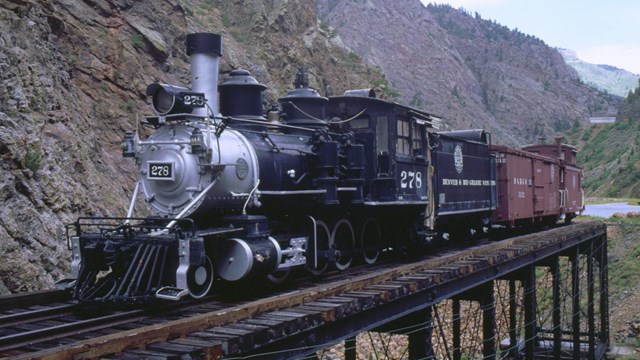
Cimarron Rail Exhibit
Learn about Engine 278 and other rail cars on the truss bridge at Cimarron. 
History & Culture
Human occupation of the Curecanti area dates back to at least 10,000 years ago. |
Last updated: December 3, 2024