



|
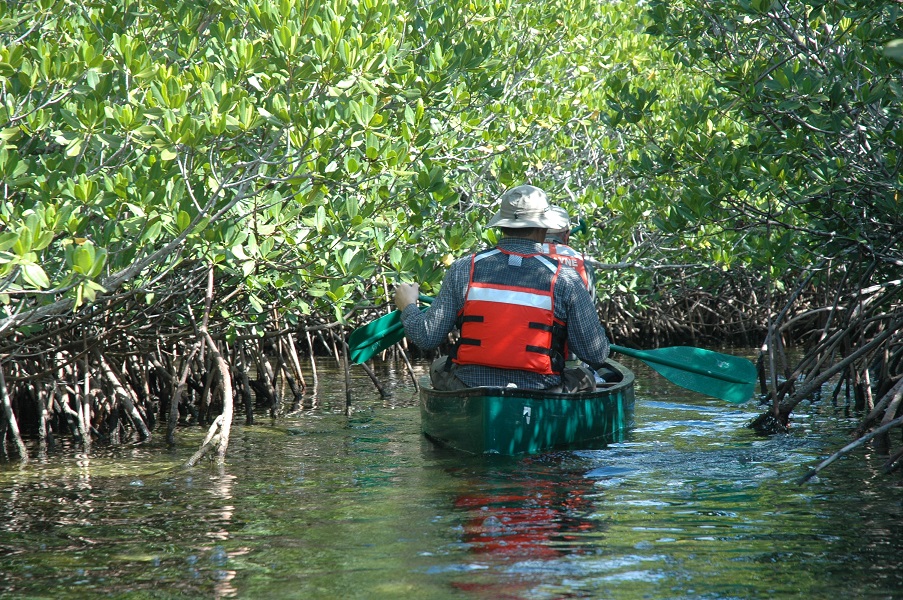
The word mangrove is used to describe several trees, not closely related to one another, that flourish in salty environments. Some are able to block salt from their roots while others secrete excess salt through their leaves, allowing them to thrive where other trees would die. These mangroves, with their impenetrable root systems, help to keep park waters clean and clear. They slow water flow from the land into the bay and allow sediment to settle. Mangrove roots provide shelter for a host of marine organisms, especially the young and small. Tree branches provide breeding and nesting areas for birds including brown pelicans. Leaves fall from mangrove branches year round. The leaves break down to become food for tiny marine organisms which, in turn, become food for larger organisms including commercially important species of fish, shrimp and lobster. Without healthy mangrove forests, Florida's vital recreational and commercial fisheries would drastically decline. Three types of mangroves live along park shorelines and the fringes of islands. Starting from the water and working inland, red, black and then white mangroves are found. 
Red Mangrove (Rhizophora mangle) - This tree was once found all along the Florida shoreline. It thrives on muddy coastlines where its roots spread outward toward the sea in water as deep as three feet. The tree appears to walk on water with its stilt like prop roots. These prop roots grow in mass thickets, which make them virtually impenetrable. Red mangrove seeds, known as propagules, resemble large green beans or cigars. They germinate on the tree. They float in the water for up to a year before anchoring along the shore to grow into trees. 
Black Mangrove (Avicennia germinans) - The black mangrove resides in mostly salty, silty, saturated soils found along the tidal shoreline. It prefers higher and dryer soils than the red mangrove. This mangrove is characterized by pneumatophores, reverse roots, sticking out of the soil all around the trunk. These snorkel-roots extend six or more inches above the saturated soil and obtain oxygen even as the tide comes in. Like the red mangrove, the green seeds of the black mangrove germinate on the tree and float in saltwater for up to four months before finding a suitable place to grow. 
White Mangrove (Laguncularia racemosa) - The white mangrove is normally found further inland than red and black mangroves. The leaf base has two salt excreting glands near the leaf blade which allow it to get rid of excess salt. All mangroves have trouble with cold weather and freezes, yet the white mangrove is the least cold tolerant of the three. |
 |
|
Last updated: February 16, 2017