
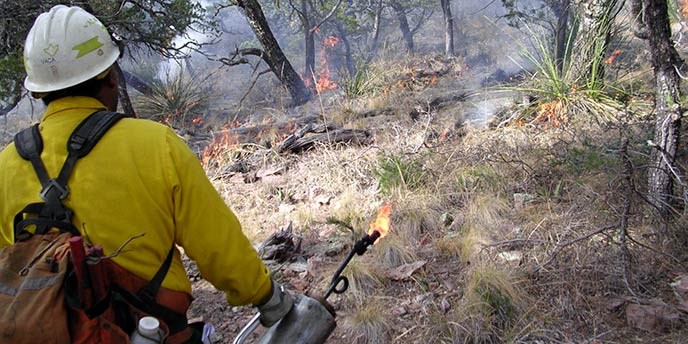
NPS Photo The park now manages fire as a critically important natural process that is allowed to resume its original role in crafting and influencing the plant and wildlife communities of the national park. The task is to manage the natural process of fire in ways that avoid negative impacts on resources and do not threaten human life and property. Any fire started by accident or by natural causes such as lightning is designated a wildland fire. Big Bend averages ten unplanned fires during the prime fire season, March through July. Each wildland fire is intensively monitored by park staff members who decide on a daily basis whether the fire should be put out. A prescribed fire is any fire intentionally ignited by management to meet specific objectives such as reduction of flammable materials around developed areas. Each of these fires has a written prescription, a detailed plan on the type of weather, staffing, and other conditions which must be met before the fire can be set. If conditions change and the fire is no longer within prescription, it will be immediately extinguished. For example, strong winds are common in Big Bend. A prescribed fire is postponed or suppressed if high winds are forecast for the park region. The National Park Service is also concerned about smoke and how it impacts human health and air visibility. Winds sometimes shift direction after a prescribed fire is started. If those winds bring large amounts of smoke to areas of high human use, the fire is put out. Big Bend's Fire Management Officer sets up a schedule for prescribed burns throughout the park. The cost of using a prescribed fire to reduce an overload of flammable material can be as low as $48/acre. Putting out a wildfire with excessive amounts of dead wood could easily top $800/acre. Thus, a well-planned program of prescribed burns could cost only 1/16th the price of traditional firefighting. In some sections of the park we may apply prescribed fire as a tool to eliminate or reduce exotic species such as tamarisk and buffel grass and to encourage native species like mesquite trees and desert grasses. Fire-adapted native plants germinate or sprout immediately after a fire and may replace exotic vegetation. For example, the roots of mesquite are rarely killed in a fire. Even if the entire above-ground portion of the tree is consumed by flames the plant can sent new shoots up from the surviving roots.
|
Last updated: June 26, 2019