
-
New Operating Hours for the National Prisoner of War Museum
Beginning Monday, May 13, 2013, the National Prisoner of War Museum will adopt new operating hours of 9:00 a.m. to 4:30 p.m. daily. More »
Camp Sumter / Andersonville Prison
|
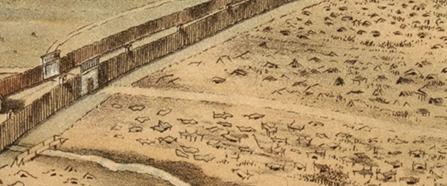
At the onset of the Civil War, neither side was prepared for a prolonged conflict. Both sides believed that the war would not last long. As a result, no one considered how to house and care for the thousands of enemy soldiers who would eventually be taken prisoner. As the war continued, the necessity of caring for these prisoners became more apparent and critical. At first, both sides used a parole system, which oftentimes occurred right on the battlefield. The prisoners would state on their honor that they would return home and no longer fight until officially exchanged. This system was quickly found to be impracticable, since many prisoners would immediately continue to fight. A formal prisoner exchange system was devised in July 1862. The system was governed by the Dix-Hill Cartel, which specified the worth of each soldier by rank. For example, one captain alone was worth sixty privates. However, the Cartel soon broke down. At this time the Union realized that it was to their advantage not to exchange prisoners. As a result, large prisons such as Andersonville were created. The earliest camps for Union prisoners were in and around Richmond, Virginia, capital of the Confederacy. By 1863 the prisoner population in Richmond had grown to the point that it caused a serious drain on the city's dwindling food supply. Richmond was under constant threat of attack. Commonly known as Andersonville, the military prison facility was officially named Camp Sumter, in honor of the county in which it was located. Construction of the camp began in early 1864 after the decision had been made to relocate Union prisoners to a more secure location. This decision was made because of the battles taking place near Richmond, VA where many prisoners were being held, and as a way to procure a greater food supply. Camp Sumter was only in operation for fourteen months, however, during that time 45,000 Union soldiers were imprisoned there, and nearly 13,000 died from disease, poor sanitation, malnutrition, overcrowding, or exposure. The prison site initially covered approximately 16 1/2 acres of land, which was enclosed by a fifteen foot high stockade wall. The prison was enlarged in June 1864 to 26 1/2 acres to compensate for overpopulation. The stockade was constructed in the shape of a parallelogram that was 1,620 feet long and 779 feet wide. Approximately 19 feet inside of the stockade wall was the "deadline," which the prisoners were not allowed to cross. If a prisoner stepped over the "deadline," the guards in the "pigeon roosts," which were roughly thirty yards, apart were allowed to shoot them. The first prisoners arrived at Camp Sumter in February 1864. Over the course of the next few months approximately 400 prisoners arrived daily. By June 1864 over 26,000 prisoners were confined here. The stockade was only designed to house 10,000. The largest number of prisoners held at one time was 32,000 in August 1864. Due to the deteriorating economy, inadequate transportation, and the need to concentrate all resources on its army, the Confederate government was unable to provide the prisoners with adequate housing, food, clothing, and medical care, Due to the terrible conditions and breakdown of the prisoner exchange system, prisoners suffered greatly and a high mortality rate ensued. On July 9,1864, Sergeant David Kennedy of the 9th Ohio Cavalry wrote in his diary:
When General William T, Sherman's Union forces occupied Atlanta on September 2, 1864, moving Federal cavalry columns within easy striking distance of Andersonville, Confederates moved most of the prisoners to other camps in South Carolina and coastal Georgia, From then until May 1865, Andersonville was operated on a smaller basis than before. When the war ended, Captain Henry Wirz, the stockade commander, was arrested and charged with conspiring with high Confederate officials to "impair and injure the health and destroy the lives...of Federal prisoners" and "murder, in violation of the laws of war." Such a conspiracy never existed, but anger and indignation throughout the North over the conditions at Andersonville demanded appeasement. Tried and found guilty by a military tribunal, Wirz was hanged in Washington, D,C. on November 10, 1865. A monument to Wirz, erected by the United Daughters of the Confederacy, stands today in the historic town of Andersonville. Andersonville prison ceased operation in May 1865. Most former prisoners returned to their prewar occupations, In July and August 1865, Clara Barton, a detachment of laborers and soldiers, and a former prisoner named Dorence Atwater came to Andersonville cemetery to identify and mark the graves of the Union dead. As a prisoner, Atwater was assigned to record the names of deceased Union soldiers. Fearing loss of the death record at war's end, Atwater made his own copy in hopes of notifying the relatives of some 12,000 dead interred here. Thanks to his list and the Confederates records confiscated at the end of the war, only 460 of the Andersonville graves had to be marked "unknown U,S, soldier." The prison site reverted to private ownership in 1875. In December 1890 it was purchased by the Georgia Department of the Grand Army of the Republic, a Union veterans organization, Unable to finance improvements needed to protect the property, this group sold it for one dollar to the Woman's Relief Corps (WRC), the national auxiliary of the GAR. The WRC made many improvements to the area with the idea of creating a memorial park. Pecan trees were planted to produce nuts for sale to help maintain the site and states began erecting commemorative monuments, The WRC built the Providence Spring House in 1901 to mark the site where, on August 9, 1864, a spring burst forth during a heavy summer rainstorm-an occurrence many prisoners attributed to divine providence. The fountain bowl in the Spring House was purchased through funds raised by former Andersonville prisoners. In 1910 the Woman's Relief Corps donated the prison site to the people of the United States. It was administered by the War Department and its successor, the Deparment of the Army, until its designation as a national historic site by Congress in October 1970. Since July 1, 1971, the park has been administered by the National Park Service. |
Did You Know?
The flight suit worn by Brigadier General (then Major) Rhonda Cornum (Gulf War POW) is on display in the National Prisoner of War Museum. Brigadier General Cornum was captured during an attempt to rescue downed pilot Captain Williams Andrews, who also became a POW.