
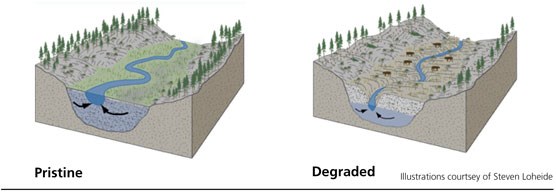
Meadows perform a variety of functions from flood control to groundwater recharge and also provide incomparable wildlife and plant habitat. Different meadows may provide some or all of these functions depending on the type of meadow: Water Quality (Pollution control): Meadows can improve water quality because of their ability to trap sediments. As the velocity of incoming waters is slowed, sediments are deposited. These sediments may contain physically or chemically attached toxicants (heavy metals, pesticides, and toxic organic substances). These toxicants may be "removed" by chemical breakdown, decomposition by soil microbes, or assimilation into plant tissues. Retention of nutrients occurs, too, within sediments and plant tissue—the transformation of inorganic nutrients to organic form, and the transformation of nitrogen to gaseous form. Nitrogen and phosphorous, generally the nutrients in greatest abundance, are taken up and stored by wetland vegetation. This function improves downstream water quality by filtering out potential pollutants. 
Groundwater Recharge: Groundwater recharge is the movement of surface water to groundwater by percolation to the underlying water table. Meadows can either serve as groundwater recharge areas (where water percolates down) or discharge areas (where groundwater percolates up) depending on the type of meadow. Three parameters that influence the movement of groundwater to and from a wetland: the elevation of the wetland relative to the groundwater; the mass and pressure of water; and the physical characteristics of the underlying soils and bedrock. |
Last updated: January 16, 2024