




NPS/Neal Herbert Amphibians are an important part of Yellowstone’s aquatic and terrestrial ecosystems. Many of Yellowstone’s reptiles, birds, mammals, and fish prey on larval and adult amphibians, and amphibians, in turn, eat a variety of vertebrate and invertebrate species. Amphibians are also sensitive to disease, pollution, drought, variations in annual snowpack, and the arrival of nonnative species; these documented sensitivities make them valuable indicators of environmental change. Amphibians often congregate in large numbers for breeding or overwintering. As a result, they can be adversely affected by localized disturbance or the loss of individual breeding or overwintering sites. Amphibian populations that are affected by one or more of these stresses may exhibit changes in their distribution or abundance. These changes can, in turn, have cascading effects on other aspects of the ecosystem. Declines in amphibian populations are occurring globally in areas where habitat destruction is pervasive, but also in protected areas. About one third of all amphibian species are believed to be threatened with extinction. Yellowstone includes some of the most climatologically and topographically complex landscapes in the lower 48 states and therefore provides a valuable study area to examine how climate may influence amphibian distribution and trends. Information about the status and trends of amphibians here may shed light on declines documented in other high-elevation locations or other protected areas around the West. PopulationAnnual surveys since the early 2000s have documented four amphibian species as widely distributed in Yellowstone: boreal chorus frogs, Columbia spotted frogs, western tiger salamanders, and western toads occur in wetlands and ponds throughout Yellowstone. In 2014, the plains spadefoot (Spea bombifrons) was confirmed in Yellowstone through genetic analyses. Spadefoots are rarely seen because they spend most daylight hours (and most of the year for that matter) underground. Currently, a single breeding population is known to exist within Yellowstone. However, monitoring efforts are under way to locate additional breeding sites because plains spadefoots typically do not disperse far from their natal pond. In Yellowstone, amphibians depend on limited suitable habitat with shallow, quiet waters needed for egg laying and larval development. Annual differences in snowpack and precipitation change the extent and location of wetland sites, resulting in considerable year-to-year variation in amphibian reproduction. Breeding data collected across the park and since 2006 show that annual variations in breeding are common. Multi-year monitoring data indicate that amphibian populations using small, shallow, isolated wetlands are most susceptible to drought or changes in precipitation. In contrast, amphibian populations occupying deeper wetlands and ponds appear to be more stable through time. Since the 1950s, air temperatures have increased across this region and changes in the flooding patterns, or even the complete drying of wetlands, have been documented. Since 2006, annual visits to approximately 250 wetlands across Yellowstone have further documented annual variation in the availability of wetlands. These data suggest that in hot, dry years (e.g., 2007) upwards of 40% of the park’s wetlands dry up. In cool, wet years (e.g., 2011), most wetlands across the park are flooded and available to support amphibian breeding. Further warming is anticipated for this region and could contribute to the drying of wetlands as well as influence the distribution and abundance of amphibians and other wetland-dependent species. Disease agents, such as ranavirus and chytrid fungus (Batrachochytrium dentrobatidis), could also affect the survival and reproduction of amphibian populations in Yellowstone. Ranavirus has been found in tiger salamanders and Columbia spotted frogs collected from die-offs since 2008 and has also been involved with die-offs of all four widely distributed species in the region. Chytrid fungus usually appears in Columbia spotted frogs and western toads following metamorphosis and does not necessarily cause a fatal infection. The DNA of the chytrid fungus has been identified in skin swabs collected from both species in Yellowstone, though the impacts at the population level have not been determined. Since 2015, 44% of tissue samples (tail clips) collected from larval amphibians (frog and toad tadpoles) have tested positive for ranavirus. These findings highlight that several factors, including host susceptibility and environmental conditions, may determine whether an infection is lethal and results in a die-off or a decline in population abundance. Studying Amphibians in YellowstoneThe Greater Yellowstone Network (GRYN) has led a collaborative monitoring of wetlands and amphibians in Yellowstone since 2006. Long-term monitoring of amphibian populations provides an opportunity to observe trends that may not be apparent at local scales or in areas with more direct human influences on habitat quality. Amphibians are monitored at catchments (or watersheds) that average approximately 500 acres in size. On average, 31 catchments are revisited during annual monitoring visits (up to 24 in Yellowstone, and seven in neighboring Grand Teton National Park). All wetlands within the selected catchment are visited each summer, when two independent observers search for amphibians’ breeding evidence (i.e., eggs, larvae, or recently metamorphosed individuals) and document important habitat characteristics and the presence or absence of surface water. The objectives of GRYN’s annual monitoring are to estimate the proportion of monitored catchments and wetlands used for breeding by each native amphibian species annually, to consider whether the rate and direction of use may be changing through time, and to document the number of wetlands within catchments that are potentially suitable for amphibian breeding. The Greater Yellowstone Network (GRYN) has led a collaborative monitoring of wetlands and amphibians in Yellowstone since 2006. Long-term monitoring of amphibian populations provides an opportunity to observe trends that may not be apparent at local scales or in areas with more direct human influences on habitat quality. This annual monitoring is then combined with local climate data to carefully examine the links among climate, wetlands, and amphibians. Taken together, amphibian and wetland monitoring data from the past decade, coupled with local climate information, will help support predictions of amphibian occurrence under different climate scenarios. MediaExplore some sights and sounds of amphibians in Yellowstone.
Visit our keyboard shortcuts docs for details
If you've visited Yellowstone during spring, you've probably heard the all-male chorus of the boreal chorus frog: but actually seeing them is another matter. Ranger Rita Garcia reminisces about discovering these tiny amphibians for the first time. Source: NPS DataStore Collection 7872. To search for additional information, visit the NPS DataStore. 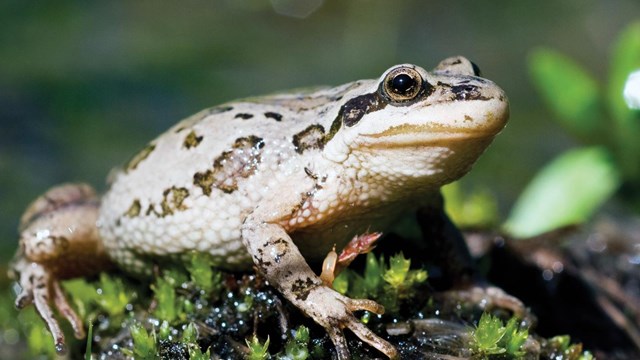
Boreal Chorus Frog
Boreal chorus frogs are common with conspicuous calls. 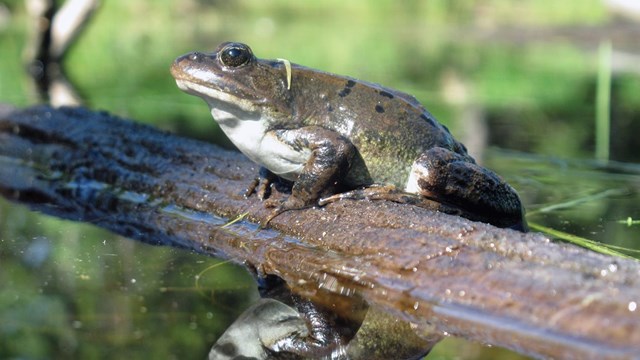
Columbia Spotted Frog
To survive the winter, Columbia spotted frogs go into water that does not freeze. 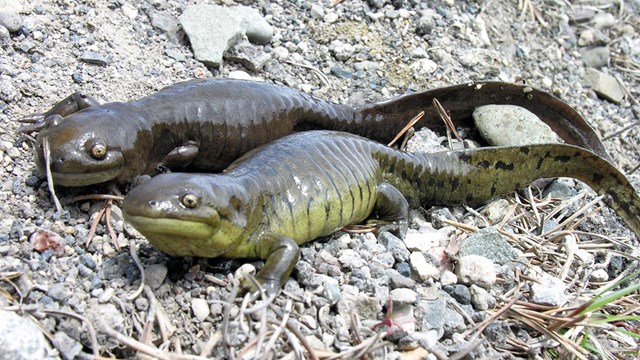
Western Tiger Salamander
Western tiger salamanders are common and abundant in some areas of Yellowstone. 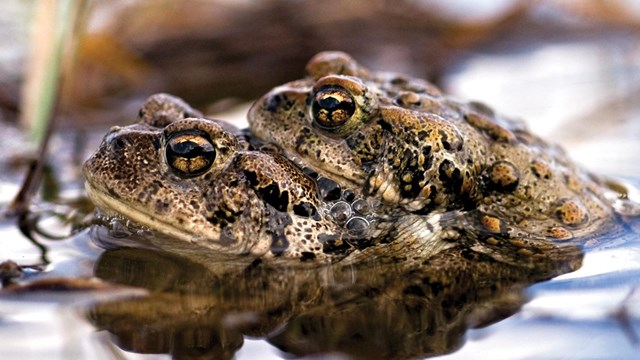
Western Toad
Western toads were once common throughout Yellowstone. 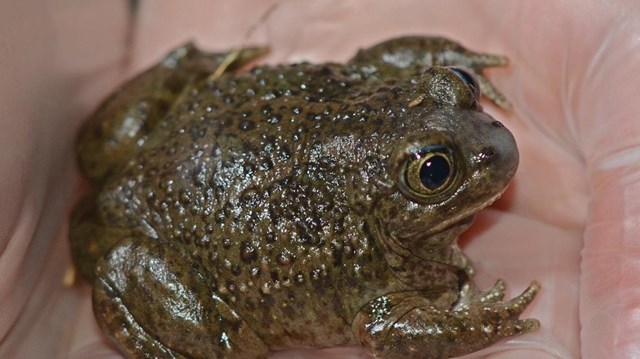
Plains Spadefoot Toad
In 2015, a breeding population of plains spadefoot toads was confirmed in Yellowstone. 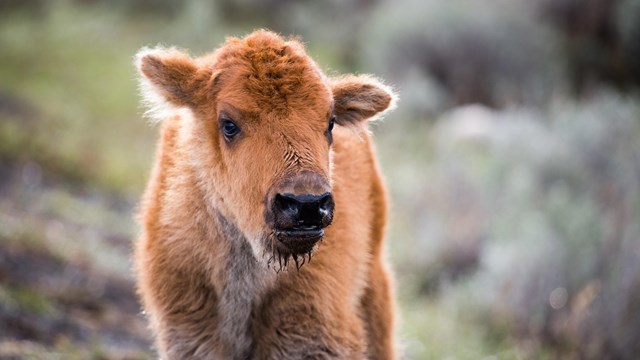
Wildlife
Learn about the park's abundant and diverse species—67 mammals, 330 birds, 16 fish, 5 amphibians, and 6 reptiles. 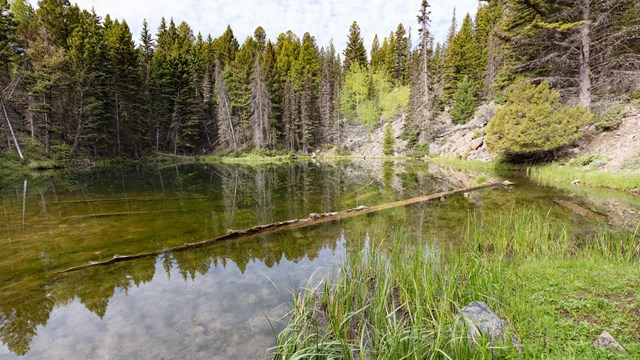
Conservation at Home
Find out how you can help protect water, lands, and wildlife wherever you are. |
Last updated: April 18, 2025