What are the best places to go fishing in and around Wrangell-St. Elias National Park and Preserve?
There are a lot of places to fish! Check the Fishing Opportunities, Alaska Department of Fish and Game website. To access the Alaska Lake Database, visit www.adfg.alaska.gov/SF_Lakes. Use this tool to find information about lakes throughout the state and which species of fish are present, including stocked fish. A State of Alaska Sport Fishing License is required.
What sport fishing area is this?
The Park and Preserve covers waters of three different sport fish regions of the State; the Southcentral Region, the Interior Region, and the Southeast Region. The road accessible waters of the Park and Preserve are located in the Upper Copper/Upper Susitna Management Area and in the Upper Tanana River Management Area, both are in the Interior Region. Additional waters in more remote locations are found in the Yakutat Management Area of the Southeast Region and in waters near the US/Canadian border of the Yukon Management Area of the Interior Region.
Where can I catch salmon?
There are not very many good opportunities to catch salmon in the road accessible areas within the park. The Copper River tends to be too silty to catch salmon. The best places to sport fish for Chinook Salmon (kings) and Sockeye Salmon (reds) are the nearby Klutina and Gulkana Rivers. The best place to catch Coho Salmon (silvers) and Pink Salmon (humpbacks or humpies) is outside of the park in Valdez, AK. Occasionally, some lakes are stocked with hatchery raised Coho Salmon (silvers). Contact the Alaska Dept. of Fish and Game for more information on stocked lakes.
What kind of salmon are in the park?
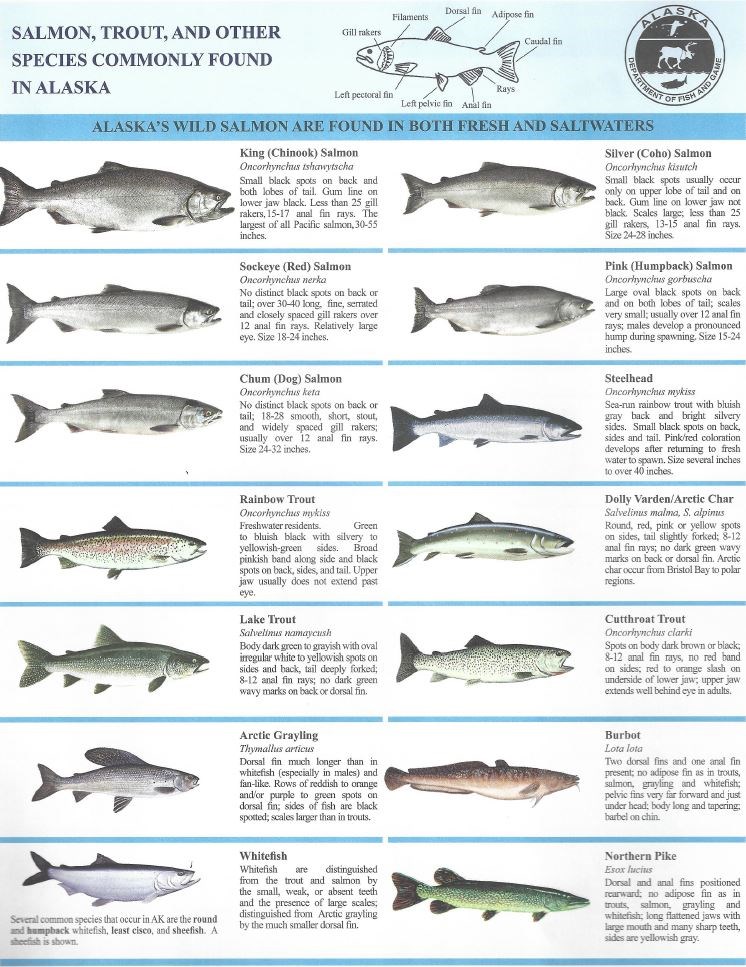
All five species of Pacific salmon that are native to Alaska are found within the park: Sockeye Salmon (reds), Chinook Salmon (kings), and Coho Salmon (silvers) are found throughout much of the park. Pink Salmon (humpbacks or humpies) and Chum Salmon (dogs or calicos) can be found in the Yakutat area. Kokanee are found in Copper Lake.
What are kokanee?
Kokanee are a life-history variant of Sockeye Salmon that complete their entire life cycle in fresh water. Pacific salmon normally spawn and hatch in fresh water, go to the ocean for 1-5 years, and return to fresh water to complete their life cycle before dying after they spawn.
What other types of fish are in the park?
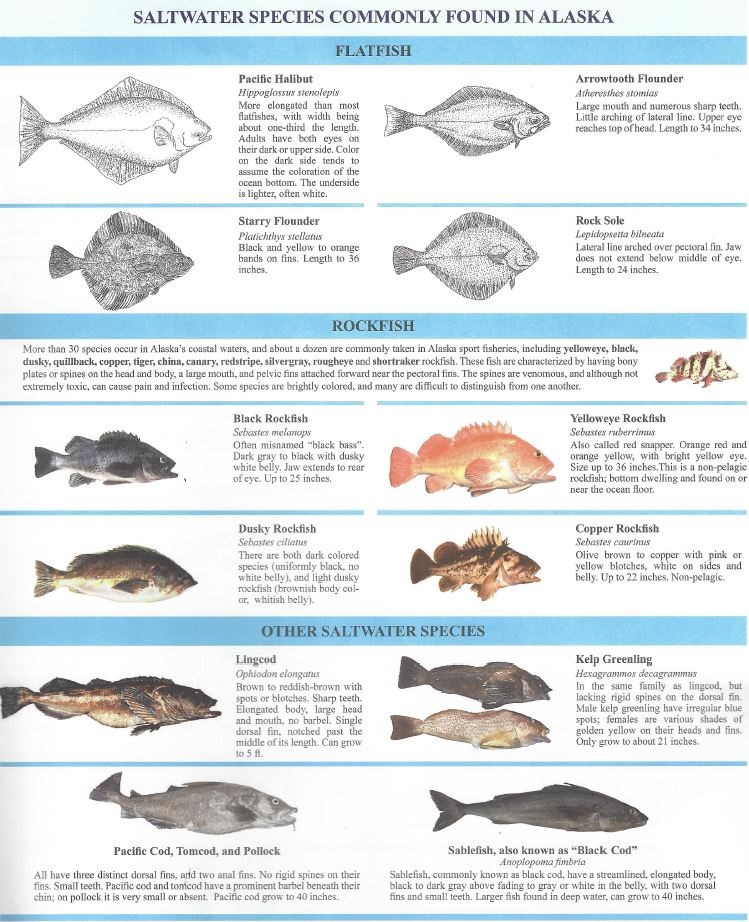
Lake Trout, Dolly Varden, Rainbow Trout/steelhead, Burbot, Arctic Grayling, Northern Pike, Threespine Stickleback, Longnose Sucker, Lake Chub, Pacific Lamprey, Starry Flounder, and various species of whitefish, smelt, and sculpin.
What is the difference between a Hooligan and a Eulachon?
There is no difference – they are the same fish, but with two different names. They are a member of the smelt family.
What kind of fish are stocked in the park?
The National Park Service does not stock any fish in the Park. The State of Alaska had once stocked Rainbow Trout, Arctic Grayling, Lake Trout, and Coho Salmon (silvers) in some waters that are now in the Park. Stocking typically occurs in landlocked lakes, where they’re not able to go to the ocean or migrate to other waterbodies. The landlocked salmon mature for 2-5 years and die just like their ocean-going relatives. Landlocked Coho Salmon don’t generally spawn successfully.
Where can I catch Rainbow Trout?
Silver, Sculpin, Strelna, 2-Mile, 3-Mile, and Pippin lakes are stocked by the State with Rainbow Trout. Wild stocks of Rainbow Trout are found in the Tebay Lakes and the Hanagita River, along with other tributaries of the Chitina River. They are also found in the nearby Gulkana River, which is considered the northern-most population of Rainbow Trout in the North American continent. Steelhead can be found in many of these waters.
What are steelhead?
Steelhead are a life history variant of Rainbow Trout that goes to the ocean to spend a part of their life and return to freshwater (anadromous), much like salmon. However, they don’t die after they spawn.
What are the worms in some of the fish? Are those worms dangerous? Can we get worms in our system from eating the fish?
Worms found in local fish are likely a species of round or tape worm. When cooked properly, there is a low likelihood of worms found in fish causing health issues in people. It is advised to not eat raw fish.
Can I go dip netting for salmon?
Only Alaska residents may dip net for salmon. Under State regulations, any Alaska resident can choose to either dip net in the Chitina Subdistrict Personal Use fishery or in the Glennallen Subdistrict Subsistence fishery. You must have a permit; there is a fee for the Personal Use dip net permit, but the subsistence permit is free. To dip net under Federal Subsistence regulations, one must be a resident of Alaska and have their primary, permanent residence located in a rural area specifically designated (by the Federal Subsistence Board) as qualifying for the fishery (see Federal Subsistence Fishing Regulations). A Federal Subsistence Fishing permit is required; this permit is free. To be considered a rural Alaska resident, you must have maintained a primary, permanent place of residence in a rural area and lived in Alaska for the previous 12 months. Having a seasonal residence in a rural area does not qualify you as a rural resident.
Can I operate or use a fishwheel?
Like with dip netting, you may operate or use a fishwheel only if you are a resident of Alaska and have a subsistence fishing permit. This can be done with either a State or a Federal permit, with similar qualifications as listed above for dip netting.
What are the sport fishing harvest limits for fish in the Upper Copper – Upper Susitna River Management Area?
The General Regulations for the Upper Copper/Upper Susitna Management Area allow harvest limits as listed below. However, consult with the ADFG Sport Fish Office in Glennallen or the State Sport Fishing Regulations for additional details for specific waters.
Chinook Salmon (kings) - 20 inches or longer- Annual limit of 4, 1 per day, 1 in possession
Less than 20 inches- 10 per day, 10 in possession
Other salmon- 16 inches or longer- 3 per day, 3 in possession
Less than 16 inches- 10 per day, 10 in possession
Dolly Varden- 10 per day, 10 in possession
Lake Trout- 2 per day, 2 in possession
Rainbow Trout/steelhead- Note: some waters are closed to retention
Other waters: 2 per day, 2 in possession, only 1 of which may be 20 inches or longer
Arctic Grayling- 5 per day, 5 in possession
Burbot- 5 per day, 5 in possession
For Stocked Waters- combination of species- 10 per day, 10 in possession, only 1 of which may be 18 inches or longer
When will salmon be in the streams and when do they spawn?
• Sockeye Salmon (reds): arrive in the upper Copper River between late-May and August and spawn in streams and lakes mostly between August and September.
• Chinook Salmon (kings): arrive in the upper Copper River between late-May and July and spawn in rivers mostly during July and August.
• Coho Salmon (silvers): arrive in the upper Copper River from early-August to late-September and spawn from late-September to November.
For fish counts throughout the State, check here: https://www.adfg.alaska.gov/sf/FishCounts/
What should I use for flies, lures, or bait to catch fish*?
• Dolly Varden: preserved fish roe, corn, flies, or small lures
• Arctic Grayling: preserved fish roe, corn, flies, or small lures
• Rainbow Trout/steelhead: flies or lures
• Lake Trout: lures
• Chinook Salmon (kings): preserved salmon roe clusters, lures, or flies
• Sockeye Salmon (reds): streamer flies
• Coho Salmon (silvers): lures or streamer flies
• Burbot: bait such as whitefish flesh
* In NPS waters, any fish parts used as bait must be of native species, you may not “chum” by placing bait in the water to attract fish, and Sport Fishing can only be done by hook and line, with the rod or line being closely attended (no set lines). Reference the most recent version of the ADFG Sport Fishing Regulations Summary for general gear and bait restrictions under State regulations.
When do steelhead spawn?
In the Copper River drainage, adult steelhead typically come up in the fall and lay over until the spring. Then they spawn in early summer and the adults return to the ocean. In other areas they come up in the spring, then spawn and return to the ocean.
How many salmon come up in the Copper River each year?
The Miles Lake Sonar is used in the lower Copper River to estimate the number of salmon migrating upstream each year. Based on this sonar data, the average in-river return for the past 30 years is 850,000 salmon. Find current sonar salmon passage estimates of the Miles Lake Sonar via the AK Dept. of Fish and Game at: https://www.adfg.alaska.gov/index.cfm?adfg=commercialbyareacopperriver.salmon_escapement
Are there any places I can’t fish?
All lakes and streams within Wrangell-St. Elias National Park and Preserve are open to sport fishing, unless they are on private property. Please know and understand the land status maps within the national park and respect private property.
When is the sport fishing season?
For some species, it’s year-round from January 1 – December 31. Some species and some waters may have different seasons, and some regulations may vary for different management areas; consult the State ADFG Sport Regulation Brochure for the area of interest.
How big do local species of fish get? (inches ", pounds lbs.)
• Arctic Grayling: up to 17” – generally 9-12”
• Lake Trout: up to 20 lbs. – generally 1-8 lbs.
• Rainbow Trout: up to 22” – generally 10-18”
• Steelhead: up to 32” – Average 26”
• Chinook (king) Salmon: up to 45 lbs.
• Sockeye (red) Salmon: up to 8 lbs.
• Coho (silver) Salmon: up to 12 lbs
• Burbot: up to 20 lbs. – Average 1 to 6 lbs.
• Dolly Varden: generally 6-14”
• Landlocked Coho Salmon: up to 16” – generally about 12”
Are the rivers in this area dangerous?
All of the rivers, especially the larger ones, are dangerous. The water moves fast and is cold; a person cannot last very long in the water. Silt in the rivers causes poor visibility. Exercise extreme caution when fishing Alaskan waters. Risks include drowning, hypothermia, slips and falls, and encountering aggressive bears. Info for fishing in bear country.
Here’s a question for YOU! Would you like to help conserve native fish species?
Read the Catch and Release Fishing brochure (pdf format, 2.7 MB) to learn about conserving and protecting native species populations.
Learn More...
Fish of Alaska (Alaska Department of Fish & Game website)
Fish Surveys
A freshwater fish survey was done in Wrangell-St. Elias in 2001-2003 (this report contains information from Denali National Park and Preserve and Yukon Charlie National Preserve as well). This survey documented fish present within the park’s boundaries and it is still ongoing. In 2006 the fisheries crew captured and documented northern pike in the park for the first time. So far, we have documented 21 species of freshwater fish, with more expected.
NPSpecies Fish Checklist
Our fisheries biologists keep track of fish species within the park. They are documented within a database called NPSpecies. If you'd like to view or print out the most updated checklist of fish species, please follow these directions:
Fish sampled in four Alaskan national parks have tested positive for mercury and in some cases exceeded State of Alaska unlimited human consumption thresholds for women and children. The testing was part of a multi-year U.S. Geological Survey and National Park Service study of fish in remote, high elevation lakes and streams in 21 national parks across 10 western states and Alaska. Mercury was found in all fish sampled though levels of the chemical harmful to fish, other wildlife and humans, varied. Please connect to the Mercury in Fish page for more information.
Alaska Dept of Fish & Game posters
Last updated: February 6, 2024
Park footer
Contact Info
Mailing Address:
Wrangell-St. Elias National Park & Preserve
PO Box 439
Mile 106.8 Richardson Highway
Copper Center,
AK
99573