
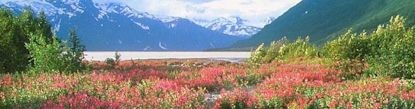
The most common flower in Alaska appears to be the fireweed, occurring in vibrant purple rows along the highways. In the Wrangells, there represents 54% of the Alaskan flora (which has approximately 1535 species) and 69% of the Yukon Territory flora. The high diversity of sub-arctic plant communities in Wrangell-St. Elias is due in part to its large size, the three climatic zones it covers (maritime, transitional and interior), the wide variety of landforms, and the extensive and complex topographic relief found within its boundaries. Some regions of the park have a strong coastal influence, particularly in the Chugach-St. Elias and southern Wrangell Mountains. The extent of the Pleistocene glaciation has had a major effect on the distribution and composition of the flora of the park, most of which was glaciated during the last ice age. A recent inventory of the park's flora indicates that there are 936 vascular plant species. The sedge family has the highest number of species (111) in the park, followed by the grass family (79), the sunflower family (86) and the mustard family (74). There are 13 tree species, 27 willow species and 43 introduced species in the park. The park also has 327 documented non-vascular plants including 31 species of liverwort, 131 species of lichen and 165 species of moss. NPSpecies Plants Checklist Our biologists and ecologists keep track of plant species within the park. They are documented within a database called NPSpecies. If you'd like to view or print out the most updated checklist of plant species, please follow these directions:
|
 |
|
Last updated: April 14, 2015