• Wind Cave National Park - Two Worlds

    Wind Cave

    National Park South Dakota

Animals

Bison Bull

Bison Bull

NPS Photo by Bromley

National parks are great places to see wildlife. However, that has not always been the case. In the early 1900's many animal populations were nearing extinction because of habitat destruction or hunting pressures. You could not see them in the wild or in national parks.

At one time, more than 60 million bison roamed this continent. By the early 1900's fewer than 1,000 were left. Some were in zoos, a scattering on private ranches and a few were still wild in places like Yellowstone but most wild bison had been killed.

People noticed what was happening and took action. Ranchers started private herds and zoos began protecting species at risk. Conservationists and hunters realized that action must also be taken to protect the animals' habitats or we might never see them in the wild again.

In 1911, the American Bison Society looked for places to establish free roaming bison herds. They selected Wind Cave National Park as one of the first areas where these animals would be returned to the wild. The rolling mixed grass prairie is excellent habitat for bison.

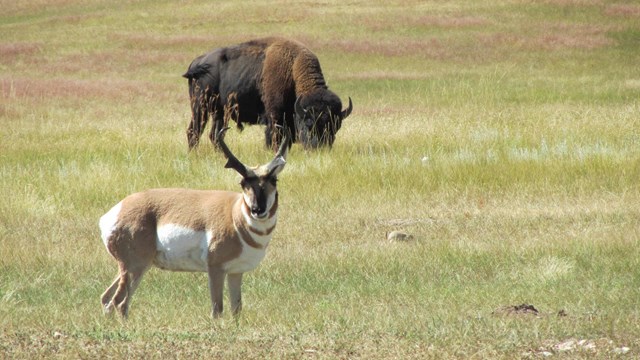
Other animals, like pronghorn and elk, were reintroduced to the park at the same time. Because of this effort, we can see elk, bison, pronghorn, turkeys and even prairie dogs. And, just as important, we can see the habitat that supports them.

Click here for more information about reintroducing wildlife to Wind Cave National Park.

Click here (8 MB) for the 2011/2010 status report on the wildlife of the park.

For the 2009 wildlife report click here (2.19 MB).

Did You Know?

American bison on the Wind Cave National Park prairie

The American bison is the largest terrestrial mammal in North America.  Male bison can weigh a ton and can run 35 miles per hour.  Do not approach bison.  They weigh more and can outrun you. More...