![]() |
||||||||||||||||||||||||||||||||||||||||||
![]() |
![]() |
|||||||||||||||||||||||||||||||||||||||||
| |
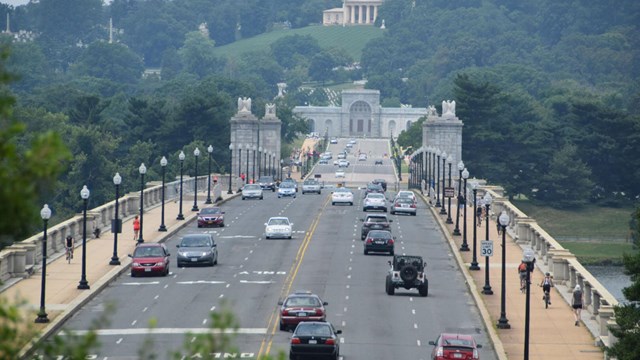
Funding National Scenic Byways Program National Scenic Byways Program Update On September 22, 2005, the Secretary of Transportation announced the designation of 45 America’s Byways™ as part of a designation ceremony held at Union Station (Washington, D.C.). Several national park units were recognized as part of this program. Those parks units that received National Scenic Byways designation were: Catoctin Mountain Scenic Byway (Catoctin Mountain Park), Flint Hills Scenic Byway (Tallgrass Prairie National Preserve), Trail of the Ancients (Mesa Verde National Park), and Skyline Drive (Shenandoah National Park). Blue Ridge Parkway (Blue Ridge Parkway), Colonial Parkway (Colonial National Historical Park), George Washington Memorial Parkway (George Washington Memorial Parkway) and Northwest Passage Scenic Byway (Nez Perce National Historical Park) received All-American Road designation. These newly designated roads join numerous other national park units that are already part of the America’s Byways ™ Program. The America’s Byways™ Program is part of the U.S. Department of Transportation, Federal Highway Administration, and was established in 1991 to help recognize, preserve and enhance selected roads throughout the United States. The U.S. Secretary of Transportation recognizes certain roads as America’s Byways™ — All-American Road or National Scenic Byways — based on one or more archeological, cultural, historic, natural, recreational and scenic intrinsic qualities. Once a road is designated a National Scenic Byways or an All-American Road, they are able to compete for Grant funding from the program under 8 categories which include: 1) State Programs, 2) Corridor Management Plan, 3) Safety Improvements, 4) Byway Facilities, 5) Access to Recreation, 6) Resource Protection, 7) Interpretive Information, and 8) Marketing. We encourage parks to take advantage of the America’s Byways™ Program because it enables the NPS to take advantage of a grassroots program that focuses on enhancing the traveling and visitor experience and managing, restoring and preserving scenic or historic roads. A successful Byways program shares one essential component: partnership. While national parks are public lands, they are at the same time extensions of local communities. The program provides an opportunity for national parks to collaborate with partners, such as State and local governments, gateway communities, and other stakeholders and allows the NPS to tap into the skills of a larger community and extend its mission outside park boundaries, while working towards a common goal. The NPS seeks to provide transportation improvements “that lies lightly on the land” in and around park units, while balancing the protection of the natural and cultural resources and providing for public enjoyment. Designation of a NPS road as a Byway helps a park achieve resource protection and visitor enjoyment. A recent email went to the parks with information on how they could apply for National Scenic Byways Grant Funds. The text from that email has been included. Submit on-line grant applications and seek other information, such as Byway Contacts and State Coordinator Contacts at this website. There are a few things to keep in mind when submitting a grant application for National Scenic Byway Funds. 1) Although it states that the grant application deadline is March 10, 2006, all applications must go through the individual State Coordinators. Because of this, each State Coordinator will set a specific date in which they must receive the application in order to review it and forward it on to Federal Highway Administration. Parks need to be aware that there may be an earlier deadline. http://www.bywaysonline.org/grants/contacts.php provides a mechanism to select a state and then go to that particular state's deadline for applications. 2) At a recent Byways event, it was stated that when reviewing the Grant applications reviewers like to see a multi-year plan in which a Byway identifies several projects that will be completed over several years. 3) Parks should work with their other partners when submitting a grant application. Two reasons for this are partnership coordination and maximizing funding efforts. 4) Grant applications require a minimum 20% match. Parks can use appropriated funds as this match (i.e. Federal Lands Highway Program Funds or Recreation Fees). Federal Highway provides 80% for eligible projects. This could be very beneficial to a park who may have existing approved NPS projects identified. If the approved project meets one of the 8 eligible categories under the Scenic Byways Program, instead of having to fund the entire project, a park would only need to use 20% of NPS funds and the remaining 80% of NPS funds could be applied to another approved project. 5) There are 8 eligible categories for grant funding. I have identified below numerous parks that I am aware of that are part of a Byway. Please keep in mind that there may be other parks that have partnered with a community to be designated a Scenic Byway that I may not be aware of or I may not have included below. Federal Highway Administration this year asked as part of the designation package that if a Federal land management agency was part of the Byway to please identify it on the designation information. There is an attempt to keep better track of whether a park is involved in the Byways Program. I am requesting that if a park does seek a grant nomination under the National Scenic Byways Program to please let me know. I can not only track the application through the process, but if any projects are funded under this program, I will be able to identify it as an accomplishment under the program. If you have any questions regarding the National Scenic Byways Program as it relates to the National Park Service, please feel free to contact Jennifer Getz or at 202/513-7030.
National Scenic Byways Guide This document is an introduction to the National Scenic Byways (NSB) Program. Topics covered included nominating a park road as a Scenic Byway or an All-American Road (AAR) and applying for grant project money for roads currently designated NSB or AAR. National Scenic Byways Guide - May 2002 |
|||||||||||||||||||||||||||||||||||||||||
|
||||||||||||||||||||||||||||||||||||||||||