National Park Service
Park Roads  & Parkways Program Logo Page header photo.
History
Accomplishments
Challenges
Strategic Focus
Funding
Reauthorization Act
Library
Contact Us
 

What is the cost of ownership?

Maintaining the NPS transportation system is like owning a car or a house. Preventive maintenance is a far more cost-effective strategy, since it will typically extend the life of an asset.
Workers at Yosemite National Park October 1999

A National Research Council 1990 study concluded that an appropriate budget allocation for infrastructure maintenance and repair "will typically be in the range of 2 to 4% of the current replacement value." The replacement value of the NPS roads and bridges is some $10 billion. Even at the current funding level of $165 million, the NPS is spending less than 2% annually.

The result is a steady degradation of the NPS infrastructure (roads, bridges, alternative transportation systems and trails) and a sizeable backlog of deferred projects.


Back to
Challenges  »
More Challenges, Backlog, Preventive Maintenance Treatments

Backlog of Road Needs - 65% of all roadway pavements are in unacceptable condition. Sound asset management and preserving the road infrastructure requires strategies that will improve and maintain the overall condition of roads at an *acceptable level.

Sequoia Kings Cannon, National Park

Road in unacceptable condition. -Sequoia Kings Canyon,
National Park

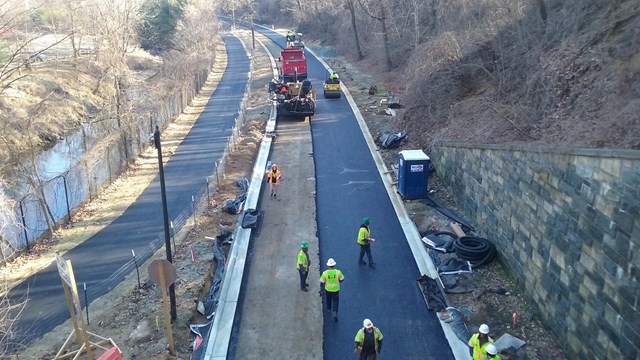
Preventative Treatments - In order to maintain the NPS road system in acceptable condition and protect the investment, the NPS must provide an aggressive preventative treatment program. This program will extend the life of these transportation systems, and save substantial amounts of money by avoiding full reconstruction costs.

Environmental Impacts - The air quality in 30 parks is considered to be poor. As roadway congestion worsens, noise, air and water pollution levels increase. Off-road parking in undesignated, resource sensitive areas creates significant natural and cultural resource impacts. Deploying additional alternative transportation systems reduces roadway congestion and environmental impacts.

Although the parks are not the primary sources of the pollution, the NPS along with FHWA are taking steps of mutual interest to be leaders in showcasing methods and technologies to reduce pollution in and around parks and the country.

Safety - The NPS must improve safety and reduce traffic related injuries and property damage. As traffic congestion increases and transportation systems maintenance needs are deferred, the safety of park visitors is at increased risk. Currently, approximately $187 million or more in traffic related injuries and property damage are incurred annually. This can be reduced by continuing to apply modern, state of the art engineering and safety design standards, systematically eliminating conditions that may contribute to accidents, and implementing enforcement and training campaigns.
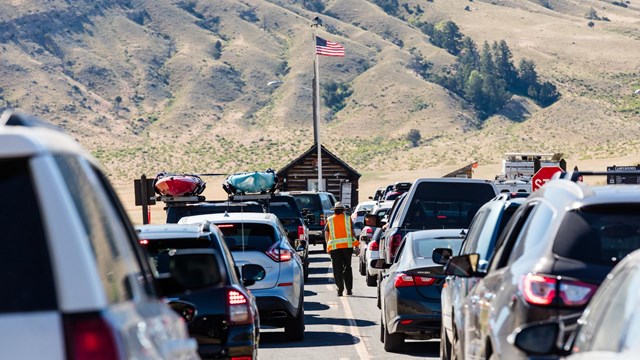
Construction and reconstruction of transportation systems must be managed to ensure that the visitor can access the park in a safe and enjoyable fashion. Traffic Congestion - Rocky Mountain National Park

Transportation Planning and Management Systems - The NPS needs to expand its efforts to incorporate sound transportation


Traffic Congestion - Rocky
Mountain National Park

planning strategies into all Park General Management Plans. Management systems should influence annual expenditures and track how well NPS is meeting its goals.

Future Planning - National parks are loved by the American people. Currently 285 million people visit national parks each year, a number nearly equivalent to the entire U.S. population. Visitation is expected to increase to 367 million by 2020. Our first challenge for the future is restoring, building and reshaping the transportation system to keep pace with visitation while continuing to balance resource protection.

New advances in technology are available to help us meet these challenges. For instance, computer technology, electronics, automation, along with quieter engines and low emission fuels will help to improve NPS transportation system efficiency and effectiveness. Integrating transportation systems with fuel efficient buses, trains, ferries and electronic messaging signs provide visitors alternatives for their convenience and enjoyment.

Neighborhood partnerships must expand and grow. Joint transportation projects built with local gateway communities help sustain economic development, at the same time giving the public a transportation choice that will result in reduced traffic congestion, air and noise pollution, while improving the park experience and the quality of life.

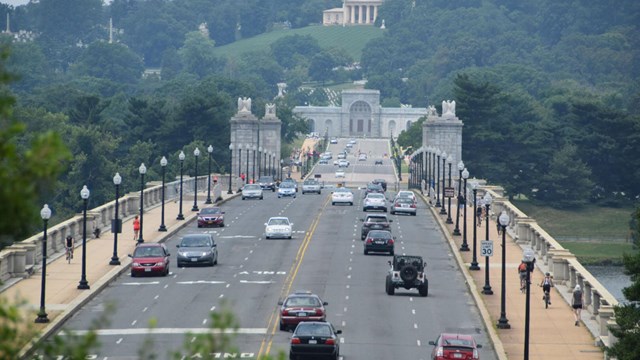
Parkways - Numerous parkways located in metropolitan areas are commuter routes. High traffic volume usually results in a comparably high rate of traffic accidents. Three perfect examples of this are the Rock Creek Parkway, George Washington Memorial Parkway, and Baltimore-Washington Memorial Parkway. All three funnel commuters into the Nation's Capital. They also have the top accident rates of any NPS roads.

Homeland Security - Transportation systems must be designed or redesigned to address the safety and security of the nation's monuments and the visiting public.

* Acceptable meaning the economic breaking point between a well managed and a poorly managed road infrastructural asset.

 
NPS HOME DOI FOIA Privacy Disclaimer USA.gov

U.S. Department of the Interior National Park Service National Park Service