
The Early Springfield Armory Museum
Springfield Armory NHS, US NPS Visitors to the Musuem in the late 19th and early 20th centuries viewed a wide array of arms, including many mounted on the ceiling. The caretaker/curator is seen in the apron.
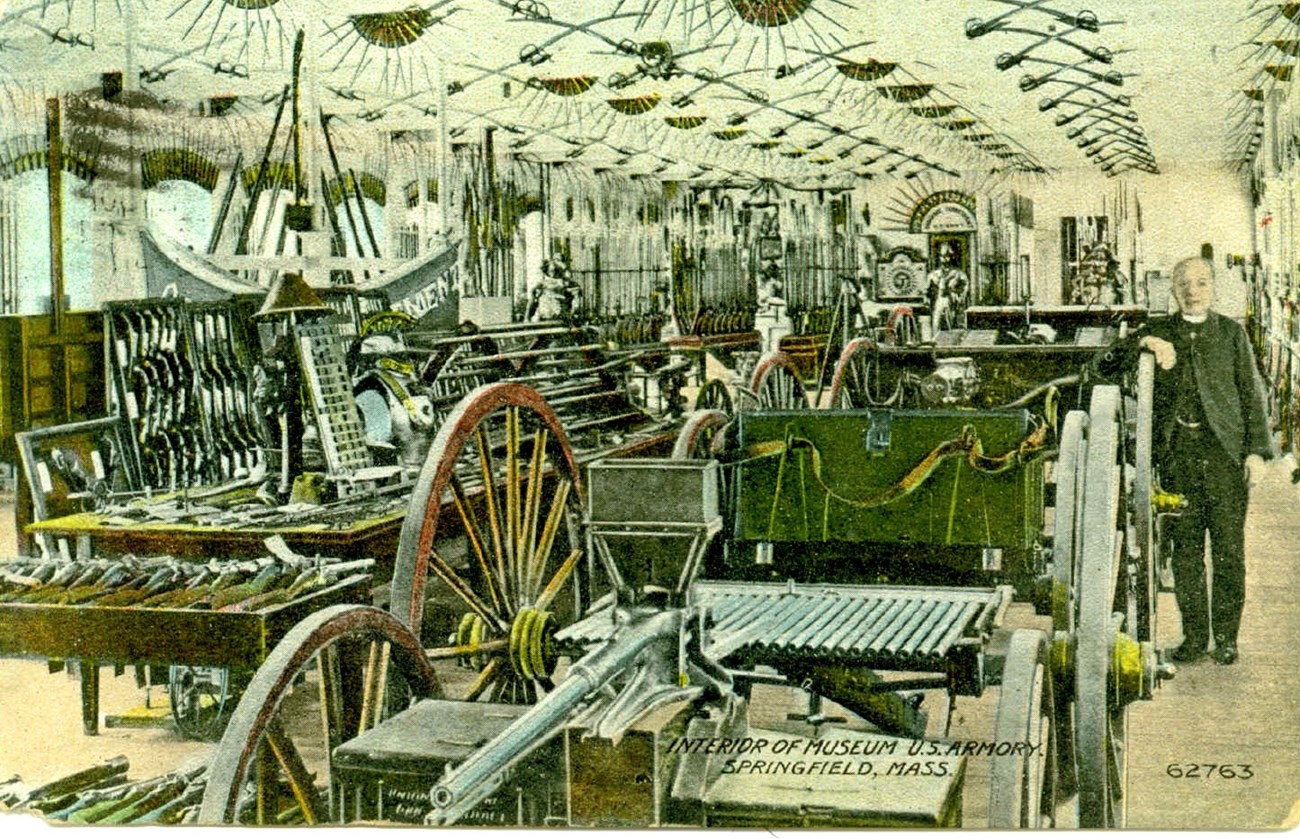
Here's another view of the Museum interior, in a hand-colored print from a postcard. The Ager rapid-fire gun and the Requa-Billinghurst volley gun in the foreground, both early American Civil War weapons, are still part of the Musuem collection. Much of the early Asian armor and weapon collection was moved, in the mid-1900's, to the Smith Art Museum at the Springfield Museum Quadrangle, a few blocks away from Springfield Armory NHS on State Street, where it may be viewed today.
Springfield Armory NHS, US NPS
Springfield Armory NHS, US NPS These gun racks are used today to hold the same hundreds of Civil War rifle muskets seen above.
Springfield Armory NHS, US NPS These early gun racks are now being replaced with modern state-of-the-art storage racks that will better protect the Armory's extraordinary collection. The old racks will, however, continue to see service for special displays and exhibits were the visual qualities of the old 19th Century racks remain unmatched. Here are seen the 1876 gun racks holding US Model 1903 rifles in today's Musuem storage room. In the foreground may be seen US M1903 serial number 2 followed by a number of early US M1903 rifles, so-called "rod bayonet" rifles. US M1903 rifle #2 was unigue in possessing a muzzle brake forged onto the barrel during manufacture, as may be seen in this image. Unlike US M1903 #1, which was altered by up-dating, US M1903 is entirely original. |
Did You Know?
After visting Springfield Armory during his honeymoon, Henry Wadsworth Longfellow published a poem in 1845 entitled "The Arsenal at Springfield," which used the racks of muskets stored there as an anti-war metaphor. More...