

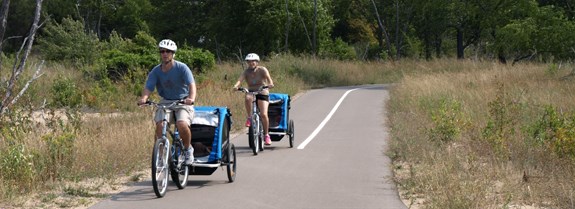
The Sleeping Bear Heritage Trail (SBHT) will be a hard-surfaced, multi-use trail paralleling M-22 and M-109 for 27 miles through the Lakeshore. Nearly ten miles have been completed already. It provides a safe, non-motorized, multi-use transportation alternative connecting the Lakeshore’s main visitor destinations with Glen Arbor and Empire. The SBHT gives walkers, runners, wheelchair users, bicyclists, cross-country skiers, baby strollers, and rollerbladers a safe, enjoyable, and car-free way to access and explore the Lakeshore and neighboring communities. The SBHT idea came from the Leelanau Scenic Heritage Route (LSHR) Committee. The State of Michigan designated the LSHR in 2002 to promote measures which preserve and enhance the scenic, historical, and recreational characteristics of Michigan Highways 22, 109, and 204 as they traverse the rural countryside and unique villages of Leelanau County, including Sleeping Bear Dunes National Lakeshore.
The LSHR Committee is made up of representatives from all 12 townships and villages along the route, Leelanau County, the Michigan Department of Transportation (MDOT), the National Park Service, the Grand Traverse Band of Ottawa and Chippewa Indians, several private organizations, and local citizens. The Northwest Michigan Council of Governments coordinates the Committee’s activities. Information and materials on the LSHR can be found atwww.nwm.org/lshr.asp. The SBHT concept is supported by all members of the LSHR and is the group’s top priority.
|  |
Planning for the SBHT began in 2005 when the LSHR Committee suggested the concept to the National Park Service. The SBHT received repeated public reviews in the National Lakeshore’s recent General Management Plan process, and was included in the final Plan. In 2009, an Environmental Assessment (EA) for the SBHT was completed that demonstrated that the SBHT will have no significant impact on the environment. The "Finding of No Significant Impact," or FONSI, was signed by the National Park Service Midwest Regional Director on August 27, 2009. When complete, the SBHT will extend from Manning Road on the Leelanau-Benzie County line to Good Harbor Beach at County Road 651 at the north end of the National Lakeshore. The trail will be entirely on public lands in the National Lakeshore or on county road or state highway rights-of-way. Because short distances of the SBHT extend outside of developed areas and special use zones, it has been designated for bicycle use by special regulation (36 CFR 7.80). 
Construction of the SBHT will occur in segments over a period of approximately ten years at a projected cost of $10 million. It is anticipated that 50% of the cost will be funded through federal and state grant sources and 50% raised philanthropically over the first five years of the project. Over $2.5 million in grant funding has already been secured. | |
Last updated: December 21, 2017