
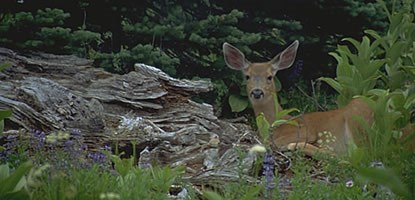
Mammals are less commonly spotted in Sitka National Historical Park than birds and fish, but these fauna are present in the park and fill a unique niche. The rarity of some terrestrial animals increase their mystique, and the potential to spot a whale or otter from the shore keeps visitors' eyes on the water. Some more common mammal species inhabiting the park include shrews, moles, red tree squirrels, Sitka blacktail deer, and mink.

While marine mammal species don't live within the boundaries of the park, many are observed in nearby waters. Steller sea lions, sea otters, harbor seals, Pacific white-sided dolphins, harbor porpoises, Dall's porpoises, and northern elephant seals have been sighted near the park. Nearby whales include orca whales, gray whales, and the endangered humpback whale. In particular, the sea otter is characteristic of the region and can be found abundantly in Sitka Sound. Sea otters often compete with local fisheries for prey, but are also an indicator of good ecosystem health.

Photo from SCS On Baranof Island and the surrounding island archipelago, biodiversity is characterized by several endemic species, or organisms unique to a restricted area. Some examples of endemic species are the Baranof Island ermine, the Sitka root vole, and the Sitka deer mouse. All three require varied habitats that are tied to prey abundance. Endemism is common on the North Pacific Coast because of its historical isolation from the rest of the continent, ecological complexity, and narrowness between the ocean and mountain ranges. Many organisms are restricted to certain islands and are more susceptible to endangerment because of their ranges and very specific habitat requirements. As human-caused changes occur, including development and urban expansion, these mammals could be threatened with permanent elimination from the only place they call home. Preserved public lands provide opportunities for endemic species to find sanctuary. Just as Sitka National Historical Park is a treasured place for human visitors, mammals also find refuge amongst the ever-changing world. Bear Country The Sitka brown bear (Ursus arctos sitkensis) is also an endemic species: genetic studies suggest a distinctive lineage of brown bears that are restricted to the Admiralty, Baranof, and Chichagof islands. Brown bears occupy the Indian River drainage and occasionally enter the park, often at the beginning of the salmon runs. They are characterized by a hump-like mass of muscle on their shoulders, and their fur color can range from black to tan. These mammals are omnivores, eating berries, shrubs, fish, and small rodents. Like most bears, brown bears will hibernate during winter months and become active in the spring and summer. They typically have a solitary lifestyle, but mother bears will stay with her cubs for 2-3 years, or until they are ready for independence. Encounters with brown bears are unlikely at Sitka National Historical Park, but preparing to visit the park should include some basic bear safety knowledge.

NPS image To avoid encountering a bear, sing or talk aloud to yourself while hiking. The noise will indicate your presence to a bear and prevent a surprise meeting. Carry EPA-certified bear spray, and learn how to use it, and hike in groups for increased security. Bears are most active at dawn and dusk, and can be indicated by scat or tracks on the trail. Here are some tips if you are to encounter a brown bear near Sitka National Historical Park:
|
 |
|
Last updated: September 27, 2021